
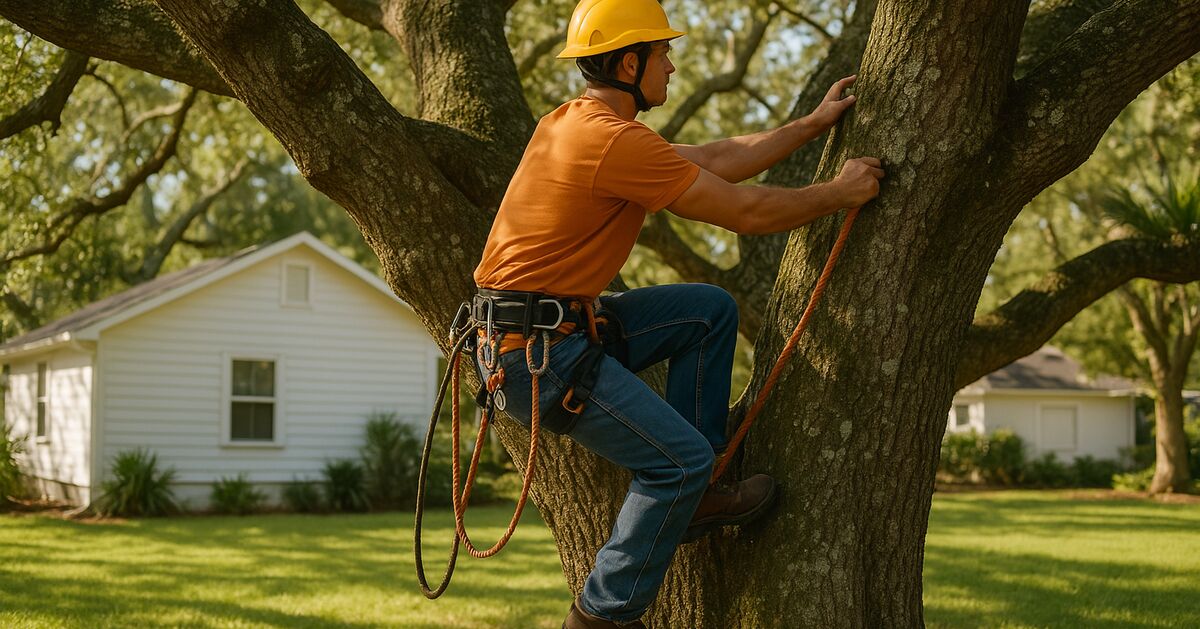
Most homeowners spend exactly zero minutes thinking about workers' compensation before a tree crew shows up. That's understandable - you're focused on the tree, the quote, and clearing your schedule. But the insurance question is the one that can turn a routine job into a lawsuit that lands on your doorstep. Understanding what workers' comp actually does, and what general liability alone cannot do, is one of the most useful things you can know before you hire anyone to work on your property.
What general liability insurance actually covers
General liability insurance protects against damage to your property or to a third party caused by the contractor's work. Think of it this way: if a climber drops a large limb and it crushes your pool cage or punches through your lanai roof, general liability is what pays to repair that damage. If a chunk of wood rolls off the truck bed and dents your neighbor's fence, general liability addresses that too.
It is genuinely important coverage, and any reputable tree service should carry it. But here is the critical gap: general liability does not cover injuries to the workers themselves. It covers what they do to your stuff, not what happens to their bodies.
Tree work is one of the more physically demanding and hazard-prone trades you can hire. Climbers work at height with running chainsaws. Ground crews work under falling wood. Equipment operators deal with vehicles, chippers, and heavy logs on uneven terrain. The work is done outdoors in Florida heat, on ground that can be wet and soft, often close to structures and utility lines. Injuries happen in this business, and when they do, someone has to pay for the medical care and lost wages.
What workers' compensation actually does
Workers' compensation is a state-regulated insurance program that provides medical benefits and partial wage replacement to an employee who is injured on the job. When a crew member gets hurt at your house and the employer carries workers' comp, here is what happens: the injured worker files a claim with the employer's insurance carrier, the carrier pays the medical bills and compensates the worker for lost time, and the matter is resolved through that system.
You, the homeowner, are not part of that process. Your name does not appear on any claim. Your homeowner's insurance is not dragged into it. You are not served with anything.
Now remove workers' comp from the picture. The same worker is hurt in the same way in your yard. The employer either has no coverage or is operating with lapsed or fraudulent coverage. The worker cannot recover through the workers' comp system. So they look for another avenue. Under Florida law, a property owner can in some circumstances be held liable for injuries that occur on their property, particularly if the injured party can argue that the property owner was negligent in some way - failing to disclose a hazard, for instance - or if the injured worker was effectively functioning as an employee of the homeowner rather than an employee of an independent contractor.
That last point sounds technical, but it has real teeth. Florida courts have held that when a contractor does not carry proper workers' compensation coverage, the "employer" analysis can shift, and the homeowner who hired the work can find themselves in that role. It is not automatic and not guaranteed to happen in every case, but it is a documented legal risk, not a theoretical one.
Even if liability never attaches to you personally, the process of defending a lawsuit is expensive and stressful. Your homeowner's insurance carrier will be involved. Your time will be consumed. The outcome is uncertain regardless of fault.
Florida's workers' compensation rules for tree services
Florida requires most employers to carry workers' compensation. However, the rules have important nuances for the tree care and landscaping trades. Sole proprietors and certain small operations can exempt themselves from coverage. That means a one- or two-person crew operating as a licensed business can, legally, have no workers' comp in place and still take on residential jobs.
This is not unusual. Smaller operators sometimes exempt themselves to save on premium costs, which can be substantial for tree work because of the injury risk the insurers are covering. The problem is that from your driveway, you have no way of knowing whether the crew trimming your live oak has coverage or not simply by looking at them.
The only way to know is to ask for a certificate of insurance before work begins, and to verify that the certificate shows workers' compensation coverage alongside general liability. A certificate is a one-page document that any properly insured company can produce immediately on request. If a company hesitates, offers excuses, or provides a certificate that lists only general liability, that is a significant warning sign.
Our frequently asked questions page covers what documents to request before work begins and what to look for when you receive them.
Why the risk is higher with tree work than with many other trades
Not every trade carries the same injury profile. A painter working on the interior of your home faces different risks than a climber working sixty feet up in a sand live oak. Tree work consistently ranks among the more dangerous occupations in the country because of the combination of height, moving cutting equipment, unpredictable wood behavior, and outdoor conditions.
In Southwest Florida, the local environment adds specific factors. Sandy soil throughout Sarasota, Venice, North Port, Osprey, and Englewood means trees sometimes shift or lurch in ways that surprise even experienced crews when cuts are made. Palms, which are a dominant species from Siesta Key to Port Charlotte to Placida, can be deceptively heavy and behave differently from hardwood when they fall. Summer heat and humidity push crews to work fast, and fatigue increases accident rates.
The higher the injury risk of the work, the more consequential it is that proper coverage is in place. This is not abstract. It is directly proportional to the likelihood that the question will ever actually matter.
What to look for on a certificate of insurance
When you request a certificate, look for three things.
First, check that the certificate lists both commercial general liability and workers' compensation as separate line items. They are distinct policies and should appear separately. If only one is listed, ask directly about the other.
Second, check the effective and expiration dates. A certificate is only as good as its dates. Coverage that expired last month is no coverage at all.
Third, ask to be named as an additional insured on the general liability policy. This is standard practice for residential work and costs the contractor nothing. If they cannot or will not do it, that is worth noting.
You can also call the issuing insurance agency listed on the certificate to confirm it is current. A legitimate certificate will have the agency's contact information on it.
Our full breakdown of how to read a tree service estimate in Florida touches on this topic as part of evaluating what a quote actually represents - because the cheapest number on the page often reflects what the company is not paying for, and insurance is one of the first places corners get cut.
The price connection: why proper insurance costs more
There is a direct relationship between what a company pays for insurance and what they charge you. A tree service carrying full general liability plus workers' compensation for a crew of climbers and ground workers is paying significant annual premiums, because insurers price tree work as high-risk.
When you get a quote that seems strikingly low compared to others, it is worth asking what is behind it. Sometimes a lower price reflects genuine efficiency: better equipment, a faster crew, lower overhead. But sometimes it reflects the absence of coverage. The crew without workers' comp saves real money on premiums, passes some of that to you as a lower price, and transfers the risk to your property and your life.
This is not to say every low quote hides a problem, or that every higher quote reflects better coverage. But the insurance question should be part of your evaluation, not an afterthought. Ask before you accept, not after the work is done.
Our tree and land services overview explains what full-scope residential tree work involves, which helps give context to why proper operations carry real costs.
What the ANSI standards say about safety and accountability
The ANSI Z133 standard governs safety practices in tree care work. Among the things it addresses are the responsibilities of employers to maintain safe working conditions, to provide appropriate personal protective equipment, and to ensure workers are trained for the specific tasks they are performing. These are employer-side responsibilities.
The connection to insurance is structural: a company that takes the ANSI Z133 safety requirements seriously is also a company that is managing its injury exposure, which means it is buying insurance, keeping it current, and treating coverage as a cost of doing business rather than an optional line item.
When a company talks about following ANSI standards, it is not just a statement about how they make cuts. It is a statement about how they run the business. Insurance is part of that picture.
How this plays out differently in different scenarios
Consider a homeowner in Nokomis with a large laurel oak overhanging the house. They hire a crew they found through an online ad. The crew looks professional, the equipment seems right, and the price is good. Two hours into the job, a climber takes a bad fall and is seriously injured. The homeowner calls the company - and learns the owner is a sole proprietor who exempted himself from workers' compensation.
Now compare that to a homeowner in North Port who takes five minutes to request a certificate before signing anything. The certificate shows both policies, the dates are current, the coverage amounts are appropriate. The same fall happens. The injured worker is covered. The homeowner is not involved in the aftermath.
The difference between those two scenarios is one request and one document. It is genuinely that simple, and genuinely that consequential.
For context on what a healthy job site looks like from start to finish, our North Port tree care page describes the kind of work we do and how we approach residential jobs in that area.
A note on subcontractors
Some larger tree companies subcontract portions of their work, particularly stump grinding or chipping. When that happens, the subcontractor's employees are working on your property, and their coverage matters just as much as the primary company's coverage.
Ask whether subcontractors will be used, and if so, confirm that the primary company either requires certificates from its subs or extends its own coverage to cover subcontractor labor. A reputable company will have a clear answer. Vagueness here is a flag worth paying attention to.
Making the ask: it's not awkward, it's standard
Some homeowners feel uncomfortable asking a contractor for insurance documents. They worry it will seem presumptuous or like they do not trust the company. Let that go.
Any professional tree service that carries proper coverage will hand over a certificate without hesitation or irritation. They produce these documents regularly for customers who ask, and they understand why the question matters. If a company reacts badly to a reasonable request for a certificate of insurance, that reaction tells you something important about how they operate.
You are inviting people to work on your property with heavy equipment and cutting tools, often close to your home, your car, your family, and structures you have invested in. Asking for proof that they are properly covered is not distrust - it is good judgment. It is also the kind of question that well-run companies appreciate, because it signals that you understand what professional work actually looks like.
Our Sarasota tree care team and our crews throughout the region carry current general liability and workers' compensation coverage and can provide documentation before any job begins. If you want to talk through a project or get a quote, reach out through our contact page and we will get back to you promptly.
The short version, if you need it
General liability covers damage to your property. Workers' compensation covers injuries to the workers. You need both in place before a crew starts work. Ask for the certificate before you say yes, check that both policies appear on it, confirm the dates are current, and note whether subcontractors are involved. That process takes less time than signing the estimate, and it is the single most protective thing you can do for yourself before a tree job begins.
The tree question - whether to remove, trim, or treat - is what most homeowners call us about. The insurance question is what we hope they always ask first.
Got a tree that worries you?
Free, no-pressure on-site estimate across Sarasota & Charlotte Counties.