
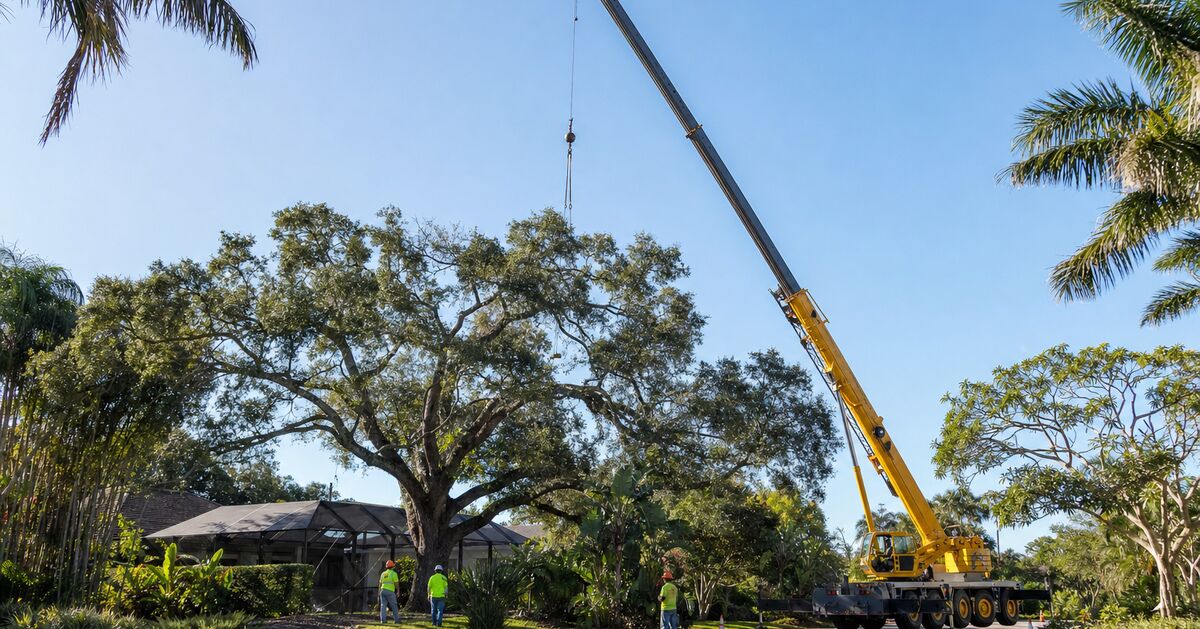
A 70-foot live oak overhanging a pool cage, a royal palm wedged between a screen enclosure and a six-foot vinyl fence, a dead slash pine leaning toward a neighbor's lanai with nowhere safe to lay a section down - these are the jobs where every experienced crew stops, looks around, and says the same thing: we need the crane.
Crane-assisted tree removal is not an upsell. It is a calculated response to physics, geometry, and the reality that many lots in Sarasota, Venice, Nokomis, and across our service area were platted long before the trees on them had any idea how big they would get. This post walks through exactly when a crane is required, what it adds to the cost of a removal, and why pool cages and tight lot lines so often leave no other choice.
Why conventional "cut and lower" removal has limits
Most tree removals follow a straightforward sequence: a climber sections the canopy from the top down, rigging ropes redirect each piece to an open landing zone, and the ground crew chips or stacks the debris. That method works beautifully when there is a clear drop zone - an open lawn, a wide driveway, or a side yard with no obstructions.
The method starts to break down the moment the usable drop zone disappears. A large section of trunk can weigh several hundred pounds. Even a carefully rigged piece swings in an arc when it drops, and that arc needs clear space. When a screen enclosure, an air-conditioning unit, a neighbor's fence, or a parked vehicle sits inside that arc, the risk of damage climbs fast. Rigging physics - load factors, swing radius, the mechanics of friction-based lowering - are governed by ANSI Z133, the safety standard that defines how aerial tree work must be conducted. Z133 does not prohibit conventional rigging in tight spaces, but it does require that the system be capable of safely handling the actual loads involved. On a big, heavily loaded tree over a pool cage, the honest answer is sometimes that no ground-based rigging system meets that standard safely.
That is the point where a crane becomes the right tool, not a luxury.
The specific site conditions that require a crane
Several conditions, alone or in combination, tend to push a job into crane territory. Our owner, ISA Certified Arborist Michael Calabro (certificate FL-362432A), evaluates each site before any proposal goes out, and these are the factors that consistently tip the decision:
No usable drop zone. A pool cage, screen enclosure, or covered lanai directly beneath or adjacent to the tree eliminates the landing area that conventional rigging depends on. Pool cages in Sarasota County and Charlotte County are often built right up to the property line and close around large trees that were planted or seeded long before the cage was constructed.
Narrow side yard clearance. Many older homes in Venice, Laurel, and Port Charlotte sit on lots where the gap between the house and the fence line is six feet or less. A trunk section cannot safely be swung through that corridor without contacting the structure or fence.
Extreme tree height or mass. A mature live oak in the neighborhoods around Siesta Key or Osprey can carry a canopy spread of 60 to 80 feet and a trunk diameter well over two feet. The sheer mass of each section multiplies the load on any rigging system. ANSI Z133 requires that rigging components be rated for the actual load, including dynamic load factors from the movement of a falling section. At some tree sizes, the hardware required for safe rigging becomes impractical without crane support.
Structural lean toward a structure. When a tree leans toward a house, pool cage, or neighboring structure, every cut made in a conventional climb increases the chance the tree moves toward that structure rather than away from it. A crane's crane line holds the section against that direction of pull before the cut is made. That changes the geometry of the operation entirely.
Limited aerial access for a climber. Heavily dead trees, trees with advanced wood decay (documented through probing and assessment per ANSI A300 Part 9 guidelines), or trees badly damaged by a storm can be unsafe for a climber to ascend at all. Crane-assisted removal allows the crane line to be attached from outside the canopy using a throw line or aerial lift, so the climber's exposure is minimized or the tree can be removed without a full climb.
Tight waterfront or barrier-island lots. Properties on Casey Key, Manasota Beach, and Englewood's waterfront streets are often narrow with water on one side and a road on the other. There is simply no room for a long-reach rigging setup. You can read more about the specific wind-load pressures trees on those barrier islands face in our post on Casey Key and Siesta Key wind exposure explained.
How pool cages in particular change the math
Florida's screen enclosures are engineered for wind resistance, not for point-load impacts. The aluminum framing is light and the screen panels have almost no tolerance for a falling tree section - even a glancing blow from a guided section can buckle a corner post or tear out an entire panel section. Repair costs for a pool cage can vary widely, from a single panel to full structural framing, and such costs may fall on the tree service's liability coverage if the crew caused the damage. More important, it falls on the homeowner's disruption and stress.
A crane eliminates that risk by lifting each section vertically out of the canopy and swinging it clear of the cage entirely before it comes down. The section never passes over the enclosure. It goes straight up and then out to a landing zone - often a street, driveway, or neighboring open area arranged in advance with the crew.
This is one of the reasons crane work is more common in Sarasota's established neighborhoods than many homeowners expect. The tree inventory in areas like South Sarasota, the East Venice corridor, and the older subdivisions of North Port includes a lot of mature oaks and pines that have grown up around structures built in the 1970s, 1980s, and 1990s. The trees are large. The cages are close. The geometry often points to a crane. You can explore the full range of tree removal and trimming services we provide for situations like these.
What crane work actually adds to the cost
Crane-assisted removal costs more than conventional removal. That is straightforward. Understanding why helps you evaluate a quote intelligently.
The crane itself. A mobile crane capable of reaching a 60- to 80-foot tree on a residential lot is specialized equipment. Rental and operator costs are real and they get passed through in the job price. Mobilization (getting the crane to and from the site) is a fixed cost regardless of how long the job takes, which is why crane jobs on smaller trees are sometimes proportionally more expensive than on large ones.
The crane operator. Operating a crane requires a separate qualified operator coordinating with the tree crew throughout the job. This is not the same person making the cuts. Communication between the climber and the crane operator during each lift is a specific safety protocol under ANSI Z133 - hand signals, verbal signals, and load control are all defined. That coordination requires experienced people on both ends of the crane line.
The ground crew size. Crane work typically requires a larger ground crew than conventional removal. Someone manages the tag line (a secondary rope that controls swing on the lifted section), someone coordinates the landing zone, and the crew needs to clear and stack or chip faster because sections arrive at the landing zone quickly.
Rigging and hardware. Crane lifts use rated slings, shackles, and hardware that get inspected before every use per ANSI Z133 requirements. These are not trivial costs in a full rigging kit.
Permitting and access. In some Sarasota County and Charlotte County neighborhoods, setting up a crane in the street or on a right-of-way requires a road use permit or coordination with the county. That adds time and sometimes a permit fee to the job.
Rather than inventing a dollar range that may not apply to your specific tree, we recommend reaching out through our contact page for a site-specific quote. The size of the tree, the crane mobilization distance, the complexity of the landing zone, and local permitting requirements all vary enough that a real estimate requires a real look at the site.
What to expect on the day of a crane removal
Crane jobs tend to move faster than homeowners expect once the crane is set up, but setup itself takes time. Here is a general sequence:
- Site prep. The crew assesses the landing zone, lays down plywood or ground protection if the crane will be positioned on a lawn or paver driveway, and confirms communication protocols with the crane operator.
- Crane positioning. The crane is positioned for maximum reach to the target tree. On tight lots, this sometimes means the crane is on the street with a long boom reach over a roofline. Road cones, flagging, or a spotter may be used if public traffic is involved.
- First cuts and lifts. The climber (or in some cases an aerial lift operator) attaches the crane sling to a canopy section before the cut is made. The crane takes tension on the line. The cut is made, and the crane lifts the section clear of the structure. The section is swung to the landing zone and lowered.
- Repetition down the trunk. This process repeats, working down the canopy and then the trunk in sections. The pace picks up as the canopy opens and the climber has more room to work.
- Stump and debris. Once the trunk is down to a safe height, conventional cutting finishes the trunk to grade. Stump grinding follows, either same-day or scheduled separately. Debris is chipped, hauled, or staged per whatever was agreed in the scope of work.
If you have questions about what happens to the wood and root structure after the tree is down, our frequently asked questions page covers a range of post-removal topics.
Common questions homeowners ask about crane removals
"Can't you just be really careful with ropes?"
Sometimes yes, and experienced crews use rigging to do a lot of work that might seem impossible. But there is a hard physical limit to what rope rigging can control. Once the mass of a section, the angle of the lean, and the proximity of the obstruction combine past that limit, adding more rigging does not make the job safer - it just creates more complexity and more potential failure points. ANSI Z133 exists in part to address the risks of rope rigging failures in tree work, which can lead to injuries and property damage.
"Will the crane damage my lawn or driveway?"
Ground protection mats and careful positioning reduce the footprint. Outrigger pads are required to protect the surface under the crane's stabilizing legs. On a soft lawn, some tire ruts or compaction is possible, especially after Florida's summer rains. Discuss ground protection specifically when you get your quote - a reputable crew will address it directly.
"Do I need to be home?"
You do not need to be present for the work itself, but being available by phone is helpful. You will need to have cleared the area of vehicles, pets, and loose items from the landing zone before the crew arrives.
"Does crane work require a separate tree permit?"
The permit question depends on the tree species, diameter, and the county. Sarasota County, Charlotte County, and the municipalities within them each have their own canopy and removal ordinances. Crane use itself does not typically trigger a separate permit, but the removal of certain protected or regulated trees does. For a thorough breakdown of the permit landscape, see our post on the tree removal and care services we provide and reach out for guidance on your specific situation. Our team serves the full area from Sarasota down through Venice, Nokomis, and Englewood, and we know which jurisdictions require what.
The bottom line
Crane work is not always necessary, but when the site calls for it, it is the method that protects your pool cage, your neighbor's fence, your roof, and the crew doing the work. The extra cost is real, but it is modest compared to the cost of repairing a buckled screen enclosure or a damaged lanai frame - and far more manageable than a workers' compensation or liability claim from an injury on a rigging system pushed past its safe limits.
If you have a large tree in a tight space in Sarasota, Venice, North Port, Port Charlotte, or anywhere across our service area and you are wondering whether crane work applies to your situation, the right first step is a site visit. The answer usually becomes obvious once someone with the right training is standing on your property looking at the geometry.
That is exactly what we are here to do.
Got a tree that worries you?
Free, no-pressure on-site estimate across Sarasota & Charlotte Counties.