
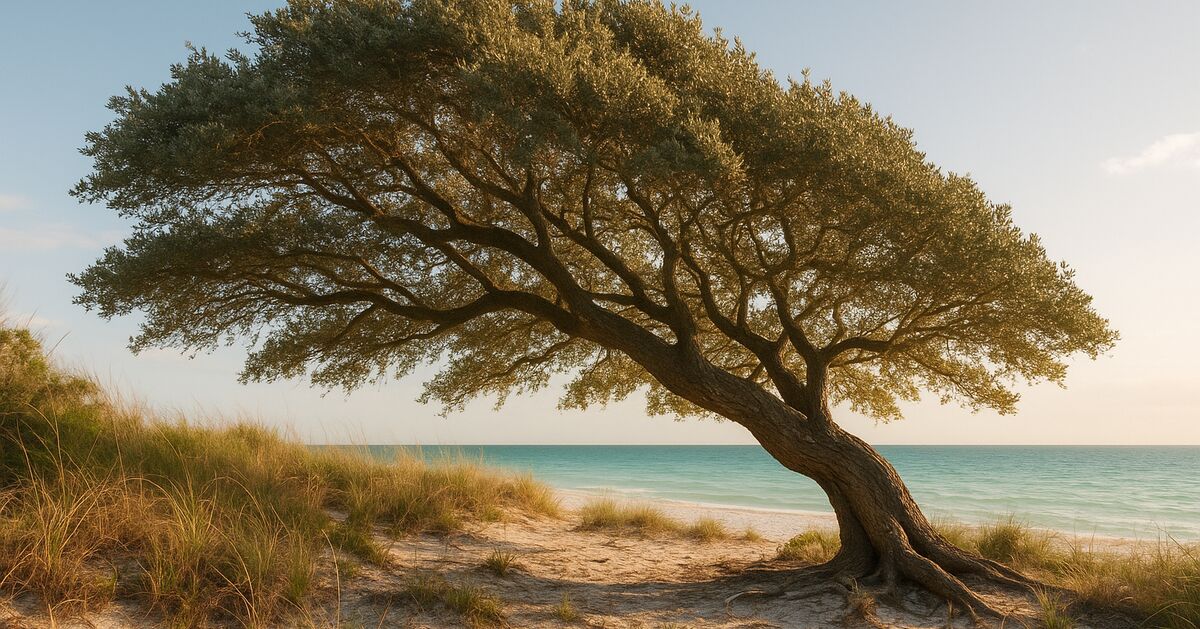
Salt air is doing something to your tree right now, and if you live on Casey Key, Siesta Key, or any other barrier island along this stretch of the Gulf Coast, the pace of that damage is faster than you might expect. Live oaks growing close to open water can show crown dieback, root instability, and structural failure much sooner than the same species growing inland. Understanding why gives you a real chance to extend the life of your trees and avoid the kind of surprises that end with a crane in your driveway.
What makes a barrier island a harsher place for trees
The phrase "barrier island" describes geography, but it also describes a set of stacked stressors that interact with one another in ways that compound the damage.
Salt spray and salt loading. Wind coming off the Gulf carries microscopic droplets of seawater far inland. On a calm day the spray drift might be light. During a tropical system, a sustained onshore blow, or even a stiff afternoon sea breeze in summer, the salt load landing on leaf surfaces and in the root zone rises sharply. Per USDA research on coastal plant stress, sodium chloride accumulates in leaf tissue, disrupts the osmotic balance that allows roots to pull moisture out of soil, and causes what looks like drought stress even when rainfall is adequate. The visual result is marginal leaf scorch, premature leaf drop, and tip dieback that an untrained eye can mistake for a pest problem or drought.
Sandy, nutrient-poor soil with poor cation-exchange capacity. The soils under Casey Key and Siesta Key are predominantly fine sands with extremely low organic matter content and almost no clay particles to hold nutrients. Cation-exchange capacity (CEC) is the measure of how well a soil holds positively charged nutrient ions against leaching. Sandy coastal soils have very low CEC values, which means fertilizer, calcium, magnesium, and potassium wash out quickly with rain or irrigation. A tree that looks well-fed in spring can be running a nutrient deficit by July.
Shallow, compacted root zones. Development on barrier islands is dense, setbacks are tight, and impervious surfaces are common. When soil volume is restricted, roots cannot spread far enough to anchor a large canopy or find consistent moisture and nutrients. This is a separate issue from root spread in native soil; on a built island lot, hardscape physically limits where roots can go. Our post on what live oak soil tells you about root spread goes deeper on how soil texture shapes the root footprint.
Wind load that never fully stops. Inland trees in Venice or Laurel get afternoon sea breezes, but the wind drops at night and the canopy gets a rest. On a barrier island, especially on the Gulf-facing side of Casey Key or the western properties of Siesta Key, onshore flow runs much of the day and the canopy is working mechanically every hour. Sustained dynamic loading fatigues the union between scaffold branches and the main stem over time, especially at narrow-angle attachments that already carry embedded bark.
Why the same species fails faster on the island
This is the part homeowners find most counterintuitive. A species is not a guarantee; its performance is inseparable from the site conditions it is asked to tolerate.
Live oaks
Live oaks (Quercus virginiana) are the signature canopy tree on Florida's barrier islands and with good reason: they tolerate salt better than most hardwoods. But "tolerates salt" is not the same as "ignores salt." When a live oak is already dealing with a restricted root zone, compacted sandy soil, and consistent wind load, the additional osmotic stress from salt loading tips the balance. Crown dieback starts at the windward tips, which is often mistaken for normal seasonal thinning. Over several years a significant portion of the crown can become non-functional. Dead wood in a wind-exposed canopy is a structural problem, not just an aesthetic one, because brittle deadwood fails unpredictably during gusts.
The ANSI A300 Part 1 pruning standard recognizes crown cleaning (removal of dead, dying, diseased, and crossing branches) as the foundational pruning operation for a reason. On a barrier island live oak, staying current with crown cleaning is more urgent than it is for the same tree growing on a protected inland lot. Waiting three or four years between assessments allows dead wood to accumulate in a canopy that is taking constant wind energy.
Queen palms
Why a trimmed queen palm can still collapse covers one failure mode in detail. On barrier islands the risk profile includes an additional factor: salt spray directly damages the spear leaf and the meristematic tissue at the crown. When a queen palm's single growing point is repeatedly exposed to salt loading, the new fronds emerge distorted or fail to open fully. Because a palm has no vascular redundancy the way a hardwood does, damage to the crown is not recoverable. The palm does not push new growth from a different location. It declines from the top down, sometimes over months, sometimes faster after a tropical event.
Slash pines
Slash pines (Pinus elliottii) are a Florida native and generally more salt-tolerant than most pines, but their failure mode on barrier islands is root-related rather than foliage-related. We covered the root-zone failure pattern in detail in our post on why slash pines fail at the root zone, not the trunk. On coastal sandy soils the lateral roots that provide wind anchorage must spread through soil that shifts with rainfall, is weakened by storm surge saturation, and offers relatively low resistance to the pulling and rocking forces generated by a wind-exposed canopy. A slash pine on a barrier island that shows crown thinning, resin bleeding at the root collar, or fungal conks at the base deserves immediate professional attention, not a wait-and-see approach.
Sabal palms
The sabal palm (Sabal palmetto) is Florida's state tree and genuinely tough. It handles salt, wind, and flooding better than almost anything else on the list. Even so, barrier island sabal palms have a specific vulnerability: when storm surge or prolonged brackish flooding saturates the root zone for days at a time, the root system can be damaged below the surface with no obvious above-ground symptom for weeks or months. After major storm events, some barrier island sabal palms that appeared intact in the fall have later shown spear leaf collapse and crown death months afterward. This is not a failure of the palm as a species; it is a site-driven failure that early assessment can sometimes catch.
The compounding role of fungal disease
Salt stress, wind fatigue, and nutrient deficiency all weaken a tree's ability to compartmentalize wounds and resist fungal colonization. The ANSI A300 Part 9 (Tree Risk Assessment) framework recognizes that tree health and structural condition interact with site conditions to produce a risk rating. A tree that would be rated "low risk" on a protected inland lot can move to "moderate" or "significant" on a barrier island lot because the site amplifies every underlying defect. Our post on fungal conks, cavities, and cracks explained walks through the visual indicators you can look for during a walk-around of your own property.
Ganoderma and other wood-decay fungi colonize tissue that has already been compromised by mechanical stress or environmental stressors. Once a conk forms at the base of an oak or palm, the internal decay it represents is already established and cannot be reversed. On a barrier island where wind loads are persistent, a tree with internal decay generally poses a higher risk than the same tree growing in a sheltered inland yard.
Pruning on barrier islands: what the standards say
Because wind is the dominant force acting on island trees, the pruning objective is typically to manage canopy size and density in a way that reduces drag, removes structural defects, and does not introduce new ones. The ANSI A300 standard language that applies here includes:
- Crown cleaning: remove dead, dying, diseased, and crossing branches. This is the baseline every session.
- Crown reduction: reduce the canopy spread or height using reduction cuts (cutting back to a lateral that is at least one-third the diameter of the removed stem). This is appropriate when a tree's canopy has outgrown its available root anchorage zone or when it presents an unacceptable wind target over a structure.
- Crown raising: remove lower limbs to provide clearance over structures, vehicles, or sight lines. On barrier island properties with small setbacks this comes up frequently.
What the standards explicitly do not endorse is removing large quantities of interior foliage to "let wind through" without addressing structural issues. Removing interior foliage while leaving long, heavy outer branches can actually increase bending moment at attachment points by shifting the canopy weight outward. Good structural work addresses the whole canopy, not just the visible interior.
The Z133 safety standard, which governs the conduct of tree care operations, also requires that work near coastal areas with unstable or saturated soil be evaluated for ground conditions before rigging and removal operations begin. Saturated sandy soil around a barrier island tree affects both the stability of the tree being worked and the footing available to ground workers.
What an assessment actually involves on a barrier island
Michael Calabro (ISA Certified Arborist FL-362432A) evaluates barrier island trees using the ANSI A300 Part 9 risk assessment framework, which looks at three things: the likelihood that a defect leads to failure, the likelihood that failure strikes a target (a structure, vehicle, or person), and the consequences if it does. On Casey Key and Siesta Key, where homes are close together, pools and lanais are common targets, and emergency access can be limited by the narrow road corridors, consequence ratings tend to be higher than for comparable inland sites.
A typical assessment on a barrier island property will include a visual inspection from the ground in all four quadrants, evaluation of the root zone and root collar for signs of decay or mechanical damage, a canopy condition review noting dead wood, included bark, co-dominant stems, and prior pruning wounds, and a site evaluation that considers the prevailing wind direction relative to the target zone. More complex situations (a large live oak with an enclosed root zone over a pool, for example) may call for resistograph drilling or other diagnostic tools.
You can see the full list of tree trimming, removal, and tree care services we provide across the area, and if you have specific questions before scheduling an assessment, our FAQ page covers the answers to the questions we hear most often.
Practical steps for island property owners
You do not need to be an arborist to improve your baseline awareness. A few things worth doing on a regular basis:
- Walk the windward side of your canopy after any sustained wind event. Look for hanging branches (called "widow makers" in the field), fresh cracks at branch unions, and bark that has split or is weeping sap.
- Check the root zone at the base of large trees after storm surge or prolonged rain. Heaving soil, surface roots that have pulled upward, or a visible lean that was not there before are all signs that need professional evaluation.
- Do not let pruning cycles slip. On an inland lot a two or three year gap between pruning sessions is often manageable. On a barrier island, dead wood accumulates faster, and the wind energy acting on that dead wood is greater. Annual or biennial assessments are worth the cost given the consequence of failure.
- Be cautious with fill and grade changes. It is tempting to add soil around trees to raise finished grade or improve drainage. On a barrier island with already-shallow root zones, even a few inches of fill over the root collar can suffocate feeder roots. Our post on trims that help vs. trims that slowly kill a tree touches on other common management mistakes that compound existing site stress.
Where we work
We serve all of the barrier island and near-coast communities in this area. If you are on Siesta Key, along the Casey Key corridor toward Osprey and Nokomis, or further south toward Englewood and Manasota Beach, the wind and salt exposure described in this post applies directly to your property. You can see the full list of communities we cover on our locations page.
If you have a tree you are concerned about, the most useful first step is an on-site assessment. An assessment gives you actual information about that specific tree on that specific site, which is far more valuable than a general rule about species tolerances. Reach out through our contact page and we will schedule a time to come out and take a look.
Got a tree that worries you?
Free, no-pressure on-site estimate across Sarasota & Charlotte Counties.