
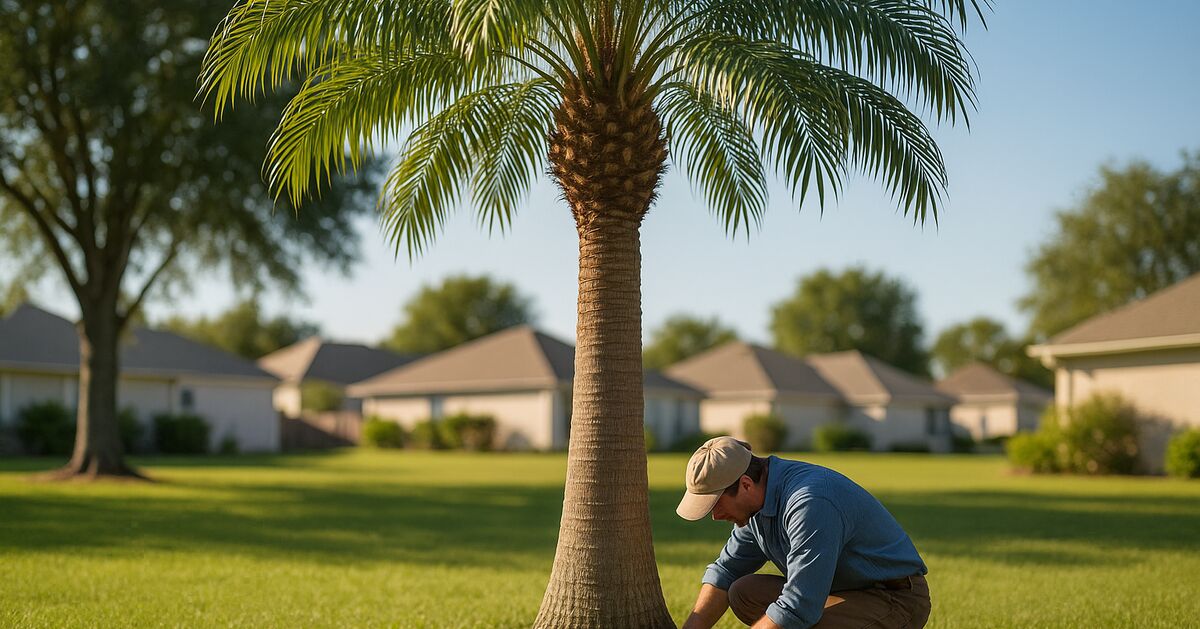
A queen palm standing in your yard with neatly cut fronds and a tidy, freshly groomed crown looks like a picture of health. That appearance is deceiving, and every year homeowners from Sarasota down to Englewood and Port Charlotte are caught off guard when one of those tidy palms drops without warning. A trim changes how a tree looks. It does not change what is happening inside the trunk or at the root collar. Understanding that gap, between appearance and structural reality, is the whole ballgame with queen palms.
Why queen palms are uniquely vulnerable on the Gulf Coast
Queen palms (Syagrus romanzoffiana) are not native to Florida. They originate in South America and they thrive here in the right conditions: well-drained sandy soil, warm temperatures, and consistent moisture. That description fits the Gulf Coast well enough that queen palms became a landscaping staple from Siesta Key to Casey Key and deep into the subdivisions of North Port and Charlotte County.
The problem is that our soils are very sandy, our water tables fluctuate, and we sit in one of the most active lightning corridors in the United States. Queen palms also have a growth habit that concentrates their entire vascular system inside a single trunk. Unlike a live oak, which can wall off a wound and continue growing around it, a palm that suffers internal damage has no backup system. When the central meristem is compromised, the whole plant eventually fails.
What a trim actually does, and what it cannot do
A proper trim on a queen palm, done in accordance with ANSI A300 Part 1 pruning standards, removes dead, dying, or structurally problematic fronds. Done correctly it is a crown cleaning, which tidies the canopy, reduces the surface area the wind can catch, and removes fronds that might harbor pests or disease. A good trim also avoids removing green fronds unnecessarily, because green fronds are photosynthesizing tissue. Strip too many of them and you stress the tree by cutting off its food production.
What a trim cannot do is address internal vascular disease, root rot, trunk compression failure, or damage from a lightning strike that traveled down the vascular column. These are internal conditions. You can groom the outside of a tree indefinitely and never touch the threat inside. The posts on our blog return to this theme repeatedly because it shows up in the field all the time: a homeowner had the palms trimmed last month, they look great, and then one comes down in a moderate windstorm with no warning.
The five things to look for before a queen palm fails
1. Spear leaf condition
The spear leaf is the new frond emerging from the very center of the crown. It should be upright, firm, and green. If the spear leaf is discolored (yellow, brown, or gray), limp, or pulls out easily with gentle pressure, that is a serious warning. A condition called spear leaf rot, which can be linked to fungal or bacterial causes after cold or physical damage, attacks the terminal growing point directly. Once the meristem is rotted, the palm cannot produce new fronds. A trimmed crown will look fine for weeks or months after this process begins because the existing fronds have not yet died back.
2. Crown lean or shift
A queen palm crown that has begun to shift off-center relative to the trunk is worth taking seriously. This can happen because the attachment of the frond bases to the internal tissue has weakened, often because of internal rot or pest galleries. It can also indicate that the root plate is failing and the trunk is beginning to lean from below. Minor lean in a recently planted palm is common and usually not alarming. Lean that develops in a mature, established palm that previously stood plumb is a different matter entirely.
3. Soft or discolored tissue at the trunk base
Run your hand along the trunk near the soil line. The trunk of a healthy queen palm should feel firm and uniform. Soft spots, areas where the bark gives slightly under thumb pressure, or tissue that is discolored or oozing are signs of basal rot. Ganoderma zonatum is a wood decay fungus known to be common in Florida and is often associated with basal rot in palms. A visible conk (a shelf-shaped fruiting body, typically brown on top and white on the underside) is a late-stage sign that the decay column inside may already be substantial. Our post on Ganoderma butt rot in Florida palms goes into that biology in detail.
4. Trunk narrowing (pencil-pointing)
A queen palm that has been over-pruned repeatedly, especially one where green fronds have been removed aggressively to achieve a skinny "hurricane cut" style, will sometimes develop a narrowed section of trunk just below the crown. This happens because the trunk grows partly in response to the mechanical load placed on it by the fronds. Remove too many fronds and the trunk does not receive the physiological signal to maintain its diameter at that point. This is sometimes called pencil-pointing or pencil-necking and it creates a structural weak zone that does not recover. The ANSI A300 standards exist in part to prevent exactly this kind of iatrogenic damage, where the care itself causes the harm. If you see a queen palm with a distinctly narrower collar just under the crown, the structural reserve at that point is reduced.
5. Root plate evidence at the soil line
Because queen palms grow a fibrous root system that extends laterally rather than deeply, a saturated or heavily compacted soil environment can undermine root anchorage. Look at the base of the trunk at the soil line. Heaving soil, a slight gap on one side, or roots that are visibly lifted on one side and compressed on the other all suggest the root plate is rocking under load. This kind of failure is not visible from a ladder during a trim. It requires a ground-level inspection, and in some cases probe work to assess what is happening below the surface.
Why lightning damage is so often invisible
The Sarasota and Charlotte County area is generally considered part of one of the most lightning-prone regions in the continental United States. Queen palms, like all palms, conduct electricity through their vascular tissue when struck. The damage may be dramatic and immediately obvious, or it may be entirely internal: vascular tissue flash-burned along a path from crown to root collar, with no external wound visible at all.
A palm that has taken an internal lightning strike may stand upright and even push a few more fronds for months before the tissue fully dies back. From the outside it looks fine. From the inside the primary vascular column is compromised. There is no way to assess this with a visual inspection from the ground. If you know or suspect a palm was near a strike, a qualified ISA Certified Arborist can conduct a closer assessment. Michael Calabro (ISA Certificate FL-362432A) performs these evaluations in our service area and can give you a grounded opinion rather than a guess.
What trimming style choices tell you about the crew doing the work
The way a palm has been previously trimmed carries information about its future risk. Some crews remove fronds aggressively, cutting into the live green fronds well above the 9 o'clock and 3 o'clock positions (the horizontal plane). This practice, sometimes called over-pruning or hurricane cutting, is not supported by ANSI A300 standards and has been shown to stress palms rather than protect them in wind events. A palm trimmed this way repeatedly will have a reduced green canopy, a narrower trunk over time, and fewer nutritional reserves to resist disease or pest pressure.
If you look at a queen palm and the crown is a tight, sparse ball with only the most recent one or two rings of fronds remaining, it has likely been over-pruned. The visible trim looks clean. But the tree has been repeatedly stressed.
Compare that to trims that genuinely help a tree's long-term health: a properly trimmed queen palm retains all green fronds at or above horizontal, has a full, rounded crown, and only the brown, dead, or seed-stalk tissue has been removed.
How to tell if your palm needs an assessment rather than another trim
If you can check yes to any of the following, the palm needs a ground-level assessment before the next trim is scheduled:
- The spear leaf looks off-color, limp, or feels loose
- You can see any soft or sunken tissue near the base of the trunk
- The trunk appears narrower just below the crown than it does six feet lower
- The palm is leaning in a direction it was not leaning two seasons ago
- There is a shelf-shaped fungal growth at the base
- The palm was within 30 to 40 feet of a lightning strike in the last two years
- The tree has been trimmed on a short cycle (every three to four months) with aggressive frond removal each time
A trim scheduled over an unexamined structural problem does not reduce the risk. It delays the conversation. For homeowners in Sarasota, Venice, Osprey, Nokomis, and the surrounding communities, this matters especially in the months before hurricane season when load on the root system increases dramatically.
The inspection process: what actually happens
A proper queen palm assessment starts on the ground before anyone goes up. Walking the base, pressing the trunk tissue at the root collar, examining the soil line, looking at the crown from multiple angles, and noting any lean or asymmetry are all part of a ground-level read. This is the kind of information that gets missed when a crew arrives, ladders up, makes cuts, and moves on.
Probe work can supplement the visual inspection when there is reason to suspect internal decay. Our post on what probe findings actually mean in a decay report explains how resistance drilling is used to map the extent of decay inside a trunk without significantly damaging healthy tissue.
When a palm is identified as a removal, the question becomes how to do it safely given what surrounds it. Queen palms near pool cages, lanai structures, or rooflines may require equipment and rigging techniques that go beyond what a climb-and-cut approach can safely accomplish. See our post on when a crane becomes the only safe removal option for context on that decision.
A note on sabal palms vs. queen palms
Homeowners sometimes assume that care and risk principles are the same across all palm species. They are not. Sabal palms (the Florida state tree) are significantly more storm-resistant, more tolerant of poor soil, and have a different internal structure than queen palms. They also respond to over-pruning differently. If your property has a mix of species, the assessment approach for each should reflect those differences. Our full range of tree and palm care services covers both, and we can walk you through what is appropriate for the specific species on your property.
The bottom line
A freshly trimmed queen palm is not a safe queen palm by default. The trim addresses the canopy. The threats that lead to unexpected collapse, Ganoderma, spear leaf rot, lightning damage, pencil-pointing, root plate failure, operate below or inside the tree where a trim crew's work does not reach.
If you have queen palms on your property in Sarasota, Venice, North Port, Osprey, or anywhere in the communities we serve, and you have not had a ground-level structural assessment done on them recently, that is the right next step before you schedule the next trim. Get in touch with our team and we can schedule an evaluation that looks at the whole tree, not just the parts that are easy to see from a ladder.
Got a tree that worries you?
Free, no-pressure on-site estimate across Sarasota & Charlotte Counties.