
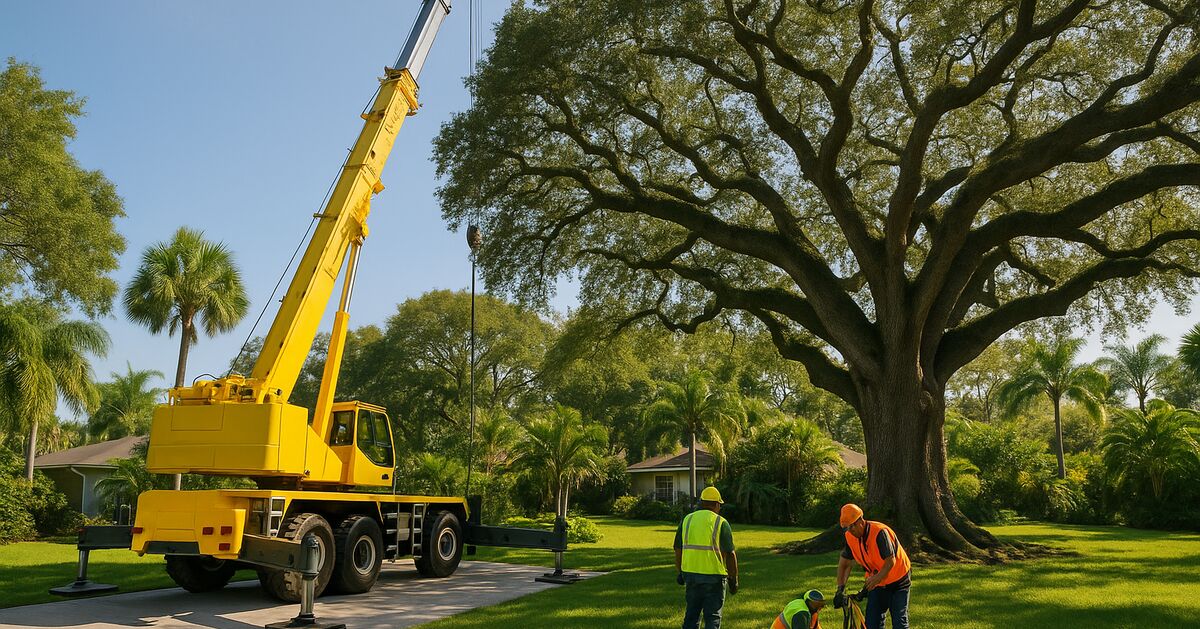
A crane sitting in your driveway changes how the neighbors look at a tree job. What it also changes, in a very practical way, is what's physically possible for a crew working in a tight or dangerous space. Understanding why a crane gets called in, and what it actually does during a removal, helps you ask better questions when a contractor recommends one.
The basic mechanics: what a crane is doing to the tree
In a standard tree removal without a crane, a climber ascends the tree, sections it from the top down, and drops each piece to the ground. The crew on the ground moves the pieces and feeds them into a chipper or stacks them for hauling. That workflow depends on having somewhere safe for the wood to fall, room for a climber to work, and a tree stable enough to climb in the first place.
A crane changes the drop equation entirely. The crane operator positions the boom above or beside the tree, and the climber attaches a rigging line, called a bull rope or crane line depending on the rigging configuration, to each section before it is cut. When the saw completes the cut, the crane lifts that section free and carries it through the air to a landing zone, usually the street, a cleared portion of the yard, or a waiting trailer. Nothing falls. Nothing swings into your pool cage. Nothing lands on the fence line between you and your neighbor.
The climber and the crane operator communicate constantly, often by radio, coordinating the timing of every cut and lift. This is not a two-person guess-and-hope situation. ANSI Z133, the safety standard for arboricultural operations, addresses aerial work and rigging requirements precisely because the forces involved in lifting large wood sections are significant and the margin for error is small.
Sections are sized deliberately. A crane with a certain rated lift capacity will dictate how large each piece can be. Cutting sections that are too heavy for the crane's working load is a genuine hazard. A competent crew calculates wood density, section length, and the crane's rated capacity before the first cut is made.
When a crane becomes the only reasonable option
Contractors don't recommend cranes to impress you. Crane rental adds real cost to a job, which means it only gets proposed when the job genuinely calls for it. Here are the situations that come up again and again in Southwest Florida.
Trees over structures with no drop zone
Sarasota, Venice, and Siesta Key yards can be tight. A large live oak or laurel oak that has grown up alongside a home may have major limbs extending directly over the roof, a screened lanai, or a pool. If there is no place to drop sections safely, a crane provides the only controlled path for the wood to exit. The alternative, rigging each section with block-and-tackle through the canopy and lowering it manually, is slower and puts higher shock loads on whatever anchor point the climber is using in the tree.
Dead or severely compromised trees
A dead tree is not a safe climbing tree. Wood that has been dead for a season or two can fracture without warning when a climber loads it with body weight and tool weight. Decay columns that look stable from the outside may be hollow inside. Climbing into a structurally failed tree violates the spirit of ANSI Z133, which requires crew members to assess the load-bearing capacity of their working position before committing to it.
In these situations, a crane solves the problem from outside the tree. The operator can position the boom and the groundworker can attach rigging at a low, reachable point, or a climber can ascend only far enough to place a strap around the trunk while staying in the lower, more solid wood. The crane takes the weight of each section as it is cut, so the remaining trunk doesn't have to bear the impact of a piece swinging or dropping onto it.
Florida's heat and humidity are thought to speed up wood decay compared to cooler, drier climates, which is one reason dead trees here can deteriorate quickly. A laurel oak that looked fine a year ago may have developed significant internal decay by the time removal is scheduled. Our tree and land care services page covers how we assess these situations before committing to a removal method.
Tight access corridors
Some properties in communities like Osprey, Nokomis, and Laurel have mature trees well inside fenced back yards with no gate wide enough for heavy equipment. The crane can work from the street, the driveway, or a cleared side yard and reach over the fence entirely. The wood travels over the fence by air and lands in the accessible zone, where it can be processed.
Tall trees close to power lines
Trees growing into or near utility lines present a layered hazard. A climber working at that height near energized conductors faces risks that require careful planning under ANSI Z133's requirements for work near utilities. A crane allows the crew to reduce the tree from the top without the climber having to position above the point where the tree contacts or approaches the lines. Each section comes free and is carried away rather than dropped through or past the conductor zone.
Large-diameter hardwoods in historic neighborhoods
The Sarasota area has some genuinely large live oaks, including specimens with trunk diameters over three feet and canopies extending sixty feet wide. The sheer mass of a section cut from the main scaffold of a tree like that can exceed what conventional rigging can handle safely. Cranes are rated in tons, not hundreds of pounds, and that capacity is sometimes simply what the wood demands.
What the setup looks like on the day
The crane truck needs a staging area. Before scheduling a crane job, a good contractor will walk the property and identify where the crane can set up its outriggers, the stabilizing arms that extend from the body of the truck to bear the load. Outriggers concentrate weight in a small footprint, so asphalt, pavers, or soft ground directly over utility lines or a septic system need to be protected with cribbing (stacked wood blocks or engineered mats that distribute the load).
If you're in Englewood or North Port where lot sizes tend to be larger, outrigger placement is often easier. In denser neighborhoods on Siesta Key or Casey Key, the setup conversation requires more planning and sometimes coordination with the county about temporary street use.
The crane operator is not typically part of the tree crew. Crane operators have their own certifications and operate under their own safety framework. The tree crew and the crane operator work together on the day, but their training pathways are separate. This is worth knowing because it means a tree contractor who recommends a crane is coordinating two specialized trades, not just showing up with a bigger truck.
What you should ask when a crane is proposed
You don't need to be an engineer to have a productive conversation about a crane recommendation. A few direct questions help:
- What specific condition makes conventional rigging unsafe or impractical here?
- Where will the crane stage, and will its outriggers affect my driveway, lawn, or underground utilities?
- What is the rated lift capacity of the crane you're bringing, and does it cover the heaviest sections you expect to cut?
- Where will the wood land when it's swung out of the tree?
- Who is responsible for any surface damage caused by the crane setup?
If a contractor can't answer these clearly, that tells you something. Our frequently asked questions page covers more of what to expect when getting a removal quoted and scheduled.
It's also worth reviewing our earlier post on what an arborist actually looks at during a tree assessment, because the structural condition of the tree is often the thing that tips a job from conventional removal to crane-assisted removal. The decision isn't made by eyeballing the height. It's made by evaluating the wood's integrity, the available drop zone, and what's underneath.
How crane work fits within ANSI A300 and ANSI Z133
The ANSI A300 Tree Care Standards provide the technical baseline for how tree work is planned and executed, including rigging and removal operations. ANSI Z133 covers the safety side, including requirements for crew communication, rigging load limits, and working near structures. Crane-assisted removal is consistent with both standards when it is selected precisely because it reduces risk to workers and property, rather than because it looks impressive.
When Michael Calabro (ISA Certified Arborist, certificate FL-362432A) evaluates a tree for removal, part of that evaluation is determining what removal method is appropriate. The arborist's role is to specify the method; the crew executes it. The certification is held by the individual, not the company, which is why having a certified arborist involved in the planning stage matters for jobs with complex logistics.
The cost question
Crane-assisted removal costs more than conventional removal. The crane itself is a rental with an hourly or day rate, plus mobilization. That cost is real, and you should expect it to appear as a line item or to be reflected in the overall quote. What it buys is the ability to complete a job that would otherwise be impossible to do without damaging your property, harming the crew, or both.
For jobs in Venice or North Port where properties may have pools, screen enclosures, or close neighbors, the cost of crane work is often far less than the cost of repairing what a poorly rigged section would damage. Our post on questions to ask before anyone quotes your tree in Venice or North Port goes into how to read and compare quotes when the scope involves specialized equipment.
If you've been told your tree needs a crane and you want a second opinion or a clear explanation of why, reach out to us directly. We're happy to walk through what we see and explain the reasoning before any work is scheduled.
A note on what cranes cannot fix
A crane solves the access and drop-zone problem. It does not make a structurally failed tree risk-free to remove. It reduces the exposure of crew members to that risk significantly, but planning, rigging knowledge, and good communication between the climber and the crane operator remain the actual safety mechanisms. Equipment is only as safe as the people using it.
That's true of every tool in this trade, but it's worth saying plainly about cranes because the machinery is impressive enough that it can appear to be doing the safety work on its own. It isn't. The crew's training and judgment, grounded in ANSI Z133 requirements, is still what keeps everyone on the ground at the end of the day.
If you want to understand more about what separates a well-run tree crew from one that's simply carrying the right equipment, our about page and our post on whether you need an arborist or just a tree crew are good places to start.
Got a tree that worries you?
Free, no-pressure on-site estimate across Sarasota & Charlotte Counties.