
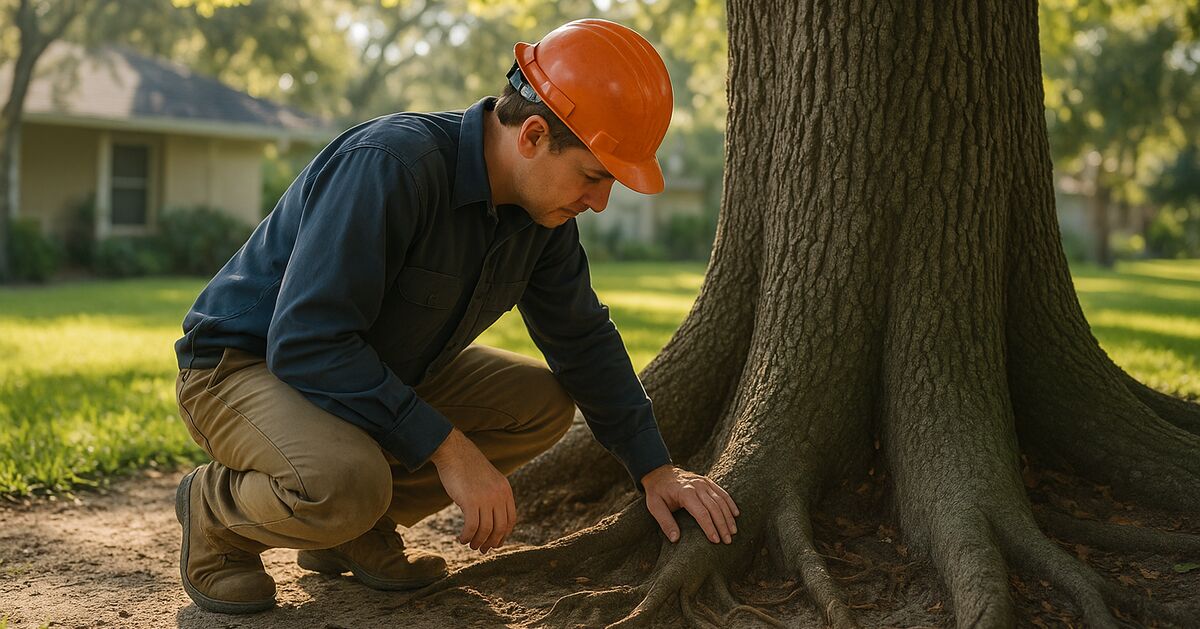
Your tree can look perfectly fine from the kitchen window and still be quietly failing from the roots up. That gap between appearance and reality is exactly why a structured tree assessment exists, and it's why a thorough one always starts at the ground, not the sky.
This walkthrough follows the same order a trained eye uses in the field: root collar first, then trunk and unions, then canopy, and finally the site itself and what a failure would actually land on. Each zone builds on the last. Skip one and you can misread everything that comes after it.
Zone 1: The root collar - start here, every time
The root collar is where the trunk flares out to meet the soil. In a healthy tree, that flare is visible at grade: you should see the base of the trunk widen like the foot of a wine glass before it disappears underground. When you can't see that flare, something is covering it, and that matters more than almost anything else you'll find higher up the tree.
Buried flare. In our experience in Sarasota and Charlotte County, trees are often planted too deep, or gradually buried over years by mulch, added fill, and soil creep. A buried flare creates a permanently moist environment around bark that is not designed to be wet. Bark, unlike the woody root tissue below grade, has no protective suberin layer to resist decay fungi. Prolonged burial feeds a slow, steady rot that weakens the trunk base from the outside in, often without any visible sign above ground until the tree is already seriously compromised.
The fix, when caught early enough, is often a root collar excavation: removing the excess soil and mulch to expose the flare and restore airflow. Our post on root collar excavation and air spading goes into detail on what that process reveals. The point here is that the assessment begins by getting down low and looking for that flare before anything else happens.
Girdling roots. When a tree is grown in a container too long, or planted in a hole that is too narrow, roots begin to circle rather than radiate outward. Over years, those circling roots grow in diameter and begin to compress the trunk's vascular tissue - the xylem and phloem that move water and sugars between roots and canopy. A girdling root can strangle a tree from below while the crown still looks reasonably full. The sign is often subtle: a trunk that goes straight into the ground on one or more sides, with no visible flare, because the girdle is compressing the base. Probing with a soil pick or a careful hand-excavation confirms it.
Mulch volcanoes. The habit of piling mulch against the trunk base is genuinely persistent on Gulf Coast properties. The ISA and the ANSI A300 Part 5 (Management of Trees and Shrubs During Site Planning, Site Development, and Construction) both address soil and mulch management around trees for exactly this reason. Mulch piled against bark traps moisture, prevents bark from drying out between rains, and creates a warm, humid environment where fungal pathogens thrive. A proper mulch ring is pulled 3 to 6 inches back from the trunk and spread no deeper than 3 to 4 inches across the root zone. When an assessment finds a volcano, correcting it is one of the simplest, most effective interventions available.
Zone 2: Trunk and unions - where structural failures begin
Once the root collar has been evaluated, attention moves up the trunk. The trunk is the column that carries every load above it, and damage here cannot be compensated for anywhere else in the tree.
Cavities and decay. Wood decay is caused by fungi that break down lignin and cellulose, the structural components of wood. A cavity is visible evidence of past or ongoing decay. The key question an arborist is trying to answer is not just "is there a cavity" but "how much sound wood remains, and is it enough to carry the structural load this tree is under?" A small cavity in a large trunk may be inconsequential. A cavity that occupies more than a third of the trunk's cross-sectional area is a much more serious finding. The ANSI A300 Part 9 (Tree Risk Assessment) provides the framework for translating those findings into a risk rating. In our sandy, frequently saturated soils, decay may progress faster than in drier climates, which is one reason assessments here should not rely on visual inspection from a distance alone.
Sounding the trunk with a rubber mallet is a basic screening tool: hollow sound indicates a void. For larger trees with complex trunk forms, a resistograph (a drill that measures resistance as it passes through wood) or sonic tomography can map internal decay without causing significant additional harm to the tree.
Included bark at tight forks. Bark is technically dead tissue. When two co-dominant stems grow at a tight, narrow angle, bark from each stem can get pinched between them as both stems grow outward. That pinched bark, called included bark, creates a weak attachment zone because wood cannot form a proper union across bark. The result is a fork that looks substantial from a distance but can split explosively under wind load, which in a coastal county with a June-through-November hurricane season is a serious concern. ISA Tree Risk Assessment guidance specifically identifies co-dominant stems with included bark as a common structural defect. A tight V-crotch on a large live oak over a lanai in Venice or a pool enclosure in Englewood deserves careful attention.
Cracks, seams, and past wound response. A vertical crack or a long seam in the bark tells a story. It may be a lightning wound, a frost crack from a past cold event, or a sign that the wood inside is shrinking as it decays. Wound response wood (called callus, or more precisely woundwood) rolling over an old wound shows the tree is actively trying to seal the damage - that's generally a good sign. Woundwood that has stopped growing, or that is cracking and lifting away, is a sign the tree has lost the metabolic resources to close the wound.
Zone 3: Canopy - reading the pattern of decline
The canopy is where most homeowners start looking when they're worried about a tree, but it's actually the last zone evaluated in a structured assessment. By the time you're looking at the canopy, you already know what's happening at the roots and trunk, and those earlier findings shape how you interpret what you see above.
Dieback pattern. Dead branches at the outer tips of the crown (tip dieback) are different from dead branches distributed throughout the interior. Tip dieback can indicate drought stress, root dysfunction, or vascular disease. Interior deadwood that progressively expands inward often points to declining vigor. Dieback on one side of the canopy - particularly the side away from a root injury, a pavement cut, or a construction zone - can indicate a vascular issue specific to that root sector.
In Sarasota and Charlotte County soils, which are largely sandy with low organic matter and rapid drainage, root dysfunction from drought stress can be a significant driver of canopy decline. Trees in those soils also tend to develop shallower root systems than they would in heavier soils, which can affect both their drought tolerance and their anchorage in wind events.
Deadwood load. Individual dead branches are evaluated for size, position, and what sits below them. A dead 2-inch branch in the interior of a large crown is unlikely to cause injury if it falls. A dead 8-inch codominant limb over a play area or a car parking spot is a very different calculation. Under industry pruning standards, removal of dead, dying, and diseased wood is classified as crown cleaning, a standard pruning objective. The assessment identifies which deadwood warrants priority removal.
Weight distribution and limb architecture. Long, horizontal limbs with heavy end weight are more susceptible to failure than limbs with tapered, well-distributed foliage loads. Live oaks trained in youth toward a balanced crown are far more resilient than those that developed long horizontal scaffolds over driveways or structures. This is one reason structural pruning during a tree's early years pays compounding dividends for decades.
When evaluating limb architecture, the arborist is looking at the angle of attachment, the ratio of the limb diameter to the trunk diameter at the attachment point, and whether the end weight is disproportionate. Species matter here: slash pines tend to shed limbs under wind load differently than live oaks, and sabal palms fail in a completely different pattern than either. Species-specific knowledge is part of what separates a trained assessment from a general visual inspection.
Zone 4: The site and the targets - where risk becomes real
Risk in tree assessment has two components: the likelihood that the tree or a part of it fails, and the consequence if it does. A tree with a moderate structural defect growing over bare mulch in a back corner has a very different risk profile than an equally defective tree growing over a roof or a driveway in daily use.
The technical term for what a failure would land on is "target." Target analysis asks: Who or what occupies the area under this tree, how often, and what would the consequence of a strike be? A tree growing over a rarely used storage shed is a lower-consequence target than a tree growing over a bedroom. Part of the arborist's job during an assessment is to walk the target zone, not just stand under the tree.
Storm season multiplies everything. From June through November, Sarasota and Charlotte County face tropical weather systems that can generate sustained winds well beyond typical conditions most residential trees experience. Wind load applied to a tree with existing structural defects does not fail in a linear way - it fails suddenly, often at a load just beyond what the defect can tolerate. That's why an assessment done in April or May, before storm season, is meaningfully different from one done in February. The goal is to identify and address defects before the wind load arrives, not after.
Soil and anchorage. The sandy soils common in Sarasota, North Port, and along the coast from Osprey through Englewood and Placida tend to hold root systems less firmly than clay-based soils. A tree that would hold in heavier soil can uproot in a wind event in sand, particularly if the root system is already compromised by girdling, grade change, or decay. Root plate failure, where the whole tree tips over with the root system still largely intact, is a distinct failure mode from trunk snap, and it may be more common in sandy soils. The assessment considers soil type and any evidence of past soil disturbance when evaluating anchorage.
What happens after the assessment
A good assessment ends with a written finding that separates observations from recommendations, and that prioritizes action by urgency. Not every finding requires immediate intervention. Some trees need a crown cleaning and a mulch correction. Others need cabling to reduce load at a weak union - you can read more about when that option applies in our post on cabling and bracing. And some trees, after a thorough assessment, are best removed before they become an emergency.
The assessment should also tell you what was not found, so you have a baseline. Trees change. A tree with no significant defects today may develop one after a drought year, a construction project next door, or a minor impact from a passing storm. Periodic reassessment, rather than a one-time look, is how responsible tree owners stay ahead of failure.
Michael Calabro (ISA Certified Arborist FL-362432A) conducts assessments across our service area, from Sarasota and Siesta Key south through Venice, Nokomis, Laurel, Osprey, and Englewood, and into Charlotte County communities including North Port, Port Charlotte, and Placida. If you have a tree you're uncertain about, the right time to have it looked at is before the next storm season, not after.
You can review the full range of tree care services we offer or get in touch to schedule an assessment. If you're comparing providers and want to know what questions to ask, our post on how to check whether the arborist quoting your tree is actually certified covers exactly that.
Got a tree that worries you?
Free, no-pressure on-site estimate across Sarasota & Charlotte Counties.