
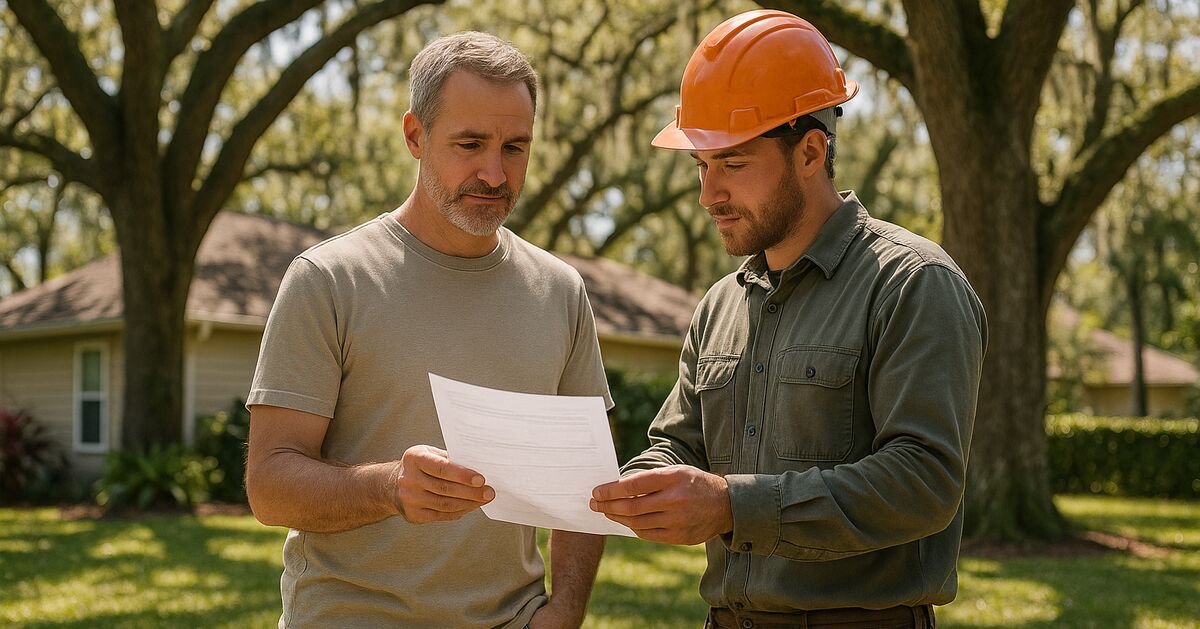
Plenty of people quoting tree work in Sarasota, Venice, North Port, and the surrounding area call themselves arborists. Some of them hold a rigorous, exam-backed credential. Others use the word because nothing stops them from doing so. Knowing the difference takes about five minutes once you know what to look for.
"Arborist" is not a protected title in Florida
This is the single most important fact to absorb before you call anyone for a quote: Florida has no state arborist registration or permit. Unlike "electrician" or "contractor," the word "arborist" is not restricted by state law. Any individual or company may legally use it in advertising, on business cards, on the side of a truck, or on a quote sheet. That is not a criticism of anyone who does so. It is simply the legal reality.
What IS restricted is a specific certification mark: ISA Certified Arborist®, owned by the International Society of Arboriculture. The ISA has registered that exact phrase as a certification mark, meaning only individuals who have met defined requirements may use it. If a company's flier just says "certified arborist services" without a person's name and credential number attached, that phrasing tells you very little on its own.
What it takes to earn the ISA Certified Arborist credential
To sit for the ISA Certified Arborist examination, a candidate must first document a minimum of three years of full-time, hands-on experience in professional tree care. That experience requirement is non-negotiable. After that, the candidate passes a written examination covering tree biology, soil science, pruning principles under the ANSI A300 Tree Care Standards, diagnosis, safety under the ANSI Z133 safety standards, and related topics. Once certified, the individual must earn continuing education units every three years to remain in good standing.
A few things worth knowing about how the credential works:
- The certification belongs to a person, not a company. ISA policy is explicit: the certification mark and the permission to use it may not be transferred to or claimed by any organization or business.
- Proper, compliant use of the mark requires the holder's full name and their unique certification ID number. A vague reference to "certified staff" or "a certified crew" does not meet that standard.
- The credential is personal. If the certified individual leaves a company, the company no longer has a certified arborist on staff unless another employee holds a current certificate.
This matters practically. When a company says "we are a certified arborist company," that sentence does not mean what it implies. At best it means at least one person there holds a certificate. Ask who that person is and what their number is.
The right way to verify: ask for the name and number
A common question that comes up in homeowner forums is how to check whether a certification is real. The ISA does maintain a public online credential directory, but participation in that directory is voluntary. A certified arborist who has not opted into the public listing will not appear there, and that absence proves nothing on its own. Do not treat a missing search result as evidence of fraud.
The more reliable approach is direct:
- Ask for the certified individual's full name and ISA certification number. A legitimate credential holder will have this memorized or close at hand. The format is a two-letter state code followed by a hyphen and a number, then a letter suffix (for example, FL-362432A is Michael Calabro's credential, the ISA Certified Arborist on our team at Eagle Eye Tree and Land Services).
- Go to the ISA's credential verification page at isacertified.org. Enter the name or number and confirm the credential shows as current. An "expired" status means the continuing education requirement was not met and the credential lapsed.
- Ask whether the certified arborist will be on site during the work. A certificate held by an office employee who never visits your property provides a different level of oversight than one held by the person directing the crew.
Our own certified arborist, Michael Calabro (ISA Certified Arborist FL-362432A), is the person who performs assessments and directs work on our jobs. You can learn more about what that credential means for your project on our certified arborist services page.
What a certification does not tell you
Here is where a lot of homeowners go wrong: treating the presence or absence of a certificate as a pass/fail test for the whole hiring decision. A certificate is evidence that one person passed one exam at one point in time and has kept up their continuing education. It is genuinely meaningful. It is not a complete picture.
A few things certification does not measure:
- Insurance. A certified arborist who carries no workers' compensation coverage or inadequate general liability can expose you to significant financial risk if a worker is hurt on your property. We have written at length about why workers' compensation coverage matters to you as the homeowner, and it is worth reading before you sign anything.
- Equipment quality and crew experience. The person swinging a saw may have twenty years of hands-on skill and no certificate at all. Credentials and field competence are related, but they are not the same thing.
- References and track record. Ask for recent local references. Neighbors in Osprey, Nokomis, Englewood, or Port Charlotte who can speak to how a crew handled their property after a removal or structural prune are worth more than any certificate in isolation.
- Honest scope of work. A certified arborist who recommends unnecessary removals or who does not explain why a particular pruning operation is appropriate is not serving you well regardless of their credential. Our overview of tree trimming, removal, and care services explains what different operations actually involve, so you can have an informed conversation with any company quoting you.
Many excellent tree crews in Southwest Florida hold no ISA certificate whatsoever. A certificate is a useful data point. Do not let it replace the other questions.
Pruning terminology worth knowing before your quote
One practical way to gauge whether the person quoting your work knows what they are talking about is to listen for the right terminology. The ANSI A300 Tree Care Standards define specific pruning operations, and a knowledgeable arborist should use them accurately:
- Crown cleaning removes dead, dying, diseased, or weakly attached branches from the canopy.
- Crown raising removes lower branches to increase clearance beneath the tree.
- Crown reduction reduces the overall size of the canopy by cutting branches back to lateral branches large enough to assume the terminal role.
- Structural pruning (sometimes called subordination pruning) corrects growth defects in young trees to set them up for long-term health. We have a full post on structural pruning and the cuts that shape a tree's next thirty years if you want to go deeper on that topic.
If someone describes your job as "thinning it out" or "cutting it back some" without using any of this vocabulary, that is worth a follow-up question. It does not make them wrong, but it is a reasonable prompt to ask exactly what cuts they plan to make and why.
Red flags that suggest a quote deserves more scrutiny
A few patterns that come up repeatedly in owner accounts and that are worth paying attention to:
- A quote that does not identify the certified individual by name and number, even after you ask directly.
- A company that claims the business itself is certified rather than a named person.
- A proposal to "top" a tree (cutting the main stem or large scaffold branches without regard for lateral structure). This practice is at odds with ANSI A300 pruning standards and causes predictable long-term damage, regardless of who performs it.
- Pressure to start work the same day without a written scope of work.
- No proof of workers' compensation coverage when you request it.
None of these individually condemn a company, but each one warrants a question. A straightforward company will answer all of them without irritation.
How this applies in our service area
The communities we work in, from Siesta Key and Casey Key on the coast through Laurel, Osprey, and Nokomis along the Tamiami Trail, to Englewood, Manasota Beach, Placida, and Port Charlotte to the south, have a healthy number of tree service companies competing for work. That is good for homeowners on price but it does mean the range of credentials and practices is wide.
Our full service area page lists every community where we work. If you are in Venice or North Port and want a quote from a crew where an ISA Certified Arborist will be part of the job, we are glad to talk.
The Sarasota area in particular has seen a surge in tree-related advertising after storm seasons, which is exactly when consumers are most rushed and least likely to ask the verification questions above. Taking five minutes to confirm a credential and request a certificate of insurance before any work begins is time well spent.
The short checklist
If you remember nothing else from this post, run through these steps before signing any tree work agreement:
- Ask for the name and ISA certification number of the certified arborist associated with the job.
- Verify the credential at isacertified.org (search by name or number and confirm "current" status).
- Request a certificate of insurance showing both general liability and workers' compensation, with your name listed as an additional insured.
- Ask for two or three recent local references.
- Get the scope of work in writing, using the ANSI A300 operation names where applicable.
If any of those requests are met with hesitation or vague deflection, that tells you something useful before any work begins.
We are happy to answer questions directly
Vetting a tree company should not feel adversarial. Any contractor who takes pride in their credentials and their insurance will welcome the questions above. If you want to talk through a quote you have received, compare it against what we would propose, or simply learn more about how we approach an assessment, our FAQ page covers a range of common questions, or you can reach us directly through our contact page.
Michael Calabro, ISA Certified Arborist FL-362432A, is the arborist behind Eagle Eye Tree and Land Services. When you call us for a quote, you are getting an assessment from the person who earned that credential and who will be accountable for the work.
Got a tree that worries you?
Free, no-pressure on-site estimate across Sarasota & Charlotte Counties.