
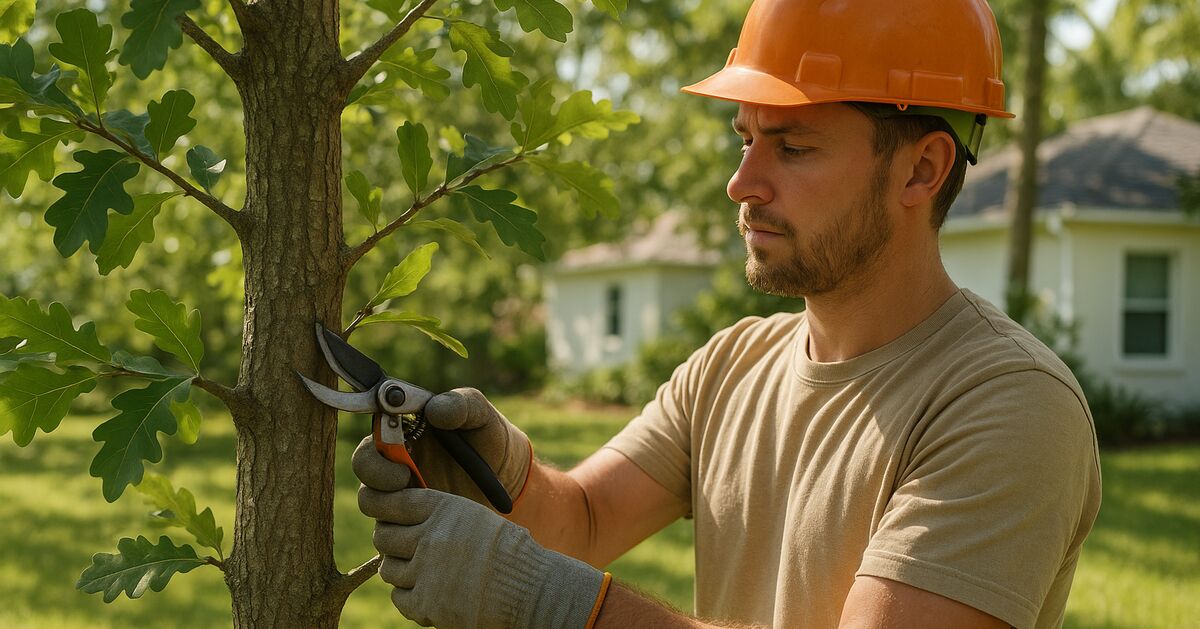
A young tree with a full canopy and a straight trunk looks perfectly fine. That can be misleading. What's already forming inside that tree, in the branching angles, the competing leaders, the included bark, will determine whether it stands cleanly through a Category 3 storm thirty years from now or splits apart and drops onto your lanai.
Structural pruning is the practice of shaping a tree while it is still young enough that small, low-stress cuts can redirect growth before problems become permanent. It is the single highest-return investment in tree care most homeowners never make, and it is almost never taught clearly. This post explains what it actually involves, why the timing matters so much here in Southwest Florida, and what you should expect when a crew does it right.
Why youth is the window that closes
Trees do not heal in the way animals do. They compartmentalize wounds, walling off damaged tissue rather than replacing it. A small-diameter cut on a young branch closes over quickly with minimal decay. That same structural defect left to grow for fifteen years produces a branch that may be six inches in diameter at the union, and removing it leaves a wound that takes years to close and may never fully compartmentalize before decay sets in.
This is why the ANSI A300 Tree Care Standards, the national standard that guides professional tree care practice in the United States, place significant emphasis on structural pruning during the juvenile and early-establishment phases of a tree's life. The idea is straightforward: guide the architecture while the material is still manageable, and the tree requires far less intervention later.
In Southwest Florida, the urgency is higher than in most of the country. Live oaks, laurel oaks, slash pines, and even the ornamental trees planted in newer developments in North Port, Venice, and Port Charlotte grow fast in our heat and rainfall. A tree that a new homeowner planted at six feet can easily be twenty-five feet tall within eight to ten years. Growth that fast means structural defects accumulate quickly, and what looked like a harmless branch pattern at planting is a serious liability by the time the tree is shading the roof.
The two problems structural pruning is designed to prevent
Codominant stems and included bark. A codominant stem is what happens when two leaders, two main trunks, grow upward at roughly equal vigor from the same origin point. Where those two stems press against each other as they thicken, bark gets trapped between them. That trapped bark, called included bark, means the two stems are never properly connected by wood fiber. The union is inherently weak. Under wind load, codominant stems with included bark are one of the most common failure points in our storm-damaged trees.
Structural pruning addresses this early by selecting one of the two leaders to remain as the dominant central leader and subordinating the other through a reduction cut, removing some of its length to slow its growth relative to the leader. ANSI A300 terminology for this operation is structural pruning, and the goal is a single dominant stem with lateral branches that are meaningfully smaller in diameter than the trunk at the point of attachment.
Over-extended lateral branches. A branch growing at a wide angle from the trunk, with length and weight far beyond what its diameter at the union can support, is a lever arm waiting to fail. Reducing its length through a crown reduction cut (removing the end of the branch back to a lateral that is at least one-third the diameter of the removed portion) redistributes the load, reduces wind sail, and preserves the branch in a stable form rather than removing it entirely.
What a structural pruning session actually looks like
A proper structural pruning visit on a young tree, say a live oak or a red maple between three and ten years of age, typically accomplishes several things in a single visit.
Crown cleaning removes deadwood, crossing branches that rub against each other, and any branches with weak attachments. The ANSI A300 standard defines crown cleaning as the removal of dead, dying, diseased, or crossing branches. On a young tree this is relatively quick work because the material is small, but it sets the foundation for everything that follows.
Crown raising removes the lowest branches to achieve the clearance the site requires, whether that means clearance over a sidewalk, a roof line, or a driveway. On young trees this is done gradually over multiple visits rather than all at once. Removing too many lower branches at one time strips the tree of photosynthetic area it needs to develop trunk taper, the gradual thickening from tip to base that gives a trunk its bending strength.
Structural pruning of the leader and scaffold branches is the heart of the visit. The crew identifies the central leader, identifies any competing stems, and makes subordination or reduction cuts to ensure the leader stays dominant. Scaffold branches, the main lateral limbs that will form the permanent framework of the mature canopy, are selected for spacing, angle of attachment, and radial distribution around the trunk. Branches too close together vertically, branches with narrow attachment angles, and branches that cross through the interior are either removed or reduced at this stage.
Every cut is made to a lateral branch, a bud, or the branch collar (the slight swelling at the base of a branch where the trunk's tissue wraps around it). Cutting into that collar or leaving a stub both violate the ANSI A300 pruning standards and create unnecessary decay entry points. The difference between a proper pruning cut and a stub is not subtle once you know what to look for, and it is one of the clearest ways to evaluate whether a crew knows what it is doing.
How many visits does a young tree need?
Structural pruning is not a one-time event. The ANSI A300 standard describes it as a process carried out over the establishment and juvenile phases of a tree's life. For most of the species common in Sarasota, Osprey, Nokomis, and the surrounding areas, that means visits every two to four years from planting until the tree reaches roughly half its mature height.
Each visit is faster and cheaper than the last as the architecture improves. The first visit may involve removing several competing leaders and a handful of problem laterals. By the third visit, the goal is mainly to confirm the leader is holding dominance, clean out any new interior crossing growth, and make small adjustments to scaffold spacing. By the time the tree reaches maturity, a well-structured specimen needs only occasional crown cleaning to remove deadwood.
Compare that with the alternative. A tree that receives no structural pruning during its youth often arrives at maturity with multiple codominant stems, heavy over-extended laterals, and an interior full of crossing and rubbing branches. At that point, the options are to live with a structurally compromised tree, spend significantly more on corrective pruning (which has limits, since major cuts on a mature tree carry real risks of decay and stress), or remove the tree entirely. For more on what cabling and hardware can do when structural problems have already progressed, see our post on cabling and bracing: when hardware saves a tree that would otherwise come down.
Common mistakes homeowners make with young trees
Topping or "rounding over" the leader. Cutting the main leader flat, or severely shortening it to limit height, is one of the most damaging things you can do to a young tree's structure. It removes the apical dominance that suppresses competing upright shoots. The result is a flush of fast-growing, weakly attached water sprouts that compete with each other, and the tree often ends up with a worse multi-stem situation than it started with. This violates the ANSI A300 pruning standards and produces trees that are more hazardous, not less.
Removing lower limbs too aggressively, too early. Homeowners often want a clear trunk quickly for sight lines or mowing. Removing the lower branches of a young tree all at once deprives it of the photosynthesis it needs to build trunk taper. A trunk that tapers poorly is more likely to flex excessively and fail in wind. Lower branches should be removed gradually over several visits.
Lion's-tailing. This is the practice of stripping interior and lower foliage from branches, leaving tufts of foliage only at the branch tips. It is sometimes done because it looks dramatic and "open," but it shifts the tree's weight to the ends of long, heavy branches and actually increases wind load failure risk. The ANSI A300 standard specifically prohibits lion's-tailing as an acceptable pruning practice.
Waiting until the tree is large. It bears repeating. The window for low-cost, low-stress structural intervention is genuinely short. A live oak that is twelve inches in trunk diameter is already a mid-size tree in Southwest Florida terms, and making structural corrections at that size means larger wounds, more stress, and more limited options.
What's different about structural pruning in Southwest Florida
Our conditions accelerate everything. The combination of sandy soil, high rainfall during summer, and a long growing season means species like live oak and slash pine can add more annual growth here than the same species would in most of the southeastern United States. That growth rate is part of why so many trees in Sarasota County and Charlotte County develop structural problems faster than their owners expect.
It also means that the window between "this is a correctable problem" and "this tree is now a structural liability" is shorter here than in a cooler, drier climate. If you have young trees in your yard in Venice, Englewood, Siesta Key, or Laurel, the question is not whether to do structural pruning. It is whether to do it now or pay significantly more later in corrective work, or in storm damage.
Soil conditions also play a role that connects directly to how a tree's root system is developing underground, which is something we cover in depth in our post on root collar excavation and air spading: what we find under the soil and why it matters. A tree with a compromised root collar is going to be further stressed by any aggressive above-ground pruning, which is one reason a proper assessment always looks at the whole tree.
What to look for when hiring someone to do this work
Because structural pruning on a young tree involves small cuts and modest time on site, it can look deceptively simple. The difference between a crew that understands ANSI A300 structural pruning principles and one that does not will not always be obvious from the ground, but a few things signal competence.
Ask the crew to walk the tree with you before they start. They should be able to point to the central leader, identify any competing stems, and explain which branches they plan to remove and why. If the answer is vague or amounts to "we'll clean it up," that is not a good sign. A crew doing structural pruning has a specific, explainable rationale for every cut.
Ask whether they are making cuts to branch collars, not leaving stubs. Ask how they plan to handle any competing leaders. A knowledgeable crew will use the vocabulary of structural pruning. Crown cleaning, subordination cuts, scaffold selection. These are not just words. They map to specific techniques with specific purposes.
For a full picture of the tree care and pruning services we provide across our service area, see our tree trimming, removal, and tree care services page. You can also browse all the communities we serve to see whether your neighborhood is covered.
Starting points: which trees to prioritize
If you have multiple young trees and limited budget to address them all at once, some general priorities make sense in our region.
Live oaks and laurel oaks tend to develop codominant stems readily and should be evaluated early. Slash pines are somewhat more self-correcting in their leader dominance but benefit from crown cleaning to remove dead wood that can attract bark beetles. Ornamental trees like crape myrtles are frequently topped by well-meaning but uninformed maintenance crews, and that damage should be corrected through structural pruning while the trees are still young enough to respond well.
Any tree within striking distance of a structure, whether a house, fence, pool cage, or outbuilding, should be prioritized. We have a separate post on what happens when a tree falls on a fence, pool cage, or lanai for situations that have already progressed to that point, but the goal of structural pruning is to make that post irrelevant for the trees in your yard.
A straightforward next step
Structural pruning does not require a crisis to justify it. If you have a tree between three and fifteen years old in your yard in Sarasota, North Port, Osprey, Nokomis, Venice, or anywhere else across our service area, scheduling an evaluation now is simply the lowest-cost version of tree care available to you.
The cuts you make at year five shape the tree at year thirty-five. There is no other point in a tree's life where a modest investment in skilled pruning delivers more long-term return, in structure, safety, and reduced future maintenance. Reach out through our contact page to schedule a look at the young trees on your property, and we will walk the site with you before any work begins.
For more posts on tree care across Southwest Florida, visit our tree care blog.
Got a tree that worries you?
Free, no-pressure on-site estimate across Sarasota & Charlotte Counties.