
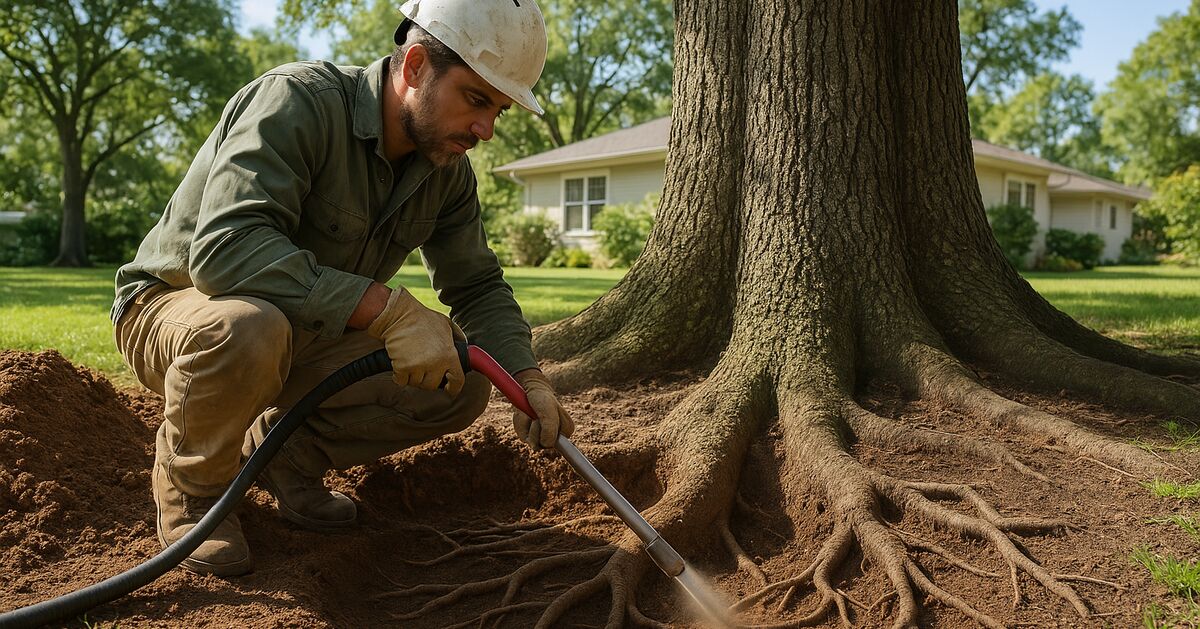
Most tree problems start underground, years before you notice anything wrong above the soil line. A tree can look perfectly healthy from the street, full canopy, green leaves, solid trunk, and still be quietly strangling itself or rotting at its base. Root collar excavation and air spading are the tools that let us look below the surface and find out what is really going on.
If you have a tree that seems to be struggling without an obvious reason, or if you have noticed the base of a tree is buried deep in soil or mulch, this post explains what those techniques involve, what we commonly find when we dig, and why what we find can change the entire plan for your tree.
What is the root collar, and why does it matter?
The root collar (sometimes called the root flare) is the zone where the trunk transitions into the root system. On a healthy tree, this area visibly flares outward at ground level. You should be able to see that flare. It looks almost like the base of the trunk is spreading its feet to anchor the tree.
That flare is not just cosmetic. The tissue there is critical for moving water and nutrients between the roots and the rest of the tree. It also responds differently to moisture than the rest of the root system does. When the root collar is buried, that tissue stays wet, which invites fungal pathogens, bacterial decay, and the kind of girdling root problems that can quietly kill a tree over five to fifteen years.
Here in Southwest Florida, root collar burial is surprisingly common. Landscapers pile fresh mulch year after year without pulling the old layer back. Grading work after construction raises the soil level. Sod gets laid right up against the trunk. Over time, six or eight inches of material builds up over a zone that was never designed to be underground.
What is air spading?
An air spade is a tool that uses a focused stream of compressed air to break up and displace soil without cutting or damaging the roots underneath. Traditional digging with a shovel or trowel risks slicing through fine feeder roots and even larger structural roots. Air spading moves soil away in a controlled way that leaves the root system intact.
The process takes time. A technician works methodically around the base of the tree, directing the air stream downward to loosen soil and using a vacuum or hand work to remove it. The goal is to expose the entire root collar zone and follow the major roots outward far enough to identify any structural problems.
This is not a quick task. On a large live oak or a mature slash pine, exposing the root collar properly can take the better part of a morning. But the information it reveals is often the difference between a tree that gets the right treatment and a tree that gets removed unnecessarily, or worse, one that stays in the yard when it should come down.
What we actually find when we excavate
After years of doing this work across Sarasota, Venice, North Port, Osprey, and the surrounding communities, there is a short list of things we find again and again under the soil. None of them are visible from outside. All of them matter.
Girdling roots
This is one of the most common findings. A girdling root is a root that has grown in a circle around the base of the trunk rather than outward into the surrounding soil. As both the root and the trunk grow in diameter over the years, the root compresses the trunk tissue beneath it. That compression restricts the flow of water and nutrients, essentially slowly strangling the tree from the base.
Girdling roots often develop when a tree was grown in a container for too long before planting, and the roots circled inside the pot. They can also develop in compacted soils where roots cannot push outward and instead curl back on themselves.
When we find a girdling root early, before it has caused severe compression, we can sometimes sever it surgically and remove it. When the damage is already advanced, the prognosis for the tree changes significantly.
Buried root collars and crown rot
When the root collar has been buried under six or more inches of soil or mulch for years, the tissue there often shows decay. It may be soft, discolored, or already showing the early stages of fungal colonization. In Florida's heat and humidity, decay moves fast once it gets a foothold at the base of the trunk.
We have written separately about Ganoderma butt rot in Florida palms, which is one specific and serious example of the kind of basal decay that can develop when conditions at the root collar go wrong. But palms are not the only trees at risk. Live oaks, laurel oaks, camphor trees, and slash pines are all vulnerable when the base of the trunk stays wet and oxygen is limited.
After excavation, if the exposed tissue is still healthy or only mildly compromised, we can remove the excess soil, improve drainage around the base, and give the tree a real chance to recover. If the decay has already moved up into the trunk or out into the major structural roots, the conversation shifts toward removal rather than treatment.
Soil compaction around the structural roots
In many yards, especially older neighborhoods in Port Charlotte, Englewood, and Nokomis where construction traffic may have run over the root zone decades ago, the soil around a tree's roots is nearly concrete-hard. Compacted soil holds almost no oxygen, and tree roots need oxygen as much as they need water.
Compacted root zones are one reason trees in otherwise comfortable-looking yards simply decline over time. The tree is not diseased. It is not infested. It is suffocating at the roots. Air spading breaks up that compaction in the immediate root zone, and in some cases we follow up with vertical mulching or soil amendment to help restore a better growing environment.
Infrastructure conflicts
Root collar excavation also reveals where roots and infrastructure are intersecting in ways that matter for decisions you will need to make later. We can see where major roots are heading toward a foundation, a seawall, irrigation lines, or a driveway. That information is genuinely useful whether you are deciding whether to remove a tree, whether to do structural pruning to reduce the load the tree places on the soil, or whether to look into cabling and bracing options to manage a structurally compromised tree without removing it.
How this fits into ANSI A300 tree care
The ANSI A300 Tree Care Standards are the nationally recognized technical standards for tree care work. Part 5 of A300 covers management of trees and soils, and it specifically addresses root zone management, soil aeration, and vertical mulching because these are recognized, evidence-based practices, not guesswork.
When we excavate a root collar and make recommendations based on what we find, we are doing exactly what those standards describe: assessing the actual condition of the tree's structural foundation rather than making assumptions based on what is visible above ground. The ANSI Z133 safety standard also comes into play when the excavation is done near active utility lines or in tight spaces where equipment positioning matters.
Working within these standards means we document what we find, explain what it means, and give you a clear picture of your options before any further work is done. A tree that looks risky from the outside may be solid at the root collar. A tree that looks healthy may be structurally compromised in ways that change how urgently it needs attention.
When should you consider root collar excavation?
Not every tree needs this. But there are specific situations where it is worth doing, and ignoring those situations tends to cost more in the long run.
Consider root collar excavation if:
- You cannot see any visible flare at the base of the trunk. The trunk appears to go straight into the ground like a telephone pole.
- A tree has been mulched heavily for many years, especially if the mulch was consistently piled against the trunk.
- A tree is showing unexplained decline, thinning foliage, or dieback on one side without an obvious above-ground cause.
- You are buying or selling a property and want to understand the structural condition of the significant trees on the lot.
- A previous grade change or landscaping project may have raised the soil level around a tree.
- You have had other trees on the property fail at the base in a storm, which sometimes suggests a pattern related to root conditions rather than isolated bad luck.
Our services page gives an overview of the full range of tree care work we do, including this kind of diagnostic and corrective work that does not involve chainsaws or removal.
What happens after excavation
If the root collar is in reasonable shape, the next steps are straightforward. We pull the excess soil and mulch back from the base of the trunk, establish the correct grade at the root collar, and advise on how to maintain it going forward. We may recommend a proper mulch ring that keeps material several inches away from the trunk while still protecting the root zone from heat and moisture loss.
If we find girdling roots that can be safely removed, we do that during the same visit. If we find early decay, we can assess how far it has progressed and what treatment, if any, makes sense. If the findings are serious enough to warrant a full structural assessment of the tree, we talk about that before you leave.
The findings also sometimes change the scope of pruning work. For example, if a tree has a compromised root collar on one side, doing a crown reduction on that same side may not be the right call, even if there are branches you want removed. The structural priorities shift based on what the root system can actually support. Crown cleaning, crown raising, and structural pruning decisions all look different when you have a clear picture of what is happening at the base.
What homeowners in our area should know about mulch
This is worth saying plainly: the single most common cause of root collar burial we see across Sarasota, Siesta Key, Laurel, and the communities up into Charlotte County is well-intentioned landscaping maintenance. Mulch is good for trees. Mulch piled against the trunk year after year is not.
The correct approach is a mulch ring that extends outward from the tree, ideally three to four inches deep, but kept clear of the trunk by at least three to six inches. You want the root collar to be at grade or just slightly above it, never buried.
If you are not sure whether your trees have been over-mulched, look at the base. If the trunk goes straight into the ground without any visible flare, or if there is a mound of mulch built up like a volcano around the base, that is worth having looked at.
Getting a clear picture before making a big decision
Root collar excavation is often the piece that makes the rest of a tree care decision make sense. It answers the question of why a tree is struggling when nothing above ground explains it. It gives you real information instead of a guess.
If you have a tree you are worried about, or a tree you are thinking about removing because it seems off, it is worth getting a proper assessment before anything is cut. Explore our frequently asked questions if you want more background on how assessments work, or reach out to us directly to talk about what you are seeing and whether root collar work makes sense for your situation.
We work across the full area from Venice and Nokomis up through Sarasota and out to Englewood, Placida, and Port Charlotte. If you have a tree on your property that you are not sure about, that uncertainty is worth resolving with real information rather than a hunch in either direction.
Got a tree that worries you?
Free, no-pressure on-site estimate across Sarasota & Charlotte Counties.