
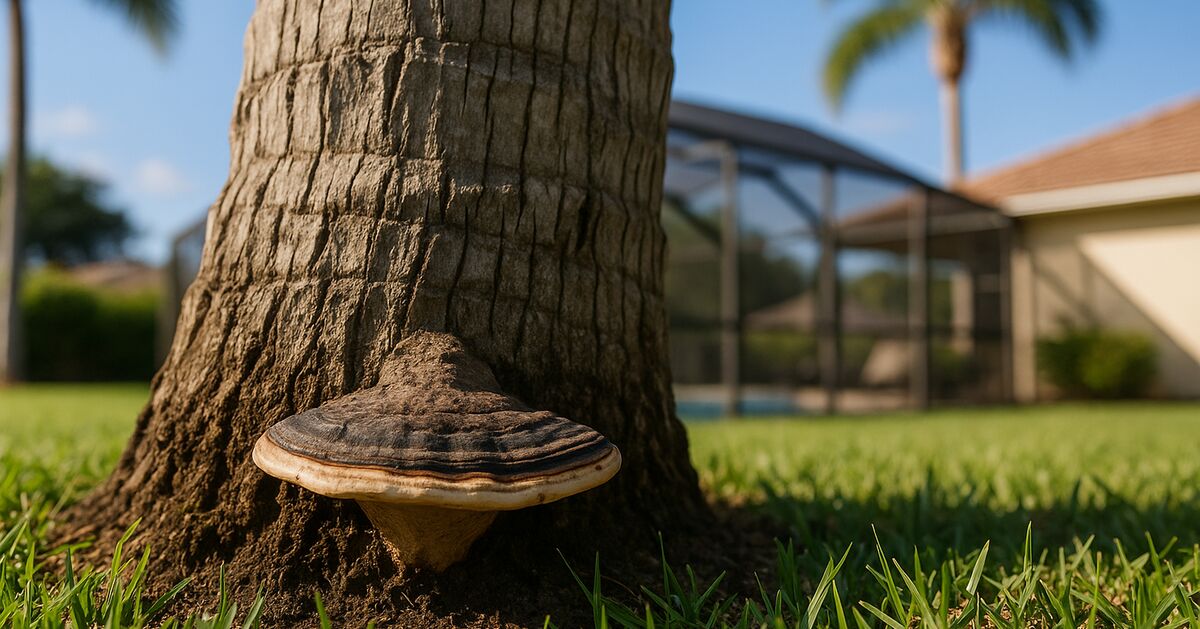
A palm tree can look perfectly healthy from the crown down and be completely hollow at the base. That is exactly what ganoderma butt rot does, and it is one of the most common reasons we remove palms across Sarasota, Venice, Port Charlotte, and the surrounding communities. By the time most homeowners notice something is wrong, the structural integrity of the trunk is already seriously compromised.
This post walks you through what ganoderma actually is, the signs you can spot yourself, why there is no treatment, and the steps you should take right now if you suspect your palm is infected.
What is ganoderma butt rot?
Ganoderma butt rot is caused by a fungal pathogen called Ganoderma zonatum. It is specific to palms (it does not infect oaks, pines, or other broadleaf trees) and it attacks the lower five feet of the trunk, which is why it is called "butt" rot. The fungus colonizes the wood tissue, consuming the structural fibers from the inside out. As it spreads, it replaces solid trunk material with soft, spongy, or powdery rot.
The infection enters through wounds at or near the base of the tree. Old pruning cuts, lawn mower strikes, weed trimmer scars, and even root damage from construction can all open the door. In Southwest Florida's warm, humid climate, the fungus thrives year-round, making our area particularly vulnerable compared to drier parts of the country.
Once the fungus is established, the palm's vascular system begins to fail. The palm may continue pushing out fronds at the crown for months or even a year or two after infection takes hold, because the growing point at the top (the terminal bud) can temporarily draw on stored nutrients. That lag between internal rot and visible crown decline is what makes this disease so dangerous.
The one sign you should never ignore: the conk
The most definitive sign of ganoderma butt rot is the appearance of a structure called a conk (sometimes called a "shelf" or "bracket fungus") growing directly out of the lower trunk or at the soil line of the palm. A ganoderma conk on a palm is hard and woody on top, with a white to cream-colored underside that is porous and releases a fine white powder when disturbed (that powder is millions of spores).
Conks are not always easy to spot at first. They often emerge behind overgrown groundcover, mulch piled too high against the trunk, or on the backside of the palm that faces a fence or wall. Make it a habit to actually walk around the full base of every palm on your property a few times a year.
A few things to know about the conk:
- Once a conk appears, the disease is well advanced. The fungus has been active inside the trunk long before the conk forms.
- A conk can be knocked off or removed, but that does not stop the disease. The fungus continues its work inside the wood.
- Conks release spores that spread to other palms nearby, so a diseased tree is a risk to the rest of your landscape.
- A conk on a palm is different from bracket fungi that occasionally appear on the roots or base of oaks and other trees. Ganoderma zonatum is specific to palms, so if your palm has a shelf fungus, ganoderma is the likely culprit.
Other signs to look for before the conk appears
Because the conk is a late-stage indicator, it helps to know what earlier signals look like. None of the following are definitive on their own, but when you see several of them together on the same palm, a closer inspection is warranted.
- Fronds that are smaller and paler than normal. As vascular function declines, the crown loses some of its vigor. New fronds may emerge shorter, lighter green, or with a yellowish tint.
- Fronds breaking or drooping from the lower canopy. Older fronds dying is normal, but if live fronds are breaking at the base and hanging down along the trunk, something is affecting the tree's internal structure.
- Soft or spongy trunk tissue at the base. Press firmly on the bark near the soil line. Healthy palm trunk tissue is dense and very firm. If it gives even slightly under moderate pressure, that is a warning sign.
- A lean that was not there before. A palm developing a new lean - especially toward a structure - deserves immediate attention. Ganoderma-rotted trunks lose the ability to support the weight of the canopy, and a lean is often the prelude to a fall.
- Discoloration or weeping at the base. Some infected palms show dark staining, oozing, or a slightly sunken appearance on the bark near ground level.
If you see any of these signs, do not wait for the conk to confirm your suspicion. Get a professional assessment.
Why there is no treatment
This point is worth saying plainly: there is no fungicide, injection, or organic treatment that cures ganoderma butt rot. None. The pathogen lives deep inside the wood tissue, and no product can reach it effectively enough to reverse the decay. Claims to the contrary are not supported by university research or extension science.
The University of Florida's Institute of Food and Agricultural Sciences (UF/IFAS) has studied this disease extensively and the consistent finding is that once a palm is infected, removal is the only appropriate response. The question is not whether to remove it, but when - and that timing matters a great deal depending on how close the palm is to your home, a pool cage, a driveway, a fence, or a public area where people walk.
If you are weighing removal options for a palm that may be infected, our post on dead or dying palm trees: remove it or treat it first? covers the broader decision-making framework in helpful detail.
How fast does the disease progress?
The honest answer is: it varies, and that variability is part of what makes ganoderma so treacherous. Some palms deteriorate rapidly over a few months after the first conk appears. Others remain standing (though hollowing internally) for a year or more. The species of palm matters, as does the size and location of the infection within the trunk, the overall health of the tree, and recent weather patterns.
What we see consistently in the field across communities like Osprey, Nokomis, and Englewood is that palms showing conks at or very close to the soil line tend to fail faster than those where the conk appears higher on the trunk. A conk right at ground level means the rot is concentrated at the point where the entire tree pivots, which is the worst structural position possible.
Do not let the palm's full, green crown lull you into thinking you have plenty of time. That crown can look normal right up until the base gives way.
The falling hazard: what actually happens
When a ganoderma-rotted palm fails, it does not usually topple slowly like a pine or oak being pushed by wind. The fibrous vascular bundles inside the trunk essentially lose cohesion, and the trunk snaps or buckles near the base under load, often with very little warning. Wind accelerates this dramatically. A tropical storm or even a moderate afternoon thunderstorm with gusty winds can take down a compromised palm that has been standing quietly for months.
In our service area, palms are frequently planted along pool cages, lanai rooflines, driveways, and property boundaries. A falling palm in any of these locations causes serious property damage and can injure or kill anyone nearby. If you have a palm showing signs of ganoderma within striking distance of your home or any area where people spend time, treat it as urgent. Our tree and land care services include hazard assessments precisely for situations like this.
What to do if you suspect ganoderma
Step one: stop mowing and trimming near the base. Mechanical wounds at the base are how the fungus enters in the first place. If the tree is already infected, additional wounds only create more entry points for spores to spread to neighboring palms.
Step two: do not pile mulch against the trunk. "Volcano mulching" (where mulch is heaped against the base of a tree) traps moisture and promotes fungal growth. Keep mulch pulled back several inches from the base of all your palms, healthy or otherwise.
Step three: do not remove the conk yourself and consider the job done. As noted above, removal of the conk does nothing to stop the internal disease, but it does release a cloud of spores. If you do knock one off, bag it and dispose of it in the trash immediately.
Step four: call a qualified tree care professional or tree service to assess the tree. A professional can probe the base of the trunk, evaluate the extent of the decay, and give you an honest recommendation about timing. If the tree is near a structure or in a high-traffic area, do not delay this call.
Step five: plan for removal of the stump. The Ganoderma zonatum fungus can survive in a palm stump and continue producing spores that infect nearby palms for years. When a ganoderma-infected palm is removed, the stump should be ground out as deeply as possible, not just cut flush with the ground. This matters especially if you plan to plant another palm in or near the same spot.
Step six: think carefully before replanting a palm in the same location. Residual fungal material in the soil can infect a new palm, particularly if stump grinding was incomplete. Most tree care professionals recommend waiting a significant period and using a different plant species in that location, or ensuring the ground is prepared properly before a new palm goes in. Our post on what happens to your yard after a tree is removed covers replanting considerations in more depth.
Can you prevent ganoderma?
Completely preventing it is not realistic in Florida's environment, but you can meaningfully reduce your risk.
- Protect the base of your palms from mechanical damage. Create a mulched ring around each palm before mowing season so the mower stays away from the trunk. Weed trimmers are especially damaging because operators often do not realize they are wounding the bark.
- Avoid unnecessary pruning cuts at the base. Some homeowners and landscapers remove the old "boots" (the fibrous bases of old fronds) all the way down the trunk for aesthetics. Every cut is a potential entry point.
- Do not over-fertilize with nitrogen. Rapid, lush growth can make palm tissue more susceptible to fungal infection.
- Remove infected trees promptly. The longer a diseased palm stands, the more spores it produces and spreads to the palms around it.
Healthy, well-maintained palms are somewhat more resistant, though no palm is immune. Regular inspection is the best early-warning system you have.
Ganoderma across our service area
We see ganoderma butt rot across the full range of communities we serve. Sabal palms (the Florida state tree) and queen palms are among the most commonly infected species in residential landscapes from Sarasota down through Venice and North Port, as well as in coastal communities like Siesta Key, Casey Key, and Manasota Beach where palms are planted in high numbers near homes, roads, and public spaces.
The disease does not discriminate by neighborhood or palm age. We have assessed infected palms that were planted fewer than five years ago and others that have stood for decades. If your property has multiple palms, a rotating inspection schedule once or twice a year is a reasonable habit, especially heading into and out of hurricane season when wind loads on compromised trees are highest.
If you are not sure what you are looking at on your palm, or you have spotted something that concerns you, our team is happy to take a look. You can find more information about the communities we serve on our service locations page, or reach out directly through our contact page to schedule an assessment.
Do not wait for the lean to start. With ganoderma, the time to act is when you first see the signs, not after the tree has made the decision for you.
Got a tree that worries you?
Free, no-pressure on-site estimate across Sarasota & Charlotte Counties.