
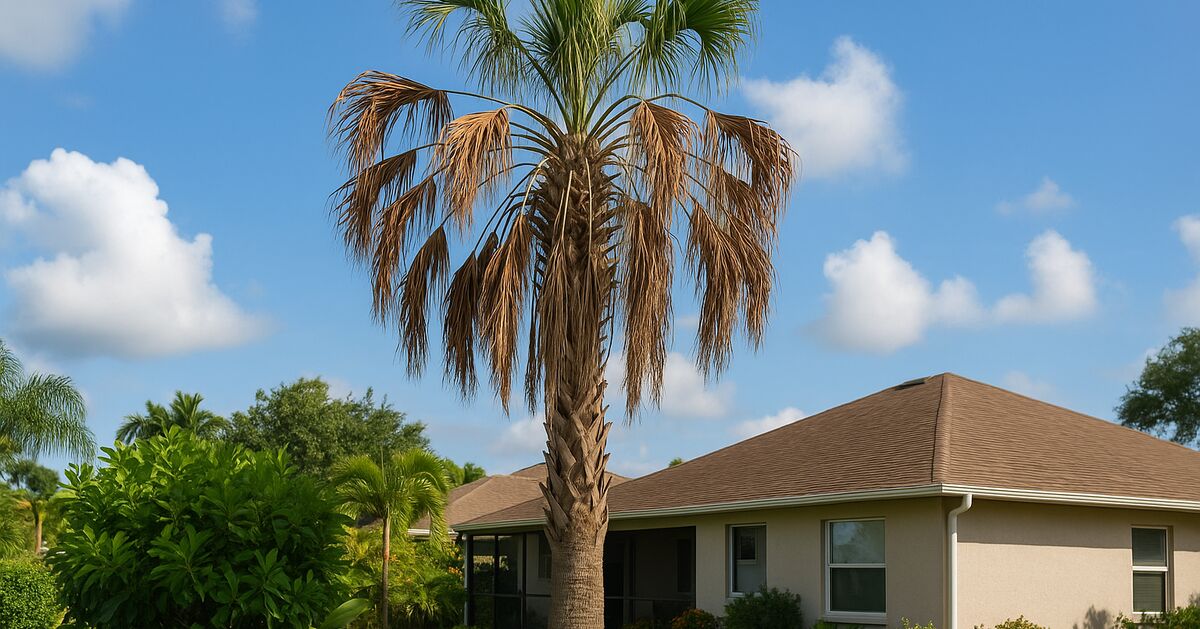
Your palm looked fine three months ago, and now the fronds are brown, the trunk looks soft in one spot, and the whole thing is leaning a little. Before you call anyone, you want to know: is this salvageable, or does it need to come down?
That is exactly the right question to ask, and the honest answer is that it depends on a handful of specific things you can actually check yourself. Palm trees fail in ways that are not always obvious from the outside, and Southwest Florida's combination of sandy soil, salt air, intense summer heat, and hurricane-force winds creates conditions that stress palms in ways that don't show up in a lot of general gardening advice. This guide will walk you through what to look for, what it means, and when to stop waiting and make a decision.
Why palms die differently than other trees
Most shade trees, think live oaks or slash pines, have multiple growing points. Damage in one area doesn't necessarily kill the whole tree. Palms are monocots, which means they have a single growing point called the meristem, located at the very top of the trunk right where the fronds emerge. People sometimes call this the "heart" or the "bud" of the palm.
If that meristem is healthy, the palm can recover from a surprising amount of stress. If that meristem is dead or severely infected, the palm is going to die, and no amount of fertilizer, trimming, or treatment will change that. This is the single most important thing to understand when you are standing in your yard trying to decide what to do.
Signs the palm is stressed but probably treatable
Not every brown frond is a death sentence. Here are situations where treatment is often worth trying:
Frond discoloration that starts on the older, lower fronds first. If the yellowing or browning is moving from the bottom of the canopy upward, that is frequently a nutritional deficiency, most often a lack of potassium or magnesium. Both are common in Southwest Florida's sandy, fast-draining soils, particularly in North Port, Rotonda West, and other areas with newer construction where topsoil is thin. A proper slow-release palm fertilizer (look for an 8-2-12 with micronutrients) applied a few times a year can reverse this pattern over the course of a growing season.
Frizzle top or narrow, stunted new growth. This specific symptom, where new fronds emerge very small and crinkled, is a classic sign of manganese deficiency. It looks alarming but it responds well to manganese sulfate applications if caught before the meristem is compromised.
Recent transplant stress. A palm that was recently installed or moved will often drop a significant portion of its canopy before stabilizing. If the trunk feels firm everywhere and the very newest spear (the tightly rolled frond at the center of the canopy) is still green, the tree is likely still alive and adjusting.
Drought stress in dry season. January through May in Sarasota and Charlotte counties can be very dry, and palms in sandy soil with no irrigation can go into serious stress. If the timing lines up with an unusually dry stretch and the trunk is still solid, hydration and fertilization often bring them back.
Signs the palm is dying and needs to come down
These are the situations where treatment is unlikely to help and where waiting only increases the risk to your property:
The new spear is brown, dead, or pulls out easily. This is the most reliable field test. Pull gently on the tightly furled center spear at the top of the canopy. If it pulls out without resistance, or if it is already brown and limp, the meristem is very likely dead or fatally infected. Once that growing point is gone, the palm cannot regenerate. It will continue to stand for months, sometimes more than a year, but it is dying and will eventually fall.
The trunk is soft, hollow, or visibly rotting. A healthy palm trunk should feel firm and dense throughout. If you press on it and find soft or spongy spots, especially in the upper half of the trunk, that is internal rot, often caused by fungal infection or beetle damage. Soft spots in the lower trunk can indicate root rot. Either way, the structural integrity of the tree is compromised. A palm that looks upright today can fail in the next thunderstorm. Given how frequently strong afternoon storms roll through areas like Siesta Key, Casey Key, and Manasota Beach between June and October, that is a serious concern.
Lethal Bronzing disease (formerly called Texas Phoenix Palm Decline). This bacterial disease, spread by a planthopper insect, has moved steadily through Florida and is now well-established in Sarasota and Charlotte counties. The progression is specific: first the fruit (if present) drops early and turns dark, then the oldest fronds yellow and brown from the tips inward, then the discoloration moves up the canopy rapidly, and finally the spear dies. The whole process from first symptoms to total canopy collapse can take as little as three to five months. If caught very early, trunk injections of oxytetracycline can slow or halt progression, but a palm that is more than halfway through this symptom sequence is not going to recover. If your neighbors have lost palms to this disease, yours is at elevated risk.
Ganoderma butt rot. If you see a shelf-like fungal growth (called a conk) at the base of the trunk, this is Ganoderma zonatum, a fungus that causes internal decay in the lower trunk and root system. There is no treatment for Ganoderma. The palm needs to come out, and the stump should be ground out thoroughly because the fungus can persist in the soil and spread to adjacent palms.
Severe lean that developed quickly. A palm that has developed a significant lean in a short period of time, especially after heavy rain, is signaling root failure. Southwest Florida's shallow, sandy soils give palm root systems limited purchase, and once roots are compromised by disease, drought, or saturated soil, the tree can shift or fall with very little warning. Our post on what to do when a tree is leaning toward your house covers the immediate steps worth taking regardless of species.
Bark beetles and borer damage. Look for small round or D-shaped exit holes in the trunk, sawdust-like frass at the base, or weeping, discolored sap. Beetle infestations in a palm that is already stressed are typically a sign that the tree is in serious decline. Beetles generally target palms that are already weakened, so their presence confirms a pre-existing problem.
The species matters too
Not all palms are equally valuable or equally risky to leave in place. Sabal palms (the Florida state tree, common throughout Sarasota, Venice, Englewood, and Port Charlotte) are remarkably tough and can look terrible and still recover if the meristem is intact. They are also worth saving where possible, both for ecological reasons and because mature natives are hard to replace.
Queen palms are popular in landscaping but they are not native and are more susceptible to Lethal Bronzing and nutritional deficiencies. They are also structurally weaker in high winds. A declining Queen palm is generally not worth the investment of aggressive treatment.
Canary Island date palms are expensive to purchase and plant, so treatment is often worth attempting early. But they are also highly susceptible to Fusarium wilt, a fungal disease that enters through wounds made by contaminated pruning tools. If your Canary Island date is declining and a neighbor's has recently been diagnosed with Fusarium, that is important context for your tree specialist.
Before you call anyone, do this quick check
Walk up to the palm and do the following:
- Press the trunk firmly from the base up to about two-thirds of the height. Note any soft spots.
- Look at the canopy from below. Is the browning on the outer, older fronds (potentially nutritional) or on the youngest growth at the center (more serious)?
- Try to gently tug the center spear. If it moves at all, stop and call a professional.
- Check the base of the trunk for fungal conks, beetle holes, or soft, discolored bark.
- Look at the neighboring palms and ask neighbors if they've lost palms recently.
If you're not sure what you're seeing, that is a reasonable place to be. The combination of diseases that affect palms in this area, particularly Lethal Bronzing, is not always easy to distinguish from nutritional problems without a trained eye. An experienced tree specialist can often tell you within minutes whether the tree is worth saving. The services we provide include exactly this kind of assessment before any removal decision is made.
What removal actually involves for a palm
If the palm does need to come down, the process is somewhat different from removing a large oak or pine. Palm trunks are not as rigid as hardwood trunks, which changes how they are cut and lowered. The fibrous root system is generally shallower and more spread out, which can matter if the palm is close to a pool, irrigation lines, or a fence (a common situation in tight lots in Sarasota and Venice neighborhoods).
If the palm is in a location where it can fall freely, removal is often straightforward. If it's near a screen enclosure, power line, or pool cage, the work requires more planning and rigging. For a closer look at how root systems interact with surrounding infrastructure, our post on how tree root systems affect your foundation, pipes, and driveway gives useful context even though it focuses on other tree types.
After the palm is down, you will have a stump and a root ball to deal with. Stump grinding is usually the cleanest option, particularly if you want to replant in the same spot. If Ganoderma was involved, grinding and removing as much of the root material as possible is especially important.
What to plant if the palm can't be saved
If you're losing a palm to Lethal Bronzing, be thoughtful about what goes back in that spot. The disease pathogen persists in the landscape (spread by insects, not soil), so another susceptible palm in the same spot faces similar risk. Some palms are naturally resistant to Lethal Bronzing, including the Sabal palm, the Bismarck palm, and the paurotis (Acoelorrhaphe wrightii). A local nursery with Florida-specific expertise can help you choose something appropriate for your specific spot and soil.
For a broader look at what happens to the yard once a tree comes out, our post on what happens to your yard after a tree is removed walks through the replanting and grading process in more detail.
When to stop waiting and make the call
The main mistake homeowners make is waiting too long because they're hopeful. A palm that is truly dying does not get better with time, it just becomes taller, drier, and more dangerous. A dead palm trunk can become brittle and unpredictable faster than people expect, particularly in the intense heat of a North Port or Englewood summer. If a storm rolls through before you've acted, a dead palm near a structure is a serious liability.
If you've done the checks above and still aren't sure, get a professional assessment. Our frequently asked questions page covers a lot of common concerns about the process, and you can always reach out directly if you'd like someone to take a look.
Our team works throughout the area, from Sarasota and Venice to North Port, Englewood, and out to Siesta Key and Casey Key. If a palm on your property is giving you concern, don't wait until the next storm makes the decision for you.
Got a tree that worries you?
Free, no-pressure on-site estimate across Sarasota & Charlotte Counties.