
Dead roots don't always mean harmless roots. Long after a tree is cut down and the stump is ground away, the root system left behind keeps interacting with your soil, your concrete, and your plumbing in ways that can cost you real money if you're not paying attention.
This matters a lot here on Florida's Gulf Coast. The sandy, moisture-variable soils we have in Sarasota, North Port, Venice, and across Sarasota and Charlotte counties mean that root decay and soil shifting happen at a different pace than they might in denser clay-soil regions up north. Understanding what's actually going on underground helps you decide whether you can wait, watch, or need to act right now.
What tree roots are actually doing underground
A mature tree doesn't just have roots directly under its canopy. In most species common to our area, the root zone can extend two to three times the width of the canopy. A large live oak shading your backyard may have roots running well under your driveway, alongside your water main, and within a few feet of your home's slab or footer.
Roots grow toward two things: water and oxygen. That means they follow irrigation lines, seek out the moisture gradient around buried pipes, and grow preferentially in the loose backfill soil that was disturbed when your home was built or your driveway was poured. These are the same places where roots cause damage.
The three main categories of concern are:
- Foundation and slab movement from root-driven soil moisture changes
- Pipe intrusion and root clogging in sewer, drain, and irrigation lines
- Concrete heaving and cracking in driveways, sidewalks, and patios
Each of these works differently, and each has a different timeline and urgency.
How roots affect your foundation - even after removal
This one surprises a lot of homeowners. You might assume that once a tree is removed, the foundation risk goes away. Sometimes it gets worse before it gets better.
Here's why. Large roots near a slab or footer aren't necessarily cracking that foundation directly. What they're doing is managing the moisture in the surrounding soil. A big live oak or slash pine with an extensive root system is constantly drawing water out of the ground, keeping the soil drier in its immediate vicinity. When that tree is removed, it stops pulling moisture. The soil can gradually rehydrate and expand, which puts new pressure on the slab from a different direction.
In Florida, this is especially relevant for homes on expansive soils or homes built in areas where the fill material varies. Parts of North Port, Rotonda West, and some older neighborhoods in Port Charlotte have a patchwork of soil types where this effect is more pronounced. If you've removed a very large tree within about 15 feet of your home's foundation, it's worth watching for new cracks in interior tile, sticking doors, or gaps forming between walls and ceilings in the months that follow.
The other scenario, where roots are actively lifting or pressing against a footer, is less common with most Florida species but does happen with aggressive-rooting trees like Ficus, some eucalyptus varieties, and Chinese tallow trees. These species can grow roots thick enough and forceful enough to physically displace concrete and masonry.
What to do: After removing a large tree close to your home, do a slow walk through your interior every few months for the first year. Look at your tile grout lines, look at the corners of rooms where walls meet the ceiling, and check exterior stucco for new hairline cracks. A crack that's growing or a door that's binding more than it used to are signals to bring in a foundation inspector. If the tree had already been removed and you're seeing symptoms now, the timeline from removal is a useful data point for any contractor you consult.
Roots and your underground pipes: the slow invasion
This is probably the most common real-world damage that homeowners deal with, and it builds so slowly that many people don't connect the cause to the symptom until they're looking at a plumber's camera footage.
Root intrusion into pipes happens in two main ways. The first is through existing cracks or loose joints in older clay or cast-iron drain lines. Roots sense the moisture and nutrients in the pipe, and even a hairline crack lets them in. Once inside, they grow into a dense web that catches toilet paper, grease, and debris, eventually causing a blockage or full backup.
The second way is more subtle: roots growing alongside a buried irrigation or supply line can, over years, exert enough pressure at a coupling or fitting to work it loose.
In neighborhoods like Siesta Key, Casey Key, and Manasota Beach, where homes are older and original sewer laterals may still be clay tile, this is a legitimate ongoing concern. In newer developments in Venice or the newer sections of North Port, PVC pipes are more resistant to root intrusion, but not immune, particularly at joints.
Here's the part that surprises people: removing the tree doesn't stop root intrusion that's already underway. The roots in the pipe are still there. They're no longer actively growing, but they're still blocking the line. And as those roots die and decay over the following one to three years, they can collapse in ways that shift the surrounding soil and affect pipe alignment.
What to do: If you've recently removed a large tree that was within 20 feet of a sewer lateral, a drain line, or an irrigation trunk line, a camera inspection is inexpensive insurance. It typically runs in the range of a few hundred dollars through most plumbing companies, and it tells you definitively whether there's anything in there. If you're experiencing slow drains, gurgling toilets, or soft wet spots in your yard that can't be explained by irrigation, don't wait to get it checked.
Driveways, sidewalks, and patios: the most visible damage
Lifted and cracked concrete is the damage homeowners see most often, and it's also the most misunderstood in terms of what happens after removal.
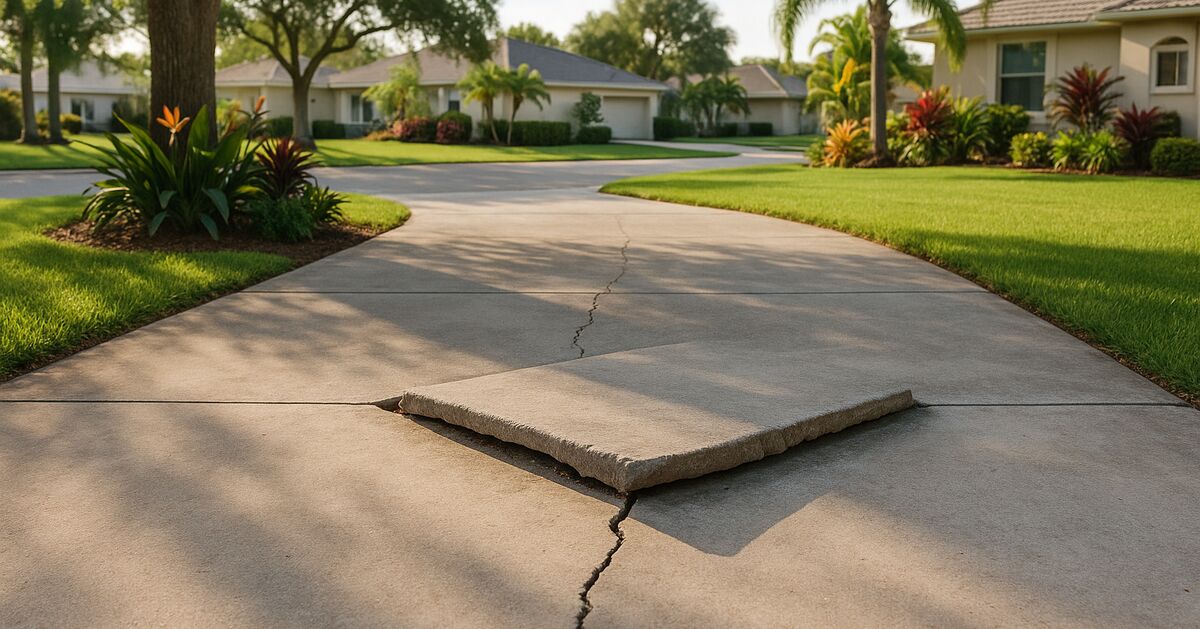
When a root is actively growing under a concrete slab, it creates an upward force that cracks and lifts the surface. You've seen this on any older sidewalk in Florida: a panel popped up an inch on one side, or a long diagonal crack running from the edge toward the middle. That was a root.
Once the tree is removed, that root stops growing. But the void it created does not disappear on its own. As the root decays over the following two to five years (faster in warm, moist conditions like those we have in Sarasota and North Port), it leaves behind a tunnel or channel in the soil. That void can cause the concrete to settle unevenly or, if water pools in it during our heavy summer rain season, to shift further.
The practical implication is that you should not assume a lifted section of driveway or patio will settle back down flat once the tree is gone. It almost never does that. What you're more likely to see is it lifting a little more at first (if some root growth was still occurring near removal time), then slowly cracking further as the void underneath loses support.
What to do: After a tree removal near hardscape, give it one full rainy season before you decide whether to repair or replace the affected sections. That gives the soil time to show you where the voids are. Before any concrete repairs, a good contractor will probe or excavate to make sure the substrate is solid. Patching concrete over a rotting root void is a short-term fix that tends to fail within a year or two.
For driveways specifically, if the root damage covers more than about a third of a panel and the surrounding soil is compromised, full panel replacement is usually more economical over a ten-year horizon than repeated patching.
When does a stump grinding job affect all of this?
You may be wondering whether grinding the stump changes any of this. It does, but only partially. Stump grinding removes the stump to a few inches below grade. It does not remove the lateral roots, which can extend many feet in every direction. The ground-up wood chips left in the stump hole are also a temporary void as they decompose and compact over time.
For most standard residential removals, stump grinding is the right call for practical and aesthetic reasons. But if you have a large tree within ten to fifteen feet of a foundation, a pipe trench, or a significant section of hardscape, it's worth talking to your tree service about what they're seeing in terms of root direction and depth before they leave the job. A good crew can give you useful information about which way the main lateral roots were running.
You can read more about what the full removal and stump process looks like in our post on what happens to your yard after a tree is removed.
Timelines: how long do you actually have?
People often ask whether this is an urgent problem or a slow-moving one. The honest answer is: it depends on tree species, root size, and what's nearby. Here's a general framework.
- Foundation moisture changes: Most significant in the first 6 to 18 months after a large tree is removed. Watch closely during this window.
- Pipe intrusion: If it was already happening before removal, it's still happening. Have it inspected within 30 days of removal for trees near lines.
- Hardscape voids: The concrete may not show visible changes for 1 to 3 years. The worst settling often happens after a heavy rain season opens up and accelerates the decay.
- Root decay overall: In Southwest Florida's warm, wet climate, most smaller roots are substantially decomposed within 2 to 4 years. Large tap roots or main laterals from big hardwood trees can take 5 to 10 years.
This timeline matters because it tells you when to watch versus when to act. You don't always need to excavate immediately. But you do need to know the clock is running.
Local species worth special attention
A few trees common in our area deserve a note because their root behaviors are more aggressive or leave larger voids than average.
Live oaks are the most common large canopy tree on the Gulf Coast, and they have dense, wide-spreading root systems. They rarely intrude into pipes the way some other species do, but they can have a significant effect on the moisture balance near foundations. In areas like inland Englewood and the rural parts of Charlotte County where live oaks often grow large and close to structures, be patient and observant after removal.
Ficus species (laurel fig, weeping fig): These are not native but are found in older landscaping throughout Sarasota, Venice, and coastal communities. They are aggressive pipe invaders and can do more direct physical damage to foundations and hardscape than most other species. If you've removed one of these, a pipe inspection is not optional in our view.
Slash pines have a deep tap root plus wide lateral roots. After removal, the tap root void can cause localized settling. Usually not a structural threat, but worth noting for driveways and patios.
If you're dealing with a tree that's already leaning toward your home, our post on what to do when a tree is leaning toward your house walks through the decision-making process before you even get to the root question.
How to find the right help
Root and foundation issues sit at the intersection of several trades: tree services, plumbers, foundation contractors, and concrete contractors. The tree service's job ends at the stump. From there, you may need other professionals depending on what you find.
A good starting point is knowing what was removed, where it was positioned relative to your infrastructure, and what species it was. If you're not sure what to do next or you have a tree that hasn't been removed yet but you're worried about what its roots are already doing, getting an assessment from a qualified local tree crew is step one.
Our tree removal and storm cleanup services include on-site assessments that can help you understand what you're dealing with before removal so you're not caught off guard afterward.
If you're not sure whether a company you're considering is the right fit, our guide on how to choose a legitimate tree removal company in Sarasota and Charlotte County lays out what to look for.
We serve homeowners throughout the region, including Sarasota, Siesta Key, Osprey, Nokomis, Laurel, Venice, Englewood, North Port, Port Charlotte, and out to the island communities of Casey Key and Manasota Beach. You can see the full list on our service areas page.
If you have a specific situation you're unsure about, the simplest move is to get in touch for a free on-site assessment. Root issues that are caught early are almost always cheaper to manage than the ones that reveal themselves through a flooded bathroom or a cracked slab.
Got a tree that worries you?
Free, no-pressure on-site estimate across Sarasota & Charlotte Counties.