
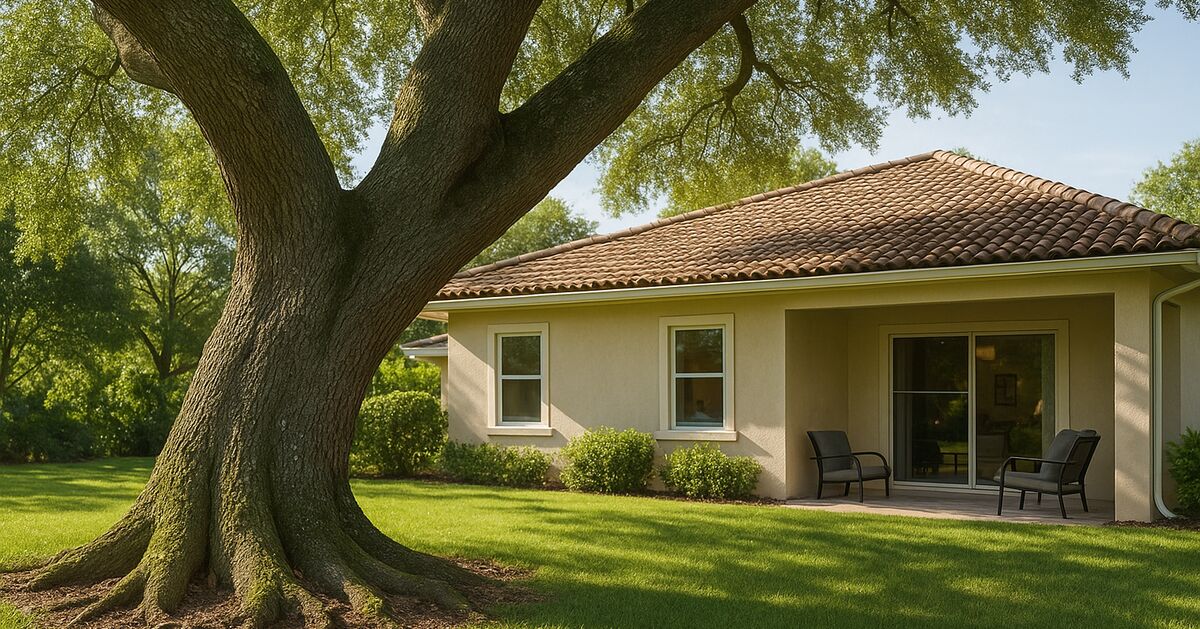
A tree that leans toward your house is one of the most unsettling things a homeowner can discover, and one of the most misread. Some leaning trees have stood that way for decades with zero risk of falling. Others are hours away from coming through your roof. The hard part is knowing which one you're dealing with, and that's exactly what this post walks you through.
First, understand what "lean" actually means
Not every lean is alarming. Many trees develop a natural lean over years as they grow toward sunlight, especially in Florida where fast-growing species like laurel oaks and slash pines compete in dense canopies. A tree that has leaned gradually and steadily, with bark, roots, and soil all looking normal, is a very different situation from a tree that seems to have shifted position recently.
The single most important question you can ask yourself is: did this lean develop slowly over years, or does it look different than it did a few months ago?
A sudden or accelerating lean is always a red flag. It suggests something structural has changed, whether that's root failure, internal decay, or soil movement beneath the root zone. These are the situations that can escalate without much warning.
Walk around the tree before you call anyone
You don't need specialized training to do a basic visual assessment. Just take a slow walk around the tree and look for these things:
At the base of the trunk:
- Soil heaving or cracking on the side opposite the lean (this means roots are pulling out of the ground)
- A gap between the root flare and the soil
- Fungal growth like mushrooms or conks (shelf-shaped brackets) growing from the trunk or roots
- Bark that looks sunken, discolored, or crumbling
- Sawdust or frass (tiny pellets) that might indicate wood-boring insect activity
On the trunk itself:
- Large cracks or splits running vertically along the trunk
- Sections of bark that are loose or missing
- Visible cavities or hollow sections, even small ones near the base
- A trunk that looks "bent" rather than gradually curved, which can mean wind stress is being absorbed unevenly
In the canopy:
- Dead branches concentrated on one side, especially the side facing the house
- Sparse or yellowing leaves on a tree that should be fully leafed out
- Hanging broken branches (called "widow makers") caught in the crown
At ground level around the root zone:
- Soil that has been disturbed by construction, grading, or trenching within the last few years
- Paved surfaces, driveways, or compacted areas pressing up close to the trunk
- Signs of recent flooding or standing water, which saturates the soil and weakens root grip
If you find several of these warning signs together, especially heaving soil plus fungal growth plus a recent change in lean angle, treat this as urgent and stop waiting to see what happens.
The four questions that determine urgency
Once you've done your walk-around, run through these four questions. Your answers will tell you whether you're dealing with a call-today situation or a schedule-it-out situation.
1. Has the lean changed recently? If neighbors, family members, or your own memory confirm the tree looks different than it did a month ago, that's a red flag. A tree actively shifting position is an unstable tree.
2. Is the soil visibly moving? Heaving soil on the tension side of a leaning tree means the root system is losing its grip. In the sandy, loose soils common throughout Sarasota and Charlotte counties (especially in areas like North Port, Rotonda West, and parts of Sarasota's older neighborhoods), roots don't always have the anchoring depth you'd find in denser clay soils. This makes the heaving-soil sign even more significant here than it might be elsewhere.
3. Is the tree leaning over occupied or high-value space? A 60-foot oak leaning 15 degrees toward a detached storage shed is a different calculation from the same tree leaning toward a bedroom where your kids sleep. Factor in what's actually in the fall zone. Think about where the tree's crown would land if it came down. That's not just the space directly beneath it but a wide arc based on the height of the tree.
4. Is there a storm in the forecast? Southwest Florida's weather patterns, particularly from June through November, can turn a marginally stable leaning tree into a full collapse in hours. If a tropical system, even a tropical depression or strong afternoon thunderstorm, is in the forecast, urgency moves up significantly. Wind and saturated soil are the two biggest contributors to unexpected tree failure, and Florida delivers both regularly.
If you answered yes to two or more of those questions, call a professional today, not next week.
When to treat it as a true emergency
Some situations call for same-day or next-morning service. You shouldn't wait for a scheduled appointment if:
- The tree is actively moving or you can hear cracking sounds
- The root ball is visibly lifting from the ground
- The tree has already made contact with your roof, walls, or power lines
- A storm is expected within 24 to 48 hours
- There's an existing crack or split at the base that is opening wider
Our emergency tree removal and storm cleanup services are designed for exactly these situations. An experienced tree specialist can look at a tree in person and give you a far more confident read on the timeline than any checklist can.
For guidance on what to do in the immediate aftermath of a storm event, our post on emergency tree removal after a Florida storm covers the first steps in detail.
When you can reasonably schedule it out
Not every leaning tree is a crisis. You may have time to plan if:
- The lean has been stable and unchanged for several years
- There are no visible signs of root failure, decay, or fungal activity
- The tree is leaning away from structures, power lines, and areas where people spend time
- You've had the tree assessed by a professional who confirmed it's currently stable
- There's no significant weather expected in the near term
"Scheduling it out" doesn't mean ignoring it. It means booking a removal within the next few weeks and monitoring the tree closely in the meantime. During that waiting period, keep people and vehicles out of the fall zone, and check the base of the tree after any heavy rain or wind event.
Even a tree that seems stable today can change quickly. Sandy coastal soils, Florida's frequent and heavy rain events, and root systems that may already be compromised by disease or construction damage can combine to produce sudden failures. The communities along Siesta Key and Casey Key see this especially during summer storm season when coastal weather conditions can shift a marginally stable situation into a dangerous one overnight.
What a professional assessment actually looks at
When an experienced tree removal crew assesses a leaning tree, they're looking at several things that aren't visible from the ground. A trained eye looks at the lean angle relative to the tree's height and crown spread. They're checking the root flare for signs of girdling roots or basal decay. They're tapping on the trunk to listen for hollow sections. They're reading the tree's stress response in the foliage.
One thing worth knowing: there is no universal safe lean angle. A 20-degree lean in a healthy 30-foot tree with a deep, intact root system is very different from a 10-degree lean in a 70-foot tree with visible root damage. Anyone who gives you a firm number without looking at the whole tree in context is oversimplifying.
This is also why it pays to choose a legitimate, experienced tree removal company rather than whoever is cheapest. A qualified crew will give you a real assessment, not just a quick quote.
What about trimming instead of removing?
Sometimes, reducing the weight and wind resistance in the crown of a leaning tree can meaningfully extend its safe life. This is a judgment call that depends on the underlying cause of the lean. If the tree is leaning because of root failure or internal decay, trimming the crown doesn't fix the root problem and can give a false sense of security. If the lean is caused by canopy imbalance and the root system is healthy, targeted crown reduction may be a legitimate option.
Ask the crew specifically: is this lean structural or is it a crown balance issue? Their answer will tell you a lot about their level of expertise and about the actual risk in front of you.
Don't wait for a crisis to become a catastrophe
Homeowners in the Sarasota, Venice, Englewood, and Port Charlotte areas sometimes put off dealing with a leaning tree because it hasn't fallen yet and daily life feels normal. That logic makes sense right up until it doesn't. Tree failures don't send a final warning. The difference between a tree you had removed on a Tuesday morning and one that came through your roof during a Thursday night storm is often just a few days of delayed decision-making.
If you're asking yourself "should I be worried about this tree?", that question itself is a signal worth acting on. Have someone look at it. A professional assessment takes less than an hour and gives you real information to make a confident decision, either to remove it promptly or to stop losing sleep about it.
You can review our full list of services or reach out to us directly to schedule an assessment. We serve homeowners across Sarasota and Charlotte counties, from North Port to Venice to Nokomis and everywhere in between. See our full service area for details.
And if a storm has already brought a tree down, or if a neighbor's tree is the one causing concern, our FAQ page has answers to the questions homeowners ask most often in those situations.
A leaning tree is a problem that rewards quick thinking and a calm, informed approach. You don't need to panic, but you do need to pay attention. The assessment you do this week, and the call you make today if the signs are there, is what keeps a manageable situation from turning into an emergency.
Got a tree that worries you?
Free, no-pressure on-site estimate across Sarasota & Charlotte Counties.