
Emergency Tree Removal After a Florida Storm: What to Do First
July 10, 2026 · Eagle Eye Tree & Land Services
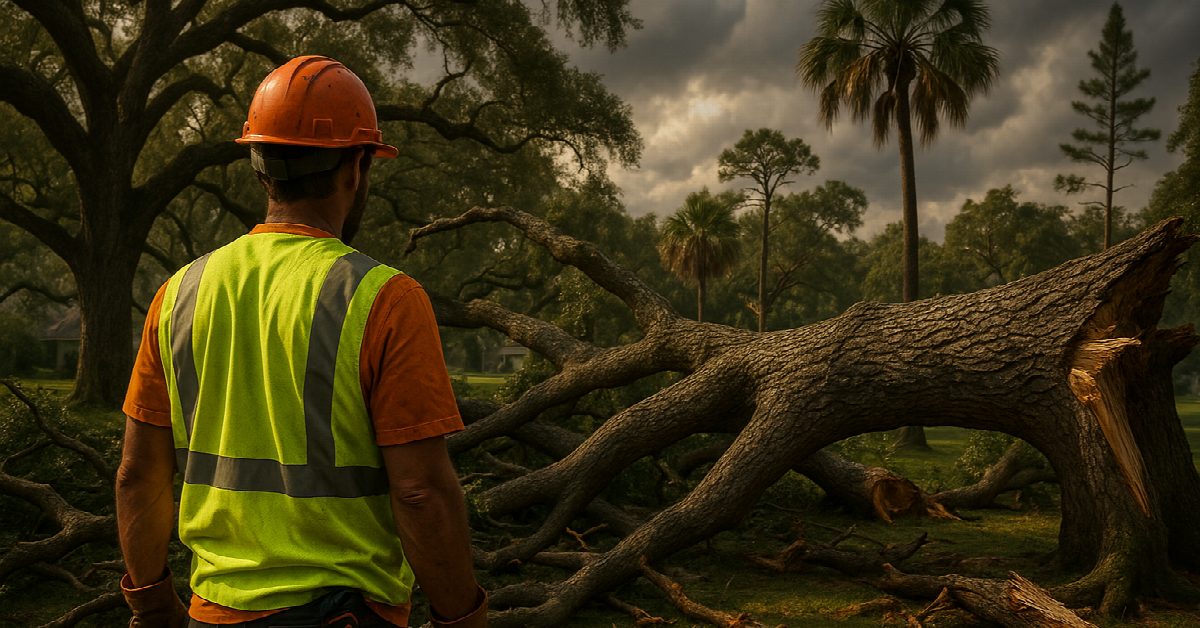
A tree is down in your yard, it's still raining sideways, and your neighbor just knocked on the door to say a branch the size of a car is resting on your roof. Take a breath. The next thirty minutes matter a lot - but panicking and rushing outside is how people get hurt.
Florida storms are in a class of their own. A fast-moving squall off Sarasota Bay can drop a 60-foot live oak in minutes, and hurricane-force winds along the coast from Siesta Key to Englewood can topple trees that looked perfectly healthy the day before. Knowing what to do - and what NOT to do - in those first hours after a storm is the difference between a manageable cleanup and a dangerous, expensive mess.
Step 1: Stay inside until the storm has truly passed
This sounds obvious, but every season homeowners walk out during a brief lull only to get caught when the back side of a storm rolls through. Check a reliable weather app or the National Weather Service before you open your back door. If there is still a Tornado Watch or Severe Thunderstorm Warning in effect for Sarasota or Charlotte County, stay put.
Once it is genuinely clear, do a visual scan from inside first. Look through windows for:
- Downed power lines anywhere near the tree
- Trees that fell against the house, fence, or another structure
- Trees that are leaning but have not fully fallen (these are the most dangerous)
- Limbs hanging overhead, sometimes called "widow makers"
Step 2: Treat downed power lines as live wires - always
This cannot be overstated. A line lying in the grass may look dead and still carry a lethal charge. If a fallen tree has brought a line down with it - which happens regularly in North Port, Venice, and the low-lying neighborhoods of Port Charlotte after major storms - call 911 and then your utility provider before you do anything else. Stay at least 30 feet away and keep children and pets inside.
Do not try to lift the line with a wooden pole or rubber boots. Do not drive over it. Do not assume it is safe because the lights in your house are off. Wait for a utility crew to clear it and confirm it is de-energized.
Step 3: Do a careful walk-around - do not touch anything yet
Once power lines are confirmed clear, you can go outside for a damage assessment. The goal here is information gathering, not cleanup. Wear closed-toe shoes and look up constantly.
What you are checking:
- Roof and structure contact. A tree resting on a roofline is a structural situation. Do not cut it yet - removing the weight improperly can cause sudden collapse or further roof damage.
- Foundation and gas lines. Root upheaval from a large falling tree can sometimes damage buried gas or water lines. If you smell gas, leave immediately and call your gas provider.
- Hanging branches. Any limb suspended in another tree or caught in the canopy is unpredictable. Mark the area with cones or chairs and keep everyone clear.
- Multiple tree failures. Storms often weaken several trees at once. The oak that fell may have struck a neighboring pine that is now barely rooted. Walk the whole property.
Take photos of everything before anything is moved. Your insurance adjuster will thank you.
Step 4: Call your homeowner's insurance company
Before you hire anyone, call your insurer and open a claim. Most policies require you to notify them promptly, and some have language about "mitigating further damage" that can affect what is covered. Get a claim number, ask what documentation they need, and ask whether they require you to get multiple quotes.
A few things Florida homeowners often do not know about storm tree claims:
- If a tree falls on a covered structure (house, garage, fence), the damage to the structure is typically covered under your dwelling coverage, minus your deductible.
- The cost of removing the tree itself is usually covered only if it damaged a structure - a tree that simply fell in the yard with no impact is often not covered for removal.
- Your neighbor's tree that fell on your house is typically a claim on YOUR policy, not theirs, unless negligence can be proven.
Get these specifics from your own adjuster because policies vary widely.
Step 5: Secure what you safely can - and nothing more
If part of your roof is exposed and rain is coming, a tarp is reasonable. Hardware stores around Sarasota and North Port often sell out of tarps within hours of a major storm, so keep a few on hand before hurricane season. Lay the tarp over the exposed section without climbing onto a roof that may be compromised.
Beyond tarping, do not start cutting. A homeowner with a chainsaw and a downed tree is one of the most common post-storm injury scenarios. Tension in fallen wood is not visible to the naked eye - a log under compression can kick a chainsaw back violently or snap and roll without warning.
Step 6: Contact a local, insured tree removal company
This is the step where you start making calls. After major storms, out-of-state crews descend on Florida communities with pickup trucks and handshake agreements. Some do fine work. Others disappear after collecting a deposit, do unsafe work, or leave debris all over your property.
What to ask when you call:
- Are you fully insured in Florida?
- Can you provide a certificate of liability insurance and workers' compensation?
- Do you have experience with storm work specifically?
- Can you give me a written estimate before any work begins?
Our team works across Sarasota and Charlotte counties year-round - not just when storms bring in the out-of-town rush. You can read more about our company and our approach before you pick up the phone. We handle everything from a single downed limb to multi-tree disasters, and our full range of storm cleanup and removal services is built around what Florida homeowners actually need after a bad night.
What emergency tree removal actually involves
When a crew arrives, here is roughly what happens so you know what to expect:
Assessment first. A good crew chief walks the site before touching a saw. They are looking at lean direction, root plate condition, structural contact points, and escape routes. This usually takes 10 to 20 minutes for a complex situation.
Rigging and sectioning. For trees on or near structures, the crew will often rig larger limbs with ropes and a ground crew before cutting so each piece is lowered rather than dropped. This protects your roof, your fence, and the crew.
Stump handling. The emergency work usually stops at the stump. Full stump removal is a separate job done later when the site is clear and safe. If you are wondering about your options there, our post on stump grinding vs. stump removal walks through the differences in plain language.
Debris management. Logs, branches, and chips have to go somewhere. Some homeowners want firewood left behind; others want everything hauled off. Talk through this before work starts. You can also read about what happens to wood and debris after tree removal to know your options ahead of time.
How much does emergency tree removal cost after a storm?
We get this question constantly, and the honest answer is: it depends on factors that vary a lot from job to job. Tree size, location, structural contact, how many trees are down, and access for equipment all move the price significantly.
What we can tell you is that emergency and after-storm work often runs higher than routine removal because of the urgency, the complexity of downed wood under tension, and the increased risk involved. We cover the full picture of pricing factors in our post on tree removal costs in Sarasota and Charlotte County. The best way to get an accurate number for your specific situation is to contact us for a free assessment - we can often get eyes on a situation the same day after a storm event.
What if the tree is not fully down but looks dangerous?
A leaning tree or one that has partially uprooted is sometimes more urgent than one that has already fallen. The root plate may still be holding but compromised, and another rain event or even a strong afternoon sea breeze off the Gulf can finish the job. If you are looking at a tree that is visibly leaning toward your house, your car, or a play area - treat it as an emergency.
For guidance on reading the warning signs before a storm even hits, our post on signs a tree on your property has become dangerous is worth bookmarking. Spotting trouble early is always cheaper and safer than reacting after a fall.
Preparing now so the next storm is less of a crisis
Every storm season in Florida brings another round of tree damage from Siesta Key and Osprey inland to Rotonda West and beyond. The homeowners who come through it with the least damage and stress are almost always the ones who thought ahead.
That means scheduling a pre-season tree inspection, removing known hazards before June 1, and knowing who you will call when something goes wrong. Our guide on getting your trees ready before hurricane season covers the inspection checklist we use and the species that tend to fail first in high winds.
We serve communities across the region - from Sarasota and Venice to North Port, Siesta Key, Englewood, and everywhere in between. You can see our full service area and find out whether we cover your neighborhood.
When the storm passes and daylight comes, you do not have to figure this out alone. Stay safe, document everything, and call a crew you trust.
Got a tree that worries you?
Free, no-pressure on-site estimate across Sarasota & Charlotte Counties.