
Stump Grinding vs. Stump Removal: Which Do You Actually Need?
July 8, 2026 · Eagle Eye Tree & Land Services
Most homeowners assume a stump is just a stump - that once the tree is down, any method of dealing with the leftover base is basically the same. It isn't. Stump grinding and stump removal are two distinct processes with different equipment, different price points, different recovery timelines, and very different results for your soil and yard. Choosing the wrong one can cost you money, delay landscaping plans, or leave you with a problem you didn't expect. Here's a plain-spoken breakdown so you can make the right call for your specific situation.
What Stump Grinding Actually Does
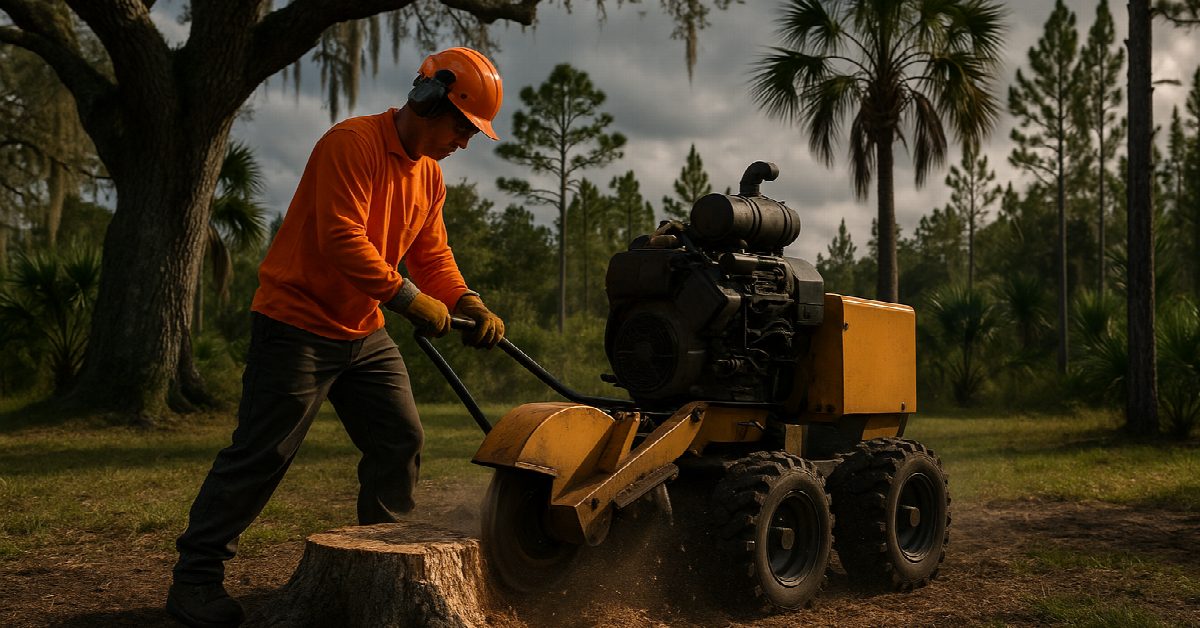
Stump grinding uses a rotating cutting wheel - sometimes called a grinder head - fitted with carbide teeth. The machine is positioned over the stump and the head sweeps back and forth, chewing the wood down in layers. A good operator will grind the stump down to roughly 6 to 12 inches below the soil surface, sometimes deeper if you ask for it.
What's left behind is a pile of wood chips and sawdust mixed with soil. Depending on the job, that pile can be surprisingly large. The root system, however, stays completely in the ground. Every lateral root, every tap root, every woody finger that spread out under your lawn over the years - all of it remains.
For most residential situations in communities like Nokomis, Osprey, and Venice, this is actually fine. The roots of most removed trees will slowly decay over the following years. They won't regrow a tree (assuming the original tree is fully gone), and they won't cause structural problems in most cases. In Florida's warm, humid climate, that decay tends to happen faster than it would in northern states, which is one reason grinding is so commonly recommended here.
That said, there are situations where leaving the root system in place creates real problems - more on that in a moment.
What Stump Removal Actually Does
Full stump removal means pulling the entire root ball out of the ground. To do that, a crew has to excavate around the stump, sever the major lateral roots, and then use heavy equipment - typically a backhoe or a large skid steer - to lever and lift the entire mass out.
The result is thorough. Once a stump is fully removed, you have clean soil and no woody material left underground. You can plant a new tree in exactly the same spot, lay a foundation, install irrigation, or do whatever you like without worrying about buried root mass.
But the tradeoff is significant. Full removal creates a large hole that needs to be backfilled, it disturbs a much larger area of your yard, and it takes considerably more equipment and labor time. In areas like Siesta Key or Casey Key where lot sizes are smaller and neighbors are close, maneuvering heavy extraction equipment can be genuinely difficult or even impossible.
The Key Factors That Should Drive Your Decision
Choosing between these two methods comes down to a handful of practical questions. Work through these and the answer usually becomes clear on its own.
What are you planning to put in that spot?
If you want to replant a new tree in the same location, grinding isn't enough. The buried root mass will compete with a new tree's roots, and the decaying wood can create pockets of nitrogen-deficient soil as it breaks down. Full removal gives you a clean slate.
If you want to lay a concrete pad, build a deck, pour a driveway, or install any kind of structure, you'll also want full removal. Decaying root systems can shift and settle over time, causing uneven surfaces or cracking.
If you just want the stump gone so you can mow over the area, seed some grass, or plant a flower bed without a big woody obstacle - grinding is the right answer and there's no reason to pay for more.
Is there a risk of sprouting or regrowth?
Some tree species are aggressive resprouters. Laurel oak, water oak, and certain palms common throughout Sarasota and Charlotte County can push new growth from remaining root tissue if the stump isn't handled correctly. If you're dealing with a species known to resprout, grinding needs to go deep enough to get below the active growth zone, or removal may be the smarter long-term choice. Our crew should be able to tell you which category your species falls into - don't hesitate to ask. You can also look through our frequently asked questions for more guidance on common Florida species.
How much disruption can you tolerate?
Grinding is relatively tidy. The machine itself is often surprisingly compact - many modern stump grinders can fit through a standard gate - and the job usually takes less than an hour for a single stump of average size. Cleanup involves raking out the chip pile and either hauling it away or using it as mulch.
Full removal, by contrast, is a serious excavation project. Expect a significant hole in your yard, disturbed soil across a wide radius, and the need to bring in fill dirt and potentially regrade before you can lay sod or plant anything. If you've just had a tree taken down and you're already dealing with yard disruption, that's worth factoring into your decision. To understand the full scope of what a tree job involves from start to finish, read our post on what happens to the wood and debris after tree removal.
What's underground near the stump?
This is a question people often forget to ask until it's too late. If there are irrigation lines, utility lines, or drain pipes running near the stump, full removal carries real risk of disruption. Grinding doesn't eliminate that risk entirely - the grinder teeth can hit a shallow irrigation line - but excavating roots that may have grown around underground infrastructure is a much bigger concern. Know what's in the ground before you commit to either option.
What About Cost?
Stump grinding is almost always less expensive than full removal for a single stump. The equipment is lighter, the labor hours are fewer, and there's less cleanup involved. Full removal requires more personnel, heavier machinery, and often a dump run for the extracted root ball.
That said, the size of the stump matters a great deal. A massive old live oak stump in North Port that's 4 feet across is a very different job than a small ornamental tree stump in a Sarasota subdivision. For a detailed look at the factors that drive pricing on all tree work in this area, read our guide on how much tree removal costs in Sarasota and Charlotte County. We'd always rather give you a specific number after seeing the actual job than quote a figure that ends up being misleading.
Grinding Depth: Why It Matters More Than You Think
If you go the grinding route, pay attention to how deep the contractor is willing to grind. Some companies do a minimal grind - just enough to get the stump below the visible surface - and call it done. That leaves a lot of wood mass very close to the surface, which can interfere with sod, create a soft spot in the lawn, or still produce minor sprouting in certain species.
A good crew should grind to at least 6 to 8 inches below grade as a standard practice, and deeper if you're planning to put sod or a garden bed directly over the area. Ask upfront what depth is included in the quote. It's a simple question and any professional operation should have a clear answer.
The Florida Angle: Soil, Roots, and Humidity
Florida's sandy soil and subtropical humidity create a specific environment that affects how stumps and roots behave after removal. On the positive side, organic material breaks down faster here than in most of the country. A ground stump in Englewood or Port Charlotte will decompose more quickly than the same stump in Tennessee, simply because of soil temperature and moisture levels year-round.
On the less positive side, Florida's sandy soil doesn't compact around disturbed areas as quickly or firmly as clay-heavy northern soils do. After full removal, the backfilled area can settle unevenly over several months. Planning for that settling - and being prepared to add more fill or regrade - is just part of the process here.
Also worth noting: if a recent storm is part of the reason you're dealing with a stump in the first place, you may be working on a tighter timeline or dealing with multiple stumps at once. Our post on emergency tree removal after a Florida storm walks through what to prioritize when you're sorting out storm damage.
Should You Ever Just Leave the Stump?
Occasionally, yes - at least temporarily. If the stump is in an out-of-the-way spot, poses no safety hazard, and you have no immediate plans for that area, leaving it to decay naturally isn't catastrophic. Some homeowners in Rotonda West and Placida use old stumps as informal garden features, planting around them or letting native vegetation grow over them.
The concerns with leaving stumps long-term are mostly practical: they can harbor termites and other wood-boring insects, they can be tripping hazards, and depending on the species, they may send up persistent suckers that you'll be mowing or cutting back for years. If the tree showed any signs of disease before it came down - and you can read more about signs a tree has become dangerous to understand what to watch for - leaving the stump and root mass could allow that pathogen to linger in the soil.
Our Recommendation for Most Homeowners
For the majority of residential jobs we see across Venice, North Port, and the surrounding communities, stump grinding is the right answer. It's efficient, affordable, and appropriate for lawns where you're not planning to build or replant a new tree in that exact spot. Combined with a good grinding depth and proper chip cleanup, it leaves your yard tidy and ready for grass or a garden bed within weeks.
Full removal makes sense when you're doing significant landscaping or construction, when the species is a known resprouter and you want a permanent solution, or when the location of the stump is somewhere that buried root decay would genuinely cause problems over time.
If you're not sure which category your situation falls into, the honest answer is to get a professional set of eyes on it before committing. Our team works across Siesta Key, Englewood, Sarasota, Port Charlotte, Nokomis, and everywhere in between. Take a look at our full tree removal and stump services or reach out directly and we'll give you a straight answer about which approach actually makes sense for your yard.
No upselling, no overcomplicated explanations. Just the right job for the situation.
Got a tree that worries you?
Free, no-pressure on-site estimate across Sarasota & Charlotte Counties.