
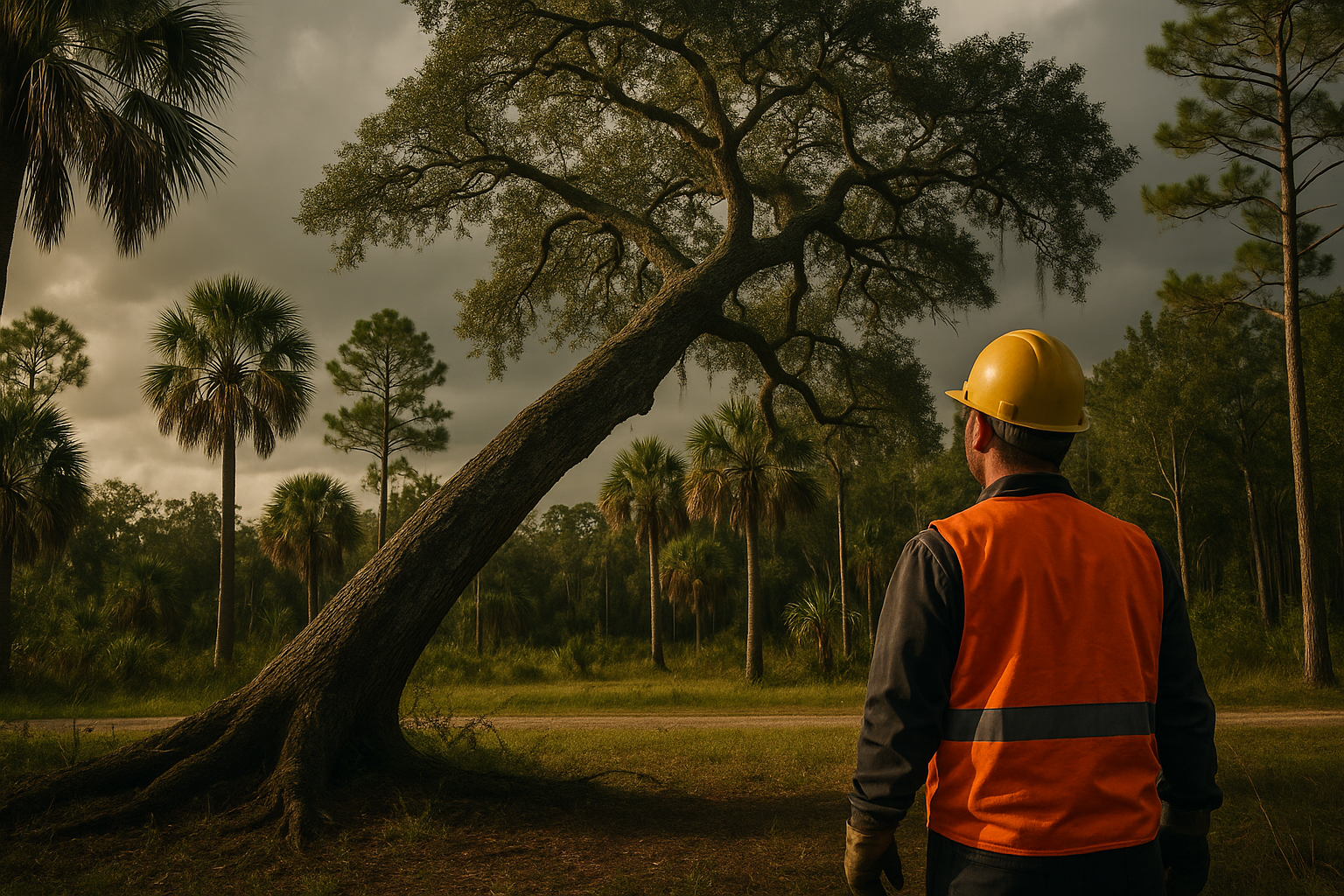
Every year across Sarasota and Charlotte counties, trees that looked perfectly healthy suddenly fail - splitting apart in a summer storm, dropping a major limb onto a roof, or toppling onto a fence line without any wind at all. The scary part is that most of those trees were showing warning signs for months, sometimes years. Knowing what to look for can save you a serious repair bill, and more importantly, it can keep your family safe.
This guide walks you through the real warning signs that a tree has become dangerous, explains why each one matters, and helps you figure out when to call a professional. We'll cover everything from root problems to canopy shape, with a focus on the tree species and weather conditions common here in southwest Florida.
Why Florida trees fail differently than trees up north
Trees in Sarasota, Venice, North Port, and the surrounding area deal with a unique combination of stressors. The sandy, shallow soils along the coast give roots very little to anchor into. The alternating wet and dry seasons stress root systems in ways that cool, consistent climates never produce. And of course, tropical storms and hurricanes deliver wind loads that would be unimaginable in most of the country.
What this means practically is that a tree can look lush and green on the outside while carrying serious structural problems on the inside. Florida's warm temperatures accelerate fungal decay. Insects like the ambrosia beetle can riddle a trunk with galleries before you'd ever notice from the ground. A heavy canopy that looks impressive in April becomes a sail in a July thunderstorm.
If you want to get ahead of storm season, our post on how to get your trees ready before hurricane season in Florida is a great companion read. But first, let's focus on recognizing a tree that has already crossed into dangerous territory.
Warning sign 1: Dead or hanging branches in the canopy
Dead branches - sometimes called "widow makers" by tree specialists - are one of the most common and most underestimated hazards in residential yards. A dead branch doesn't need a hurricane to fall. Heat, a brief wind gust, or even the vibration from a nearby lawn mower can dislodge it.
How to spot them:
- Branches with no leaves during the growing season (or brown, crispy leaves that never dropped)
- Bark that has slipped off or is peeling in long strips
- A branch that moves or sways independently in light wind, suggesting it's only loosely attached
- Visible cracks where the branch meets the trunk
In the Siesta Key and Casey Key areas, we often see this in older Australian pines and Brazilian pepper trees, both of which tend to develop brittle upper canopies as they age. But it happens in oaks, maples, and palms too. Any branch hanging over a roof, a walkway, a pool, or a play area needs to be evaluated without delay.
Warning sign 2: Leaning that wasn't there before
Trees lean for two reasons: they grew that way gradually over many years, or something caused them to shift. The first kind is usually stable. The second kind is a red flag.
A sudden or recently developed lean almost always points to root failure. The roots on one side have lost their grip, and the tree is beginning to tip. Look for these clues alongside a lean:
- Soil heaving or cracking on the opposite side of the lean (the root ball is lifting)
- Exposed roots that look dark, soft, or broken
- A gap forming at the base of the trunk on one side
- Fresh soil disturbance around the root zone
In Rotonda West and Englewood, where lots tend to be larger and trees grow close to structures, a leaning tree near a home or outbuilding deserves immediate professional attention. Don't assume it's been that way "forever" without checking with someone who actually knows the property's history.
Warning sign 3: Trunk decay and cavities
Internal decay is the silent killer of residential trees. It typically starts with a wound - a pruning cut that was never properly sealed, a lightning strike, an old storm scar, or damage from a lawn mower nicking the bark repeatedly over the years.
Once moisture gets inside, fungi move in. Wood-rotting fungi break down the cellulose and lignin that give a trunk its strength. The tree can appear completely normal from a distance while its core is essentially hollow.
Signs to look for at trunk level:
- Soft, spongy wood when you press on the bark
- Visible cavities or holes
- Shelf fungi (those bracket-shaped mushrooms growing from the bark) - these are almost always a sign of advanced internal decay
- Sawdust-like material or insect frass around the base
- Discolored, wet-looking patches on the bark
A professional can sometimes probe suspect areas or use a mallet to listen for a hollow sound. In cases of serious doubt, tree specialists use resistograph drills or sonic tomography to map decay without harming the tree further. But homeowners can catch a lot just by looking and, carefully, touching.
Warning sign 4: Root zone problems
The root zone - roughly the area under the canopy drip line - is where a tree's stability lives. Unfortunately, it's also an area that homeowners rarely think about until something goes wrong.
Root problems in Florida often come from:
- Construction damage. Adding a driveway, patio, or addition within the root zone cuts and compresses roots. Damage done five years ago can show up as tree failure today.
- Grade changes. Filling soil over roots or excavating near them disrupts the oxygen and moisture balance roots depend on.
- Girdling roots. Roots that circle the trunk and slowly strangle it are common in trees that were planted from containers without proper root correction.
- Soggy, saturated soil. Many areas around Nokomis and Laurel sit on soils that hold water. Prolonged saturation kills feeder roots and invites root rot fungi.
A tree with a compromised root system may show stress symptoms in its canopy - sparse foliage, premature leaf drop, yellowing - but the structural danger is at ground level. Even a mild wind event can topple a tree whose root plate has decayed below the surface.
Warning sign 5: Multiple trunks with included bark
Many ornamental and shade trees develop multiple trunks or major limbs that split from a single point. When that union is tight and V-shaped, with bark pressed into the crotch rather than flowing around it, it's called included bark. This is a structural weakness, not just an aesthetic concern.
Included bark means the two stems are not properly fused. They are essentially competing against each other. Over time, the union weakens, and under load - especially a wet canopy in a Florida summer storm - it can split catastrophically.
This is especially common in crape myrtles, water oaks, and laurel oaks, all of which are everywhere from Osprey to Port Charlotte. If you see a tight V-shaped split in a tree with large, heavy limbs overhead, it's worth having a tree specialist look at it. Cabling or bracing can sometimes stabilize the union, but in some cases, removing one of the stems (or the whole tree) is the safer choice.
Warning sign 6: Bark abnormalities and pest damage
Healthy bark is consistent, firmly attached, and species-appropriate in texture and color. Bark that's cracking vertically, separating in large sheets, or weeping dark liquid is telling you something is wrong.
Vertical cracks, sometimes called "lightning scars," can appear after a direct strike and signal that the tree's vascular system has been severely disrupted. Weeping, dark staining often indicates a bacterial or fungal infection called slime flux, which affects the tree's internal plumbing.
Pest pressure in southwest Florida is real. The ambrosia beetle, for example, attacks stressed trees by boring tiny holes and introducing a fungal pathogen. You might see what looks like tiny toothpicks of sawdust sticking out of the bark - those are actually strands of compacted boring dust. Laurel wilt, spread by the redbay ambrosia beetle, has devastated avocado and redbay populations across the region.
If you see unusual bark damage combined with thinning foliage, don't wait to see if the tree bounces back.
Warning sign 7: History of storm damage
A tree that has survived multiple hurricanes or tropical storms without professional attention may be carrying hidden damage from each event. Repeated stress fractures in the wood, torn root connections that partially healed, and old splits that were patched with tar or foam (a practice that is no longer recommended) all weaken a tree over time.
If you moved into a home in Siesta Key, Manasota Beach, or anywhere else along the coast and don't know the history of your trees, it's worth scheduling an evaluation after any significant storm. Our team is available for emergency tree removal after a Florida storm when things go wrong, but catching problems early is always a better outcome for everyone.
What to do when you spot a warning sign
First, don't panic - but do act promptly. Not every warning sign means a tree needs to come down immediately. Some issues are manageable with pruning, cabling, or treatment. A qualified tree care professional can assess the risk level and give you a clear recommendation.
When you contact us, we'll look at:
- The tree's overall health and species-specific failure patterns
- What targets are at risk (structures, vehicles, people)
- Whether the tree can be saved or should be removed
- The best timing given weather forecasts and site conditions
You might also have questions about what happens after a tree comes down. Our post on what happens to the wood and debris after tree removal covers the whole process, and our frequently asked questions page addresses cost, timing, and permits.
Speaking of cost, tree removal pricing in this area depends on size, location, access, and complexity. If you're wondering what to budget, check out our detailed breakdown on how much tree removal costs in Sarasota and Charlotte County.
Don't wait for the next storm to find out
The single biggest mistake homeowners make is waiting. A dangerous tree doesn't announce itself on a schedule. It waits for the worst possible moment - the peak of hurricane season, the evening you're hosting family, the night before a big trip - and then it becomes a crisis instead of a manageable problem.
If anything in this post sounds familiar, take it seriously. Walk your property this week. Look up into the canopy. Check the base of your biggest trees. If you see soft wood, hanging branches, a new lean, or mushrooms growing from the trunk, pick up the phone.
We serve homeowners throughout North Port, Venice, Sarasota, and across the wider region. You can see our full service area and all the communities we cover, or head straight to our contact page to request a free evaluation. There's no obligation, and peace of mind is worth a whole lot more than the cost of a phone call.
Got a tree that worries you?
Free, no-pressure on-site estimate across Sarasota & Charlotte Counties.