
Uninsured tree crews have been known to knock on doors within hours of a storm passing through Sarasota and Port Charlotte, cash in hand, gone before the job is fully done. Knowing how to tell a legitimate company from a fly-by-night operation could save you thousands of dollars and a lot of heartache.
This guide walks you through every step of vetting a tree removal company in Sarasota and Charlotte County: what credentials actually exist in Florida, what insurance you must verify, which questions expose a problem fast, and why the period right after a named storm is the riskiest time to hire anyone who knocks on your door.
Why this matters more here than in most of the country
Southwest Florida sits in one of the most active hurricane corridors in the United States. After a significant storm, demand for tree work explodes overnight. Legitimate crews get booked up quickly, which creates a vacuum that out-of-state "storm chasers" and uninsured locals rush to fill. These crews often have no insurance, no local business tax receipt, and no accountability once they collect payment.
The financial exposure for you as a homeowner is real. If an uninsured worker is injured on your property, you can be held liable. If a crew causes additional damage to your roof, fence, or neighbor's yard, you have no recourse if they have no insurance. And if they abandon a half-finished job, you are left with a dangerous situation and no legal remedy.
This problem is not unique to any one neighborhood. We see it play out in North Port and Englewood after storms push up the coastal corridor, and just as commonly in Venice and Nokomis when a system tracks up the coast. It is worth taking 30 minutes to vet any company you hire, every single time.
Understand Florida's credential structure for tree work
Florida does not have a single statewide "tree removal license." Instead, the credential picture has a few layers, and understanding them will help you ask smarter questions.
Certified ISA Credentials The International Society of Arboriculture (ISA) offers a Certified credential. This requires passing a rigorous exam and maintaining continuing education. An ISA credential on staff signals that someone at the company understands tree biology, risk assessment, and proper removal technique. It is not legally required to remove trees in Florida, but its presence is a meaningful quality indicator.
Florida Contractor Credentials For work that involves equipment operating near structures, or any job that could affect utility lines, contractor credentials matter. Florida's Department of Business and Professional Regulation (DBPR) maintains an online lookup at myfloridalicense.com. You can search by company name or individual name in seconds. If a crew cannot give you a number to verify, that is a red flag.
Local Business Tax Receipt Sarasota County and Charlotte County both require businesses operating locally to hold a current business tax receipt (sometimes called an occupational license). Legitimate companies operating in Sarasota, Venice, North Port, or Port Charlotte will have one. Ask for it, or ask them to point you to where you can verify it.
Workers' Compensation and General Liability Insurance These are not optional, they are non-negotiable. Tree removal is one of the most physically dangerous trades that exists. Workers' comp protects laborers on your property. General liability protects your home and your neighbor's property from damage caused by the crew. Ask for a certificate of insurance (COI) before any work begins, and ask that the certificate be sent directly from the insurance provider, not just handed to you as a printout by the crew.
The five questions to ask before you sign anything
You do not need to be a tree expert to protect yourself. You just need to ask the right questions and pay attention to how a company responds.
1. Can you provide proof of insurance before we start? A legitimate company will say yes without hesitation and will not pressure you to decide before the certificate arrives. Any reluctance or "we'll bring it day-of" answer is a problem.
2. Do you have a local business address and phone number? Storm chasers often operate from a temporary staging area and give out out-of-state numbers. A company with a real local presence in Sarasota or Charlotte County will have a verifiable local address, a local phone number, and a history you can look up.
3. Do you pull permits when required? Some tree removals in Sarasota and Charlotte County require a permit from the local municipality or county. A crew that skips the permit process is cutting a corner that could create a code enforcement issue for you as the property owner. See our frequently asked questions for more on how permits work locally.
4. What does the written estimate actually cover? A professional company gives you a written scope of work that specifies what gets removed, how debris will be handled, whether the stump is included, and what cleanup looks like. If a crew quotes you a price verbally and asks for cash up front without a written agreement, walk away. For more context on what debris handling looks like after the job, read what happens to the wood and debris after tree removal.
5. Can you provide local references or reviews I can verify? An established company will have a track record in the community. Google reviews, Nextdoor mentions, or references from neighbors in Osprey, Siesta Key, or Casey Key are all checkable. A crew that just rolled in from Georgia after the storm will have none of these.
Red flags that are easy to miss in a stressful moment
After a storm, adrenaline is high, debris is everywhere, and the pressure to get trees off roofs or driveways creates urgency that bad actors exploit. Watch for these warning signs:
- They come to your door unsolicited immediately after a storm, especially if they already have equipment staged in the street
- They demand a large cash deposit before any work begins (a reasonable deposit is normal, but "pay in full upfront, cash only" is not)
- The written estimate is vague, just "tree work" with a dollar amount and no specifics
- They pressure you to sign immediately, using language like "we're booked solid tomorrow" or "this price is only good for the next hour"
- They cannot name the insurance company they work with or the policy number
- The crew has no company logo on their truck, no uniforms, and no business cards
- When you search the company name online, nothing comes up, no website, no reviews, no address
If a situation feels rushed and unclear, trust that instinct. You have every right to say "let me verify a few things and I'll call you back." A legitimate company will respect that. A storm chaser will pressure you harder.
Why post-storm situations are uniquely dangerous
The moments right after a named storm passes over Sarasota and Charlotte County are when homeowners are most vulnerable to bad hiring decisions. The roof might be leaking. A tree might be resting against the house. The insurance adjuster hasn't arrived yet. In that state of stress, almost anyone promising a fast fix sounds appealing.
This is also when uninsured crews travel hundreds of miles to work a region that just got hit. They may have chainsaws and pickup trucks, but little else. No safety training, no tree knowledge, no insurance, and no intention of being reachable next week.
The best defense is to have a relationship with a trusted local tree company before a storm ever arrives. If you already know who you're calling and have their number saved, you won't be standing in the driveway making snap decisions. Our post on emergency tree removal after a Florida storm covers what steps to take in the immediate aftermath and how to prioritize what gets addressed first.
What the job should look like from a legitimate crew
Knowing what a professional tree removal actually looks like helps you spot corners being cut.
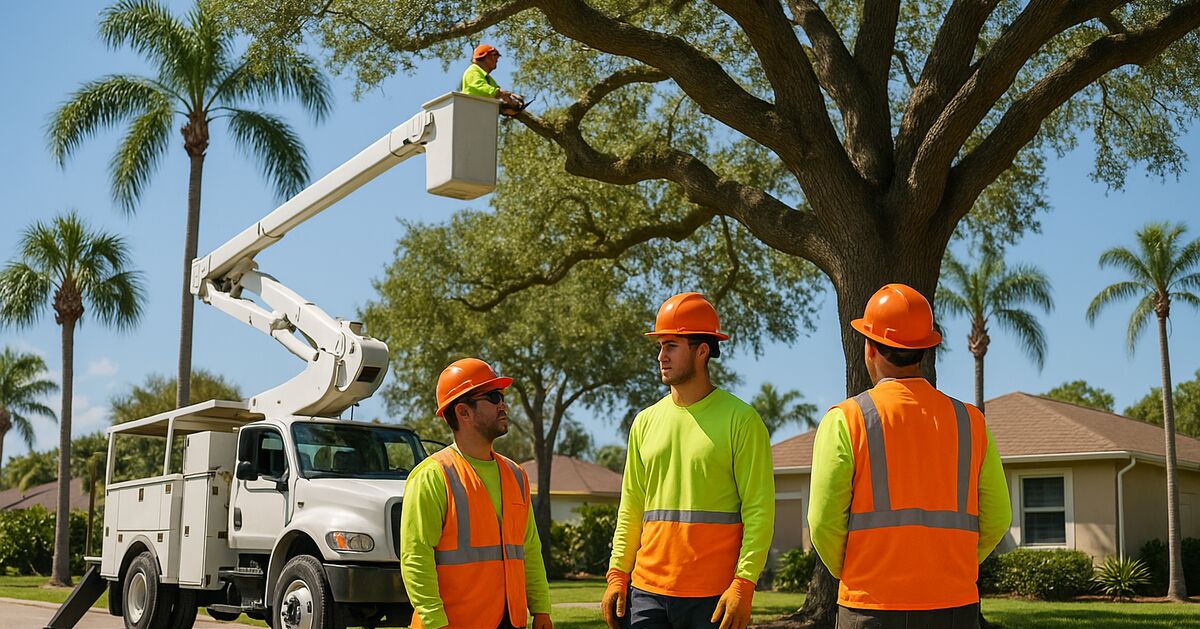
- The crew arrives with proper personal protective equipment: helmets, eye protection, chainsaw chaps, and hearing protection
- Before cutting begins, the area is assessed and a drop zone is established to protect structures, fences, and neighboring property
- Rigging equipment (ropes, blocks, and friction devices) is used on larger trees to control how sections fall, especially near homes
- A ground crew handles debris as the climber works, keeping the site clear and safe
- After the tree is down, the site is cleaned of debris down to the cut level, or to whatever scope was agreed upon in writing
- If a stump grinder is part of the job, it arrives as part of the same organized operation, not as a surprise add-on invoice later
Work that looks chaotic, where sections of tree are just being dropped wherever they land, or where the crew seems to be improvising around structures, is a sign of either inexperience or indifference. Our tree removal and storm cleanup services page explains the full scope of what a well-run job covers.
How to check a company's credentials in Sarasota and Charlotte County
Here is a simple, practical checklist you can run through in about 15 minutes:
- Verify Florida contractor or business credentials at myfloridalicense.com using the company name or number
- Check the ISA website at isa-arbor.com to confirm whether any credentials are claimed as current
- Call the insurance provider directly using the number on the certificate of insurance to confirm the policy is active and covers tree work
- Search Google, Yelp, and Nextdoor for the company name along with your town (such as "tree removal Venice" or "tree service North Port") to see if reviews match what the company claims about itself
- Check Sarasota County or Charlotte County's business tax records if you want to go a level deeper on local operating history
This process protects you whether you're in a calm pre-storm planning mode or in the middle of a post-hurricane cleanup scramble. The companies that pass all five checks without hesitation are the ones worth hiring.
Local matters: Why hiring within the community makes a difference
A company based in North Port or Sarasota has reasons to do good work that a traveling storm crew does not. Their neighbors are their customers. Their reputation is visible and searchable. They answer the phone when you call back two weeks later. They know the local permit process because they file permits regularly. They understand how county canopy ordinances affect what can be removed and what requires mitigation.
They also understand the trees themselves. The live oaks that are woven into the canopy of older Sarasota and Venice neighborhoods behave differently than the slash pines common in newer North Port developments or the sabal palms that line the Placida waterfront. Local knowledge matters in how a job gets planned and executed.
If you're comparing companies across our service area, look for signs of genuine community presence: years in operation, recognizable references, and a physical location you could drive to if you needed to.
Putting it all together
Choosing a tree removal company is not complicated when you know what to look for. Verify insurance directly. Confirm credentials exist and are active. Get everything in writing before work begins. Ask for local references. And if something feels rushed or unclear, give yourself permission to slow down and check.
The trees around your home in Rotonda West, Englewood, Siesta Key, or wherever you live are significant assets, and removing them is a serious job. It deserves a serious, accountable crew.
If you want to talk through your situation before committing to anything, we're easy to reach. Our contact page is the fastest way to get a straight answer and a written estimate from a crew that lives and works here year-round.
Got a tree that worries you?
Free, no-pressure on-site estimate across Sarasota & Charlotte Counties.