
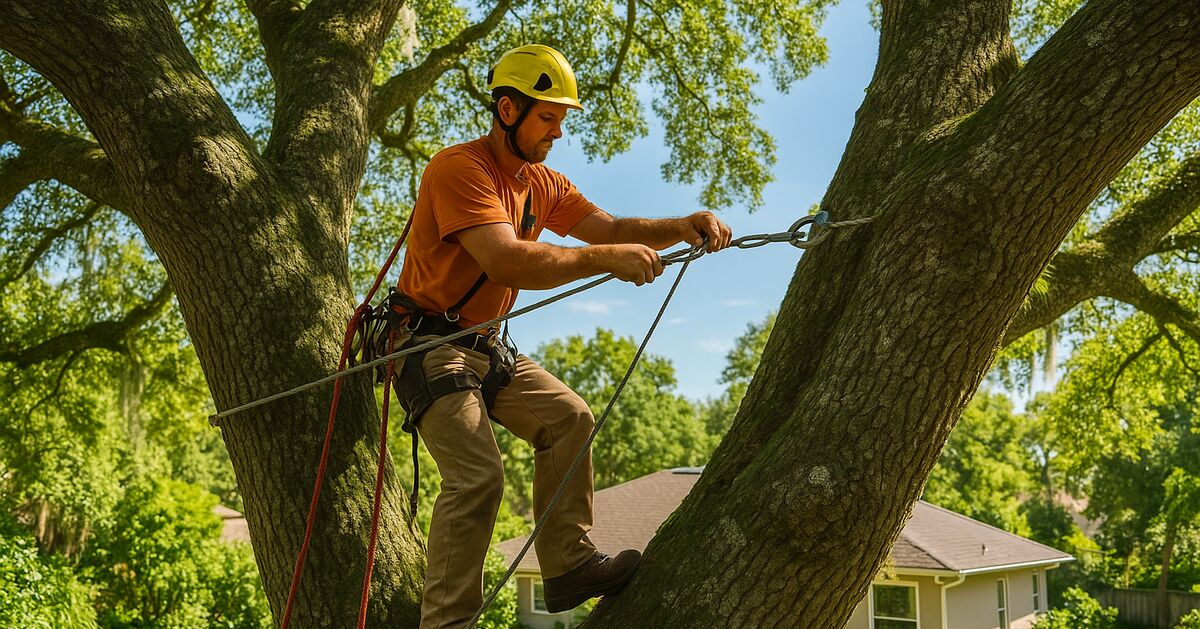
A beloved live oak spreads across your backyard, throwing shade over the patio all summer. Then you notice it: a deep crack running between two main stems, or one massive limb leaning just a little too far over the roof. A neighbor says "that tree has to go." But does it?
Not always. Tree cabling and bracing is one of the most underused tools in residential tree care, and it's exactly why some trees that look like removal candidates are still standing and healthy twenty years later. This post walks through how the hardware works, which trees and defects make good candidates, what the installation process looks like, and how to think about maintenance over time.
Why some trees develop structural weak points in the first place
Most structural failures in mature trees trace back to one of a few root causes.
Co-dominant stems are the most common culprit. When a tree produces two main trunks of roughly equal size that grow upward from a single point, the bark between them gets "included" rather than forming strong, interlocking wood grain. Included bark is essentially a wedge of compressed bark tissue where strong wood should be. It doesn't bond. Over time, the weight of two heavy stems pressing outward can split that union open, sometimes slowly over years and sometimes suddenly in a storm. Live oaks in Sarasota and North Port commonly develop this pattern, especially trees that were never structurally pruned when they were young.
Decay at a crotch or attachment point weakens the wood that holds stems together. You might see discoloration, soft wood when you press on it, or fungal growth at the union. The wood is still there, but it no longer has the tensile strength to handle wind loading.
Past damage matters too. A tree that lost a large limb in a previous hurricane, or one that was topped years ago and sprouted multiple fast-growing water sprouts, can end up with attachment points that are mechanically weaker than the original structure.
Size and age compound everything. A stem union that was borderline acceptable on a twenty-foot tree becomes a serious concern on a fifty-foot tree because the weight and leverage are dramatically higher.
What cabling and bracing actually does
The goal of supplemental support systems is simple: reduce the load and movement at a weak point so the tree doesn't fail at that point. The hardware does not "fix" the defect. It manages the risk the defect creates.
Cables are typically installed in the upper crown of the tree, connecting two co-dominant stems or a heavy limb to a more structurally sound part of the tree. When the tree flexes in wind, the cable catches the movement before the weak attachment point reaches its failure threshold. Modern installations use either steel cables (high-strength, with a defined load rating) or synthetic rope systems (more flexible, slightly more dynamic). The appropriate choice depends on the size and weight of the stems involved, the nature of the defect, and what the tree's long-term management plan looks like. Work done under ANSI A300 Part 3, which covers supplemental support systems, spells out the design criteria: cable placement height, hardware specifications, and loading assumptions.
Bracing rods are threaded steel rods installed through the wood itself, typically at the split or weak union. They are used when the failure point is at or near the base of the split rather than in the upper crown, and when movement between the two pieces needs to be mechanically limited. Bracing is more invasive than cabling because it requires drilling through the wood, but it provides direct support right at the problem zone. Many installations use both a brace rod at the union and a cable higher in the crown to manage loading at two levels simultaneously.
Neither system is "set it and forget it." Cables and hardware need to be inspected regularly because the tree keeps growing, loads shift, and hardware can fail.
Which trees and defects are good candidates
Cabling and bracing is not appropriate for every tree or every defect. Here are the situations where it typically makes sense.
A co-dominant stem union with no or minimal decay. If the union is structurally intact but the geometry creates a mechanical disadvantage (the bark inclusion, the outward lean), hardware can redistribute the load effectively. If the union has significant decay, the material you're anchoring into may not be sound enough to hold the cable loads.
A tree with high value and good overall health. Installing and maintaining a cable system costs money. That investment makes sense when the tree is large, healthy, and provides meaningful shade, visual screening, or ecological value. It makes less sense on a declining tree with other compounding problems because the cost of keeping that tree alive for a few extra years may exceed the benefit.
A specific structural problem in an otherwise sound tree. The best cable candidates have one identifiable weak point in an otherwise well-structured, well-rooted tree. If a tree has multiple competing co-dominant stems, root damage on one side, a lean toward the house, and signs of crown decline all at once, removal may genuinely be the safer path. Our team can help you think through that decision during an on-site evaluation - see our tree trimming, removal, and care services for what a full assessment covers.
A tree the homeowner wants to keep and can commit to monitoring. A cabled tree is a managed tree. If you're not in a position to have it re-inspected every one to three years, that's an important factor in the decision.
Trees in Southwest Florida that commonly benefit
The coastal communities of Sarasota County and Charlotte County have their own cast of trees that show up repeatedly in cabling conversations.
Live oaks (Quercus virginiana) are the most frequent candidates. They're long-lived, ecologically important, beloved by homeowners, and prone to co-dominant stem development when they haven't had structural pruning early in their life. A mature live oak in Osprey or Nokomis with a splitting union in the upper crown is a textbook cable candidate, provided the wood at the union is still sound.
Slash pines and longleaf pines occasionally develop co-dominant leaders after top damage from storms. Pines are generally less amenable to cabling than hardwoods because their wood responds differently to drill holes, but selective cases do arise.
Large ornamental trees and shade trees in older neighborhoods throughout Venice, Englewood, and Port Charlotte sometimes have structural issues that developed over decades of unmanaged growth. A big camphor tree or a sprawling laurel oak with a split union that has stayed stable for years might be an excellent cable candidate.
Multi-trunk trees of any species near pools, lanais, driveways, or rooflines deserve a careful look before any removal decision is made. If a failure would damage a structure, the cost-benefit math of a cable system often tips strongly toward installation. For context on what happens when trees do fall on structures, see our post on what to do when a tree falls on a fence, pool cage, or lanai.
What the installation process looks like
A proper cabling job is not a matter of wrapping a rope around two branches and calling it done. Done correctly, it follows a specific process.
Assessment first. Before hardware goes in, a thorough evaluation of the defect, the wood condition, the crown structure, and the target zone for the cables is essential. This includes checking the wood at potential anchor points for decay using a probe or, in some cases, more advanced tools. You cannot anchor a cable into a hollow stem.
Structural pruning before or alongside. In many cases, some crown cleaning or crown raising is done before the cable is installed. Removing dead, dying, or crossing wood reduces the total load the cable has to manage. ANSI A300 pruning standards define crown cleaning as removing dead, diseased, or weakly attached branches - this is often part of a cabling job, not a separate upsell. Reducing the end weight of a heavy limb before cabling it can meaningfully reduce the peak forces the hardware will see in a storm.
Hardware selection and placement. For steel cable systems, J-lag bolts or through-bolts are installed in the living wood of the target stems. Cable placement is typically two-thirds to three-quarters of the way up from the defect to the top of the crown, which is the zone where a cable intercepts movement most effectively. Hardware is rated for the expected load. Synthetic rope systems use different terminations but follow the same placement logic.
Brace rod installation (if applicable). For a split union that needs direct stabilization, a brace rod is drilled through both stems at the weak point. The rod is threaded and fitted with nuts and washers on both sides so it can be tightened. In some wide splits, more than one rod may be installed at different heights across the defect.
Documentation. A good installation includes noting the hardware specifications, placement, and the condition of the tree at the time of installation so that future inspections have a baseline.
Maintenance and re-inspection
This is the part homeowners most often overlook, and it's the reason some cable systems fail not because the hardware gave out but because no one checked on them.
Trees grow. The stems around a cable anchor grow thicker over time. If hardware is not checked periodically, the tree can eventually grow around it, causing bark damage or creating new structural problems. Cable length may need adjustment as the crown changes. The original defect may progress, meaning that what was manageable five years ago has crossed into a different risk category now.
Under ANSI A300 Part 3, supplemental support systems are supposed to be re-evaluated at intervals defined by the condition of the tree at the time of installation. In practice for most healthy trees in our area, a re-inspection every one to three years is reasonable. After a major storm event - and Southwest Florida gets its share - an inspection should happen sooner regardless of schedule. For more on how tree health problems can progress faster than expected, see our post on Ganoderma butt rot in Florida palms, which illustrates how quickly a hidden structural problem can move from manageable to critical.
When cabling is not the answer
Honest advice sometimes means saying that a cable won't solve the problem.
If the wood at the anchor points is decayed, there is nothing solid to bolt into. If the tree has severe root damage on the side that a heavy stem is leaning toward, no amount of crown hardware changes the physics of what happens when that tree flexes in a hurricane. If the split has already progressed so far that the two pieces are essentially moving independently of each other, a brace rod may stabilize things temporarily but the long-term prognosis is poor.
There are also situations where the risk to structures or people is high enough that even a well-installed cable doesn't bring the risk to an acceptable level. A massive stem hanging directly over a bedroom is a different calculation than the same stem over an open lawn. Our full list of service areas gives you a sense of where we work, and for homeowners in Sarasota or Venice with a tree that's raising these questions, a direct conversation with our crew is the fastest way to get a clear answer.
Removal is sometimes genuinely the right call. But it should be the conclusion of a real evaluation, not the default assumption because a tree looks complicated.
What this means for your property
If you have a tree with a visible crack between two main stems, a union that has been slowly opening over the years, or a heavy limb with a suspect attachment point, the first step is getting eyes on it from someone who knows what to look for. Not every split union fails, and not every co-dominant stem is a crisis. Some of them have been sitting in that configuration for decades and will continue to do so. Others are quietly working toward failure.
Cabling and bracing gives you a way to get a real answer and act on it, rather than either ignoring a problem or removing a tree you didn't have to lose. For homeowners across Sarasota, North Port, Osprey, Englewood, and the rest of our service area, that's often a meaningful difference - both for the tree and for what it adds to the property.
If you've got a tree that's been making you wonder, reach out and we'll take a look. Sometimes the best outcome is finding out there's less to worry about than you thought.
Got a tree that worries you?
Free, no-pressure on-site estimate across Sarasota & Charlotte Counties.