
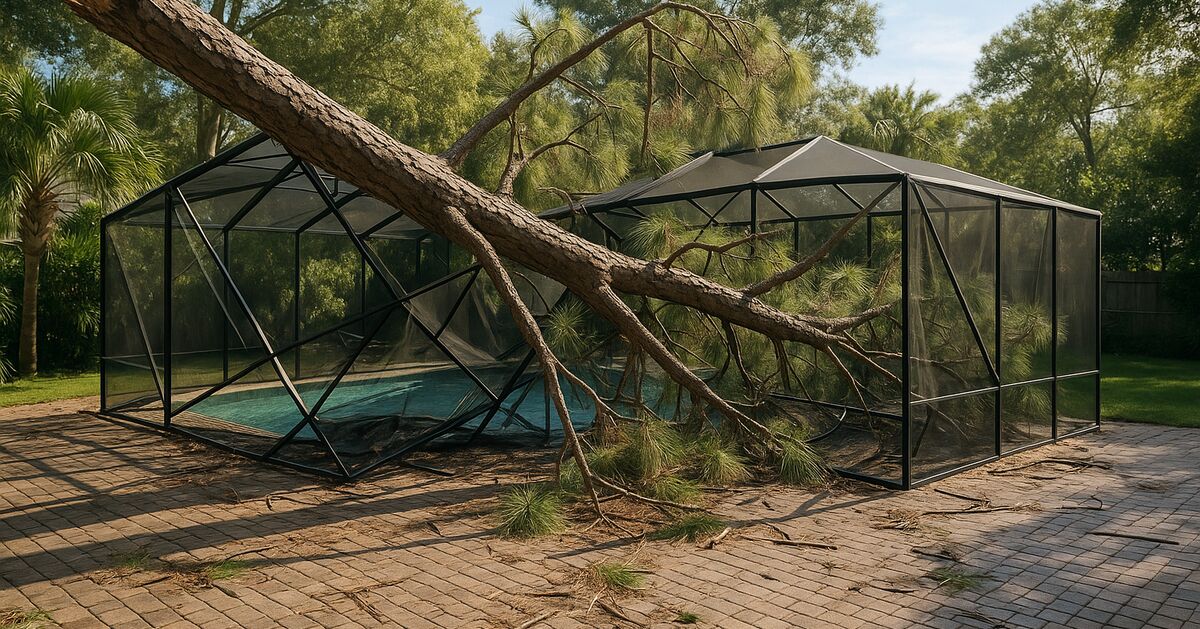
A tree comes down in the night, and by morning you're standing in your backyard staring at a pine trunk draped across your screen enclosure or a live oak that has crushed two fence panels and is leaning into your neighbor's yard. The tree is down. Now what?
This situation is genuinely common in Sarasota and Charlotte County. Between the sandy soils, the afternoon thunderstorms, and hurricane season, trees fall on structures here more than in most parts of the country. Knowing the right sequence of steps before you call anyone can save you money, prevent additional damage, and make your insurance claim go a lot smoother.
Stop and assess before you touch anything
The single most important thing you can do in the first fifteen minutes is nothing, physically. Walk the perimeter, look at what the tree is resting on, and resist the urge to start cutting or dragging.
A few things to check from a safe distance:
- Power lines. If any part of the tree or debris is touching or near a utility line, treat the entire area as energized until FPL or your utility provider tells you otherwise. Do not step over downed lines. Do not touch metal fencing that connects to the debris field.
- Structural stability. Pool cages and lanai frames are aluminum. Once a tree lands on them, the structure may be partially collapsed, partially intact, and under tension. Moving one piece can shift weight onto another section unexpectedly.
- Pool water. If debris has fallen into the pool, there may be sharp aluminum, screws, or broken glass in the water. Don't enter the pool until it's been inspected and the water is clear.
- Gas lines. Less common in this context, but if an outdoor kitchen or grill is under the lanai and something has been knocked loose, smell for gas before you go back there.
Once you are confident the scene is safe, take photos and video of everything before a single branch is moved. Walk the whole perimeter. Shoot from multiple angles. Capture the fence line, the point where the trunk rests on the structure, and any collateral damage to the pool deck, pavers, or landscaping. This documentation is the foundation of your insurance claim.
Who is responsible for the damage?
This question creates more neighbor tension than almost anything else in residential property disputes, and the short answer is: it depends on where the tree came from and whether negligence was involved. There is a longer discussion of the neighbor side of this in our post on when a neighbor's tree falls on your property, so we won't repeat that ground here. The key points for fence, pool cage, and lanai damage specifically:
Your own tree, your own structure. If a healthy tree on your property falls and damages your fence or enclosure, your homeowner's insurance generally covers the structure damage. The tree removal itself may or may not be covered depending on your policy and where the tree came from. Call your insurer before you authorize any work so you understand what's documented and what you'll be reimbursed.
Neighbor's tree, your structure. If your neighbor's tree falls onto your pool cage or fence, your homeowner's insurance still covers your structure damage in most cases. Whether you can recover costs from your neighbor depends on whether that tree showed prior signs of failure and whether you or anyone notified the neighbor about those signs in writing. A tree that was visibly dead, leaning, or diseased before the storm is a much stronger case for negligence than a healthy tree that came down in a Category 1 wind event.
Shared fences. Many fences in Sarasota, Venice, and North Port neighborhoods are on or near the property line and ownership may be shared. Before you repair or replace fence panels, confirm the property boundary. A survey and a conversation with your neighbor before work begins prevents disputes about who pays for what.
Document the tree's condition. If you suspect negligence on anyone's part, it helps to have a tree specialist document the tree's condition before it is removed. Photos of internal decay, root damage, or visible signs of disease are useful if a liability question ever goes further.
Call your insurance company first, then your tree service
The order matters. Some policies require that you notify the insurer before any covered debris is moved or any work begins. If you hire a crew and have the tree removed before filing a claim, you may have inadvertently removed the evidence the adjuster needs to estimate your loss.
When you call your insurer:
- Tell them a tree has fallen on a structure (be specific: pool cage, fence, lanai, or combination).
- Ask whether they want to send an adjuster before work begins, or whether photos are sufficient.
- Ask specifically about "debris removal" coverage versus "structure repair" coverage. These are often two separate line items in a homeowner's policy.
- Get a claim number and write down the name of every person you speak with.
Once you have the insurer's go-ahead to proceed, or once they confirm that documentation is sufficient, then you call your tree service. For tree removal and storm cleanup services in this area, the crews are accustomed to working alongside insurance adjusters and can often provide itemized invoices that match what adjusters need to process a claim.
How removal actually works in tight, confined spaces
This is where the job gets genuinely different from a tree removal in an open yard, and it's worth understanding what goes into it.
A standard tree removal involves rigging sections of the trunk and lowering them to an open ground area, then chipping or hauling the wood away. When the tree is resting on a pool cage or aluminum lanai structure, that workflow changes significantly.
The tree cannot simply be pulled off. If a trunk is resting across the top rail of a screen enclosure, pulling or dragging it sideways will tear the entire frame apart further. The crew has to cut the tree in place, section by section, relieving weight gradually so the structure beneath is not torqued or crushed further than it already is.
Working in sections from the top. Experienced crews will start at the crown end, removing smaller branches and working back toward the trunk. Each section is cut small enough to be lifted vertically off the structure rather than dragged across it. This protects whatever is salvageable in the enclosure frame.
Hand tools in confined zones. Pool decks surrounded by cage framing, or lanai areas with outdoor furniture, ceiling fans, or kitchen equipment still in place, may require work with hand saws, reciprocating saws, or small chainsaws rather than large equipment. There often isn't room to swing a bar safely without risking the structure, the pool, or the crew.
Access matters enormously. In communities across Venice, Englewood, and Port Charlotte, homes are often on smaller lots with fence lines tight to the house and no side-yard access for equipment. When a crew can't bring a skid steer or grapple truck around the side, everything has to come out by hand through whatever opening exists. This takes longer and costs more, which is worth factoring in when you get an estimate.
The fence situation. A tree on a fence is usually the most accessible of the three scenarios, but it still requires care. The crew needs to cut the tree free before fence panels can be assessed for damage or pulled for replacement. In many cases, a fence section can be temporarily re-secured or propped so the yard is not open to the street or adjacent properties while the full repair is scheduled.
Pool water and debris. If limbs or debris fell into the pool, a crew will typically remove what is on the deck and cage first, then address what is in the water. Debris in the pool is a separate category from tree removal and may involve a pool service company for water treatment and filter cleaning after the wood is out. Alert your pool company after the tree work is complete.
What the area looks like after removal in a confined space
Once the tree is out, you will likely be looking at:
- A damaged pool cage with bent or broken framing, torn screen panels, and possibly broken top rails or posts.
- A fence with crushed or missing panels, potentially leaning posts, and disturbed concrete footings.
- A lanai with similar framing damage, possible damage to a roof panel or patio cover, and debris across the pavers.
The tree crew's job ends when the wood and debris are out. Structural repair of the cage, fence, or lanai is typically a separate trade. Aluminum screen enclosure specialists, fence contractors, and lanai builders are the next calls after the tree is removed. Let your insurance adjuster see the structural damage before that repair work begins, if at all possible.
For the ground itself, root systems from larger trees can disturb pavers, deck edges, and concrete. Our post on how tree root systems affect your foundation, pipes, and driveway after removal covers what to watch for once the tree is out and before you have any flatwork repaired.
Local specifics worth knowing
If you are in a deed-restricted community or HOA in areas like Rotonda West or Osprey, check whether the HOA has any role in fence or landscape repair on common boundaries. Some communities have preferred vendors or require work to be permitted and inspected before it is closed up.
In coastal communities like Siesta Key, Casey Key, and Manasota Beach, wind and salt air accelerate aluminum corrosion. A cage that looked structurally sound before a tree fell may be far more compromised than it appears once the load is removed. Have the frame inspected by an enclosure company before you assume sections are salvageable.
Sarasota and Charlotte County both have permitting requirements that may apply to fence replacement depending on height and materials. Tree removal itself in a storm context is generally not permitted in the same way standard removal is, but a fence replacement that exceeds certain dimensions may need a permit. Our FAQ has more detail on permitting questions in this area, and the county building departments can confirm what applies to your specific situation.
Choosing who does the work
A tree resting on a structure is not the right job for a one-person operation with a pickup truck and a chainsaw. The confined space, the liability exposure, and the need to protect the structure while removing the tree require an experienced crew with proper insurance.
When vetting a company, ask specifically whether they have experience working in pool cage and lanai environments, whether they carry general liability and workers' compensation insurance (and ask for the certificate), and whether they can provide an itemized written estimate that separates debris removal from any other work. Our post on how to choose a legitimate tree removal company in Sarasota and Charlotte County walks through the full vetting checklist.
You can also browse all of our service areas to confirm coverage in your part of Sarasota or Charlotte County, or contact us directly to describe what you're dealing with and get a clear picture of what the work will involve.
A tree on your pool cage or fence is a stressful start to a day. But the steps themselves are manageable: document everything, call your insurer, get a qualified crew in to remove the tree carefully, and then work through the structural repairs trade by trade. Getting the sequence right makes every part of the process go faster and smoother.
Got a tree that worries you?
Free, no-pressure on-site estimate across Sarasota & Charlotte Counties.