
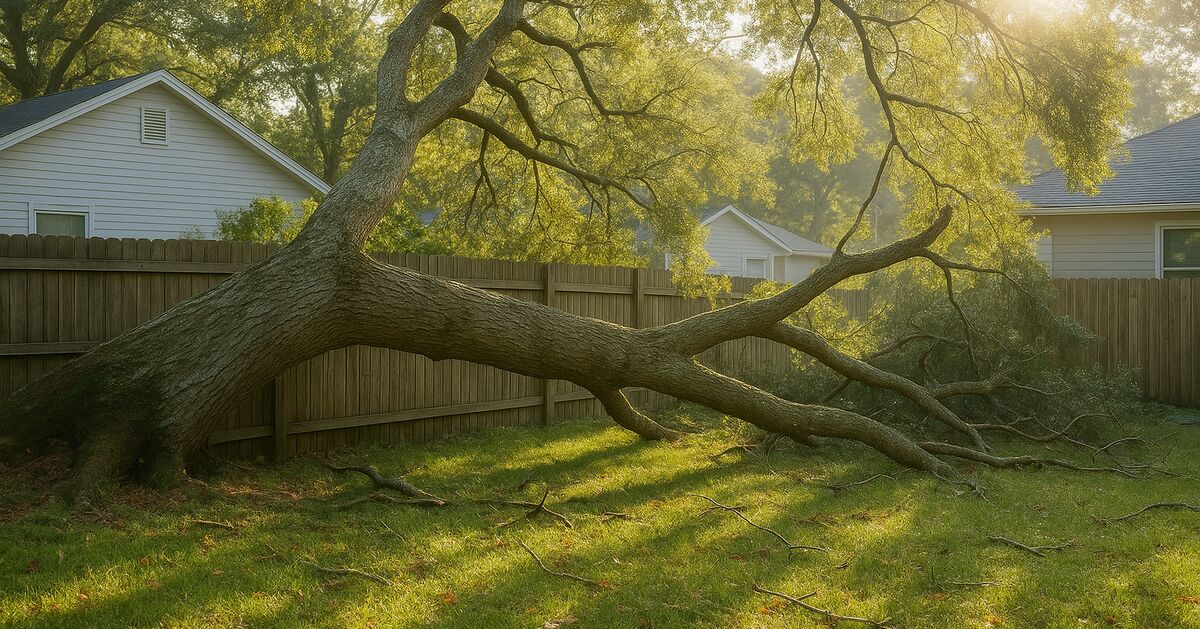
Your neighbor's oak comes down in the night, and you wake up to it resting on your fence - or worse, your roof. Before you reach for your phone to call anyone, it helps to understand exactly who is responsible for what, how Florida law actually works in these situations, and what steps to take in the right order. Getting the sequence wrong can cost you money and create unnecessary conflict with the people next door.
Florida's general rule: whose property, whose problem
Florida follows what most states call the "Massachusetts Rule" (sometimes called the "Hawaii Rule" in newer case law), and the short version is this: if a tree falls onto your property, your homeowner's insurance is typically the one that responds - not your neighbor's policy - unless you can prove your neighbor was negligent.
That feels counterintuitive. The tree came from their yard. It crushed your fence. But under Florida common law, a tree falling during a storm is generally treated as an act of nature rather than a failure by the neighboring property owner, provided the tree appeared reasonably healthy before the storm. The burden of proving negligence sits with you, the injured party.
This does not mean your neighbor is always off the hook. It means the standard matters enormously, and understanding it shapes every conversation you're about to have.
What "negligence" actually means in this context
Negligence, in the tree world, means your neighbor knew or should have known the tree was hazardous and failed to act. The classic examples:
- You sent them a written notice - a letter, a text, an email - warning them the tree was dead, leaning badly, or showing signs of disease, and they ignored it.
- The tree was visibly rotting at the base, had large dead limbs hanging over your property, or had lost its root anchorage in a way any reasonable person could observe.
- A tree specialist had previously flagged the tree as a removal risk.
If any of those conditions apply, you have a meaningful argument that negligence occurred, and your neighbor's liability insurance may come into play. If the tree looked fine - healthy canopy, solid trunk, no obvious warning signs - and a hurricane knocked it over, the negligence argument is much harder to make.
This is why documentation matters so much. If you have been watching a dead slash pine lean toward your house in North Port or Rotonda West, send your neighbor a written notice today. A dated text message is better than nothing. A certified letter is better still. That paper trail becomes critical evidence if the tree eventually falls.
What to do in the first 24 hours after a tree falls
If the tree has already come down, here is the order of operations that protects you best:
1. Make sure everyone is safe. If the tree struck your home and you have any doubt about structural stability, get out and stay out until a professional has assessed it. Do not walk under a partially suspended tree or on a roof loaded with debris.
2. Document everything before moving anything. Take photos and video of the fallen tree, where it came from, what it landed on, and any visible root condition or trunk decay. This documentation supports your insurance claim and, if needed, a negligence argument. Capture the tree's base and root zone on your neighbor's side of the property line if you can safely do so.
3. Call your own homeowner's insurance first. Even if you believe your neighbor bears responsibility, notify your own insurer promptly. Most policies require timely notification, and your insurer can investigate the liability question themselves. If they pay your claim and find negligence on your neighbor's part, they will pursue your neighbor's insurer through a process called subrogation - you stay out of that fight.
4. Talk to your neighbor calmly. This step is optional but often wise. In close-knit communities like those in Siesta Key, Casey Key, or the neighborhoods of Sarasota, a reasonable conversation can resolve things without lawyers. Show them the photos. Let them know your insurer will be in touch. Most reasonable neighbors will contact their own insurance company once they understand the situation.
5. Get professional tree removal scheduled. Before anything else can be repaired, the tree needs to come down or be removed from wherever it landed. Our team handles exactly this kind of work across Sarasota and Charlotte Counties - you can learn more about our tree removal and storm cleanup services if you need help getting the debris cleared quickly and safely.
When the tree hasn't fallen yet but you're worried
This situation is, in some ways, more complicated than the aftermath of a fall. You can see the problem. You know the risk. But the tree is still standing on your neighbor's property and you have limited control over it.
Here is what you can actually do:
Send written notice to your neighbor. This is the single most important step. Document your concern in writing - a text message, an email, or a physical letter - and keep a copy. Describe what you observe: the dead limbs, the lean, the fungal growth at the base. If your neighbor receives written notice and does nothing, your negligence argument improves substantially if the tree later falls.
Contact your county. Sarasota County and Charlotte County both have code enforcement processes. A dead or structurally compromised tree that poses an imminent hazard to adjacent property can sometimes be addressed through code enforcement, particularly if the neighbor is unresponsive. Results vary and the process is slow, but it creates an official record of the concern.
Consult an attorney if the risk is serious. If the tree is clearly dangerous and your neighbor refuses to act, a real property attorney can advise you on whether to seek an injunction or other legal remedy. This sounds dramatic for a neighborhood tree dispute, but if the tree is large and hanging over your roof in Venice or Port Charlotte, it may be worth a one-hour consultation.
What you cannot do. You cannot enter your neighbor's property and remove the tree yourself, even if it is threatening your home. You can trim branches that cross the property line up to the line itself - Florida law gives you that right - but you cannot go onto their property, and you cannot remove the trunk or root system. Doing so could expose you to a claim of trespass or property damage.
The tricky question of shared or boundary trees
Sometimes neither party knows exactly whose tree it is. A large oak sits right on the property line, with its trunk straddling both lots. In Florida, a tree whose trunk is on or straddles the boundary line is generally considered jointly owned by both property owners. Both owners share responsibility for its care and, in the event of a dispute, share the decision-making about removal.
If you and your neighbor both want the tree gone, the process is relatively straightforward - you split the cost or agree on another arrangement, and the tree comes down. If one of you wants it removed and the other does not, you may need legal guidance. And if the tree is a protected species or a certain size that requires a county permit, that adds another layer to navigate.
What your homeowner's insurance will and won't cover
Since this topic intersects so closely with the insurance question, it's worth summarizing the basics here. Generally speaking:
- Structural damage to your home (roof, walls, attached garage) caused by a fallen tree is typically covered by your homeowner's policy, minus your deductible, regardless of where the tree came from.
- Fences, detached structures, and sheds may be covered under other structures coverage, but limits are often lower.
- Debris removal is sometimes covered up to a dollar cap - read your policy carefully, because limits vary widely.
- The tree itself (if it's yours) is generally not covered unless it fell due to a covered peril, and even then, coverage for the tree as a landscape asset is limited.
For a deeper dive into how insurance interacts with tree removal costs, we've written a full post on whether your homeowner's insurance will cover tree removal costs that walks through the coverage types in plain language.
After the tree is removed: who pays for cleanup?
Debris removal is one of the most contentious parts of this situation. The fallen tree may be lying across both yards, or entirely on your property. In practice:
- If you are filing through your own insurer, your policy's debris removal provision applies.
- If your neighbor's insurer accepts liability, their policy pays.
- If neither party can agree and you need the debris cleared immediately - because it's blocking your driveway, damaging your roof further, or creating a safety hazard - you may need to pay out of pocket and seek reimbursement later.
Speed matters in debris removal. A downed tree left against your house can cause secondary damage from moisture intrusion, and that damage may not be covered if your insurer determines you failed to mitigate. Our team works across the region from Sarasota and Osprey down through Venice and Englewood, and we can often get to an emergency situation within hours. See our frequently asked questions if you're wondering about timing and process.
Keeping good records protects you long-term
Whether you are in the middle of a dispute right now or simply watching a neighbor's tree get worse season by season, the habit of documentation is your best protection. Keep the following:
- Dated photos of the tree from your property, taken at least seasonally
- Copies of any written notices you have sent or received
- Names, dates, and summaries of any verbal conversations about the tree
- Any tree specialist reports or opinions you have obtained
If you are not sure whether a tree is actually dangerous, that is a judgment call best made by an experienced tree specialist, not a guess. We are also happy to take a look and give you an honest assessment. You can learn more about our team and our approach if you want to know who you're dealing with before you call.
A note on community dynamics
Neighbor disputes about trees can turn ugly fast, and nobody benefits from that. In most cases, the person next door does not know their tree is a problem. A calm, documented approach - written notice, your insurer involved early, a professional assessment in hand - positions you well legally while also leaving room for a decent outcome between neighbors.
Communities along the Gulf Coast, from Siesta Key and Nokomis to Englewood and Port Charlotte, tend to be places where people know each other and want to get along. Most tree disputes that end well involve one neighbor picking up the phone and having an honest conversation before things escalate. Use the legal framework as a backup, not an opening move.
If you do end up needing professional help removing a fallen or threatening tree, or if you just want someone to assess a situation and tell you straight what they see, reach out to us directly. We serve all of Sarasota and Charlotte Counties, and we have been through enough storm seasons to know exactly what we're looking at when we arrive on site.
For a broader sense of where we work, our full list of service areas covers everything from Siesta Key and Casey Key inland to North Port and Rotonda West. Wherever you are in the region, we are not far.
The bottom line is this: when a neighbor's tree threatens or damages your property, your job is to document, notify in writing, call your insurer early, and get professional help clearing what needs to be cleared. The legal and insurance questions will sort themselves out much more smoothly when those steps are in place.
Got a tree that worries you?
Free, no-pressure on-site estimate across Sarasota & Charlotte Counties.