
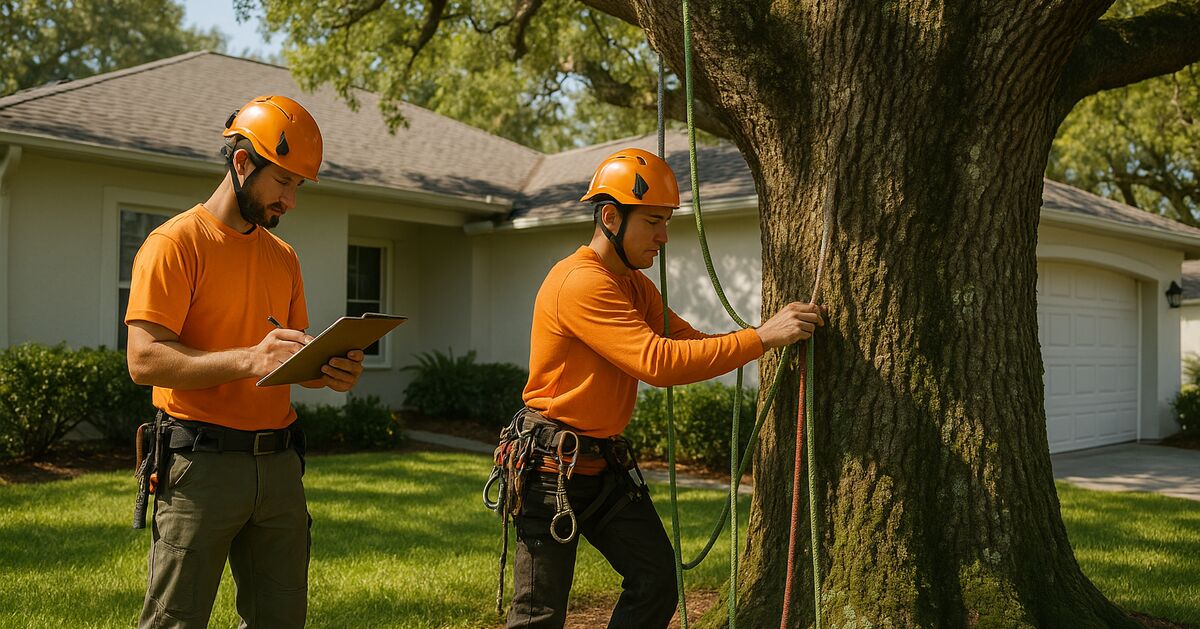
Hiring the wrong kind of help for your trees can cost you a beautiful oak, a healthy root system, or a significant chunk of money on damage that never needed to happen. So before you call anyone, it pays to understand what separates an ISA Certified Arborist from a general tree crew, and, just as importantly, when you actually need one versus when a skilled crew is perfectly sufficient.
What a "tree crew" actually is
A tree crew is a team trained in the physical work of cutting, climbing, rigging, and removing trees and large limbs. The best crews are skilled tradespeople. They know how to fell a tree safely in a tight yard in Nokomis, work around power lines in a North Port neighborhood, or drop a large palm in sections on Siesta Key without touching the pool screen below. Their work is governed by ANSI Z133, the safety standard for arboricultural operations, which covers everything from rigging angles to personal protective equipment.
None of that requires a biology degree. A great crew can execute work to the letter of ANSI A300 pruning standards without holding a certification themselves, provided someone who understands those standards has directed the job.
That last clause is the key.
What an ISA Certified Arborist actually is
ISA stands for the International Society of Arboriculture. Certification is granted to individual people, not companies, after they pass a comprehensive exam covering tree biology, soil science, diagnosis, pruning physiology, cabling and bracing, and safety. Ongoing continuing education is required to keep the credential current.
This distinction matters enormously when you are shopping for tree care. A company can call itself anything. What you can actually verify is whether a specific named individual holds an active ISA certification. At Eagle Eye Tree and Land Services, that person is owner Michael Calabro, ISA Certified Arborist FL-362432A. You can look that certificate number up on the ISA's public verification tool to confirm it is valid and current.
Our post on how to check whether the arborist quoting your tree is actually certified walks you through the verification process step by step. It takes about two minutes and is absolutely worth doing before you sign anything.
The jobs where a crew alone is genuinely enough
Honest answer: a large portion of residential tree work does not require an arborist to be standing in your yard directing every cut. Here are situations where a well-trained crew executing a clear scope of work is perfectly appropriate:
- Routine crown cleaning on a healthy tree. Crown cleaning under ANSI A300 means removing dead, dying, diseased, or weakly attached branches from an otherwise sound canopy. The biology here is not complicated. The main requirement is that cuts follow proper technique (collar cuts, not flush cuts or stubs) and that no more than the specified percentage of live crown is removed at one time.
- Mechanical removal of a tree that is clearly dead or already fallen. If a storm drops a sand pine across your driveway in Englewood, the job is rigging and removal. You need people with the right equipment and ANSI Z133 safety training, not a diagnosis.
- Palm trimming. Florida's native and naturalized palms are monocots, structurally very different from broadleaf trees. The biology of pruning them is simpler: remove dead fronds and seed pods, leave green fronds alone, and never over-trim (a practice sometimes called "hurricane cutting" that actually weakens palms rather than protecting them). A crew that knows these basics can handle routine palm care correctly.
- Land clearing on undeveloped lots. When the goal is clearing brush, removing invasive species, or prepping a lot for construction, the work is mechanical rather than diagnostic. Our post on clearing a lot before you build covers which trees are worth preserving and which ones typically have to go, but the physical clearing itself does not require on-site arborist supervision at every moment.
- Stump grinding. This is purely mechanical. The grinder does not care whether a certified arborist is watching.
The jobs where you genuinely need that certified arborist involved
Now here is where the stakes change.
Diagnosing a tree you are not sure about
A tree that looks sick, leans noticeably, has bark anomalies, or has been losing canopy over a season or two needs a diagnosis before anyone picks up a saw. Cutting the wrong branches, or removing a tree that was actually saveable, is an irreversible mistake. Keeping a tree that is structurally compromised is a liability.
The Gulf Coast's sandy soils create specific challenges. Trees planted in the fill soils common around Sarasota and Venice often develop buried root collars, girdling roots, or compaction problems that are invisible until someone trained to look for them does a proper assessment. That assessment is an arborist's job. Our post on root collar excavation and air spading describes what those inspections often reveal and why they matter so much for long-term tree health.
Structural pruning on young trees
The pruning cuts made on a tree in its first ten to fifteen years of life determine its structure for decades. Done correctly, structural pruning, per ANSI A300 Part 1, reduces the likelihood of future branch failure, manages co-dominant stems, and establishes a clear dominant leader. Done incorrectly, it can set up failure points that will not become obvious until a named storm rolls through.
This is not work to hand to a crew without arborist guidance. Our post on structural pruning on a young tree goes deep on the specific decisions involved and why they matter so much for trees in the long run.
Any situation involving cabling or bracing hardware
Installing supplemental support systems requires an understanding of how a specific tree's structure loads under wind, what type of hardware is appropriate, and where anchors should be placed to actually help rather than harm. ANSI A300 Part 3 governs supplemental support systems and is specific about assessment, hardware specifications, and inspection intervals. Getting this wrong can give a homeowner false confidence in a tree that remains dangerous, or damage a tree that could have been saved. See our post on cabling and bracing for a full breakdown.
Choosing and planting new trees
Species selection for Gulf Coast conditions, specifically the sandy, low-nutrient soils common from Osprey down to Placida and Englewood, is a genuine specialty. A tree that thrives in the clay soils of North Carolina may struggle and fail in Sarasota County within a few years. The arborist's job here is matching the right species to the right site before a single dollar is spent on a plant. Our post on choosing and siting a new tree for sandy Gulf Coast soil covers this in detail.
Permit applications and expert documentation
Many municipalities in Sarasota and Charlotte counties are reported to require a certified arborist's assessment before issuing a tree removal permit for protected species, so it's worth checking with your local jurisdiction. Casey Key, Manasota Beach, and similar areas with canopy ordinances may require specific documentation. If a tree is causing a neighbor dispute, is potentially the subject of an insurance claim, or is involved in a real estate transaction, you need someone who can sign a written assessment with credentials behind it.
Waterfront and mangrove-adjacent properties
Properties along Little Sarasota Bay, the Intracoastal near Laurel, or tidal areas near Placida often have mangroves near the property line. Florida law places specific restrictions on what a landowner can and cannot do to mangroves without permits and professional involvement, so check current regulations before acting. Our post on mangrove trimming and Florida law explains exactly where those lines are drawn.
The insurance question you should not skip
Before anyone starts work, ask two questions: Does the company carry general liability insurance? And does it carry workers' compensation coverage?
Both matter, but they protect you differently. General liability covers damage to your property. Workers' comp covers a crew member who is injured on your land. Without it, that injured worker's medical costs and lost wages can become your legal exposure as the property owner.
Our post on why general liability alone is not enough explains how this works in plain terms. This applies whether you hire an arborist or a crew only.
A practical decision guide
Here is a simple way to think about it:
- Healthy tree, clear scope, no structural concerns? A skilled crew working to ANSI A300 specifications is appropriate. Make sure they know those standards and ask how they handle crown ratios and branch collar cuts.
- Something seems wrong, or you are not sure what the tree needs? Get an arborist assessment first. The cost of a consultation is a fraction of the cost of removing a tree that could have been saved, or leaving one that eventually fails on a roof.
- Young tree, new planting, co-dominant stems, or a tree with a long future on your property? Involve an arborist at the planning stage. The decisions made early have outsized effects later.
- Permits, documentation, legal questions, or waterfront regulations involved? You need an ISA Certified Arborist by name, with a verifiable certificate number.
We are upfront about which hat we are wearing
At Eagle Eye Tree and Land Services, we serve homeowners across Sarasota, Venice, North Port, Osprey, Nokomis, Englewood, Siesta Key, Laurel, Casey Key, Manasota Beach, Placida, and Port Charlotte. We are straightforward about what we offer: owner Michael Calabro (ISA Certified Arborist FL-362432A) provides arborist-level assessment and direction, and our crew executes the physical work to ANSI A300 and ANSI Z133 standards.
When a job needs an arborist involved, we say so. When it does not, we say that too, because the goal is for your trees to be healthy and your property to be safe, not to upsell you on credentials you do not need for a given job.
You can learn more about our tree trimming, removal, and care services, browse all the areas we serve, or check our frequently asked questions if you are trying to figure out exactly what your situation calls for. When you are ready to talk through your specific trees, reach out and we will take a look.
Got a tree that worries you?
Free, no-pressure on-site estimate across Sarasota & Charlotte Counties.