
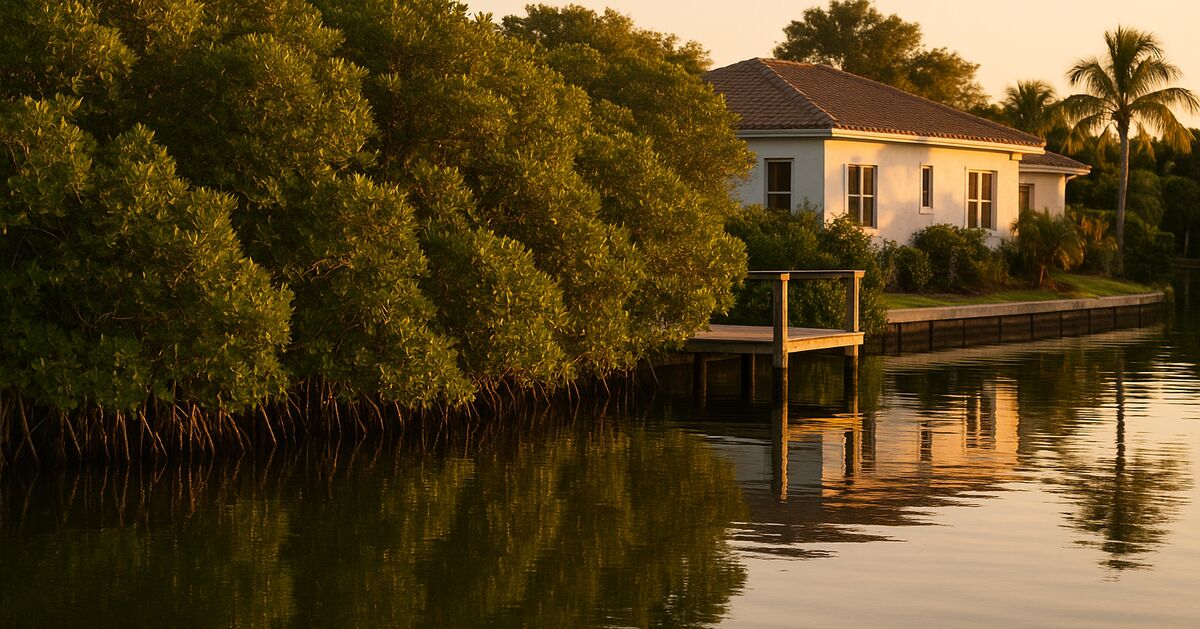
Florida waterfront property is stunning, and nothing tests a homeowner's patience quite like a wall of mangroves slowly swallowing a view they paid good money to enjoy. The instinct to grab a saw and reclaim a few feet of sightline is understandable. The consequences of acting on that instinct without understanding the law, however, can be severe enough to wipe out the savings the view was supposed to provide.
This post covers exactly what Florida's Mangrove Trimming and Preservation Act allows, what it prohibits, when you need a permit, who enforces the rules along the Sarasota and Charlotte County coastlines, and what you should realistically expect from a legal trimming project. No shortcuts, no vague reassurances. Just the actual framework, explained plainly.
Why mangroves are protected in the first place
Before getting into the rules, it helps to understand why they exist. Mangroves, primarily red, black, and white mangroves here in Southwest Florida, do an enormous amount of quiet work. Their root systems stabilize shorelines against erosion, absorb wave energy during tropical systems, filter runoff before it reaches the estuary, and provide nursery habitat for a huge portion of the fish species that make the Gulf Coast what it is.
The Florida Legislature recognized this in 1996 when it passed the Mangrove Trimming and Preservation Act, now codified under Section 403.9321 through 403.9334 of the Florida Statutes. The Florida Department of Environmental Protection (FDEP) is the primary state-level regulator, though in some counties, including Sarasota County, local governments have been delegated authority to administer the program.
The law does not ban trimming outright. It creates a tiered system based on the height of the mangroves on your property. That height distinction is where most homeowners either get it right or get it very wrong.
The three-tier system: what you can do without a permit
Florida's mangrove law sorts property owners into three situations depending on how tall their mangroves are. All measurements refer to the height of the mangroves on the parcel in question, measured from the substrate (the ground or sediment surface) to the top of the plant.
Tier 1: Mangroves shorter than 6 feet If your mangroves are less than 6 feet tall, you are generally not allowed to trim them at all without a permit. Short mangroves are considered the most vulnerable. Taking a machete to a young stand can set back decades of shoreline stabilization in an afternoon.
Tier 2: Mangroves between 6 and 24 feet This is the category most residential waterfront owners fall into along canals in North Port, Englewood, the Placida area, and along Casey Key and Manasota Beach. Here, the law allows a property owner to trim without a permit, but only under very specific conditions:
- You may not reduce the height of the mangroves by more than 25 percent in any 12-month period.
- You may not trim mangroves to a height below 6 feet.
- You may not remove any mangrove roots, including prop roots (the arching roots that are the red mangrove's signature feature).
- You may not use herbicides or other chemical treatments to defoliate or kill mangroves.
- Trimming must be done by a registered professional (more on that below) unless the mangroves total fewer than 50 feet of shoreline frontage, in which case a property owner may do it personally.
The 25 percent rule is where things get tricky in practice. A lot of homeowners eyeball it and cut more than they intended. A mangrove that is 20 feet tall can be reduced to 15 feet legally under this tier. Getting it to 10 feet is not permitted without a permit, and cutting it to 10 feet in year one and another 25 percent in year two still does not get you there legally if the result is below 6 feet.
Tier 3: Mangroves taller than 24 feet Mangroves over 24 feet fall under a different set of requirements. Any trimming of mangroves in this category requires a permit regardless of how much you intend to remove. If your shoreline has mature red mangroves that have grown well above the rooftops, stop before picking up any tools and call FDEP or the Sarasota County Natural Resources department first.
What "registered professional" means under the law
For any trimming that exceeds 50 linear feet of shoreline frontage, or that requires a permit, Florida law requires the work to be performed by a "registered mangrove trimmer." This is a specific FDEP registration, not a general contractor's license.
Registered trimmers have completed training on mangrove biology, proper trimming techniques, and the legal framework. They know the difference between a lateral branch cut that promotes healthy regrowth and a flush cut that kills the tree. They also carry the regulatory exposure if the work is done incorrectly, which is a meaningful incentive to get it right.
If someone shows up to trim your mangroves and cannot produce a current FDEP mangrove trimmer registration number, stop the job. Using an unregistered trimmer does not transfer liability away from you as the property owner. The law holds the property owner responsible for what happens on their land, regardless of who is hired to do the work.
Our tree trimming and removal services are focused on upland trees and palms, not mangroves, and that distinction matters. Anyone who offers to trim your mangroves should be able to demonstrate their specific FDEP registration, because the skill set and the legal framework for mangroves are genuinely different from those for upland tree care.
Permits: when you need one and who issues it
You need a permit for any of the following:
- Trimming mangroves taller than 24 feet.
- Trimming more than 25 percent of the height of mangroves between 6 and 24 feet.
- Any trimming project where the goal is a height reduction below what the exemptions allow.
- Removal of mangroves for any reason other than a very narrow set of exemptions (discussed next).
In Sarasota County, the county has accepted delegated authority from FDEP, so permit applications are generally handled locally. Charlotte County properties, including those around Englewood and Placida, coordinate with FDEP's Tampa District office. The process is not always fast. Environmental permit reviews for mangrove work can take weeks or months depending on the scope and the specific location.
Permits for mangrove trimming typically come with conditions: specific height targets, required follow-up inspections, and sometimes mitigation requirements if the proposed trimming is unusual in scale. Do not assume a permit will be automatically granted for whatever you want to do. Regulators will evaluate whether the proposed trimming falls within the intent of the law.
Removal: almost never legal without serious justification
Trimming and removal are fundamentally different categories under Florida law. Removal of mangroves, meaning cutting them at the base or using any method that kills the plant, is essentially prohibited for residential property owners except in a narrow set of circumstances.
The most commonly applicable removal exemption is for mangroves that are dead. If a mangrove has died for reasons unrelated to any unauthorized activity on your part, removal of the dead material is generally allowed. The operative phrase there is "unrelated to unauthorized activity." If mangroves die because someone applied herbicide without authorization, that exemption does not apply, and the property owner can face restoration orders requiring replanting.
Other removal exemptions exist, but they apply primarily to government agencies, certain public utilities, and situations involving navigation channels. A residential waterfront homeowner in Osprey or Nokomis who simply wants to open up a view does not qualify for a removal exemption under normal circumstances.
The penalties for unauthorized removal are real. FDEP can issue cease and desist orders, require full restoration of the mangrove community at the property owner's expense, and levy fines. Restoration of mangroves is slow and expensive. Replanted mangroves take years to establish, and the property owner is on the hook for the cost of planting and monitoring until the regulators are satisfied the restoration is successful.
The "single-family residential exemption" and its limits
There is a provision in the law that some homeowners misread as broader than it is. The single-family residential exemption allows property owners to trim mangroves on their property without a permit, subject to the tier-based rules described above, as long as the trimming does not remove more than 25 percent of the height and does not reduce the height below 6 feet.
This exemption does not allow:
- Any amount of root removal.
- Trimming in a way that opens a gap or "window" through the mangrove fringe by removing interior plants.
- Any use of chemical treatments.
- Work that results in the death of a mangrove, even if that was not the intent.
The window-cutting practice, where someone removes individual mangrove trees from within a fringe to create a view corridor, is a particularly common violation along canals in North Port and Englewood. It looks like just a few plants, but under the law it constitutes removal, not trimming, and it is treated accordingly.
What a compliant trimming project actually looks like
If your mangroves qualify for permit-exempt trimming under Tier 2, here is what a proper job looks like in practice.
A registered trimmer will measure the existing height before starting. That measurement establishes the baseline for the 25 percent calculation. They will mark target heights and work methodically, making cuts that encourage lateral regrowth rather than simply lopping tops. Mangroves respond to trimming by redirecting energy into side branches. A well-trimmed fringe remains dense and healthy at a managed height. A poorly trimmed one develops dead zones and gaps that invite further dieback.
The trimmer will document the work, typically with before-and-after photographs, because this documentation protects both the trimmer and the property owner if a complaint or inspection follows. Good documentation is not paranoia. It is a straightforward professional practice on any regulated activity.
After trimming, expect the mangroves to look rough for several weeks. Browning at the cut surfaces, some leaf drop, and initial die-back of terminal buds are all normal. Healthy mangroves in our Gulf Coast climate will begin showing new lateral growth within a growing season if the cuts were made correctly and no more than the allowed percentage was removed.
If you are on the fence about whether your situation requires a permit or falls under an exemption, the safest and cheapest step is a call to Sarasota County's Natural Resources department or FDEP before any work begins. Getting an informal confirmation of your situation takes a phone call. Responding to an enforcement action takes far more than that.
How this intersects with your other waterfront trees
Most waterfront properties along our stretch of coast have a mix of mangroves along the actual shoreline and upland trees, live oaks, sabal palms, slash pines, and various exotics, back from the water. The rules that govern mangroves have nothing to do with the rules that govern those upland trees, and the two should not be managed as a package deal.
For the upland trees, proper structural pruning under ANSI A300 Tree Care Standards, including crown cleaning to remove dead, diseased, or crossing branches, crown raising to improve clearance, and crown reduction where the structure of the tree warrants it, is well within what a qualified tree service can handle. Our full range of tree trimming and care services covers all of the upland work you might need.
If you are dealing with a palm that has gone downhill and you are trying to decide whether to save it or take it down, the considerations are different from the mangrove question entirely. The post on dead or dying palm trees covers that decision in detail.
For properties in Venice, Englewood, and along the Intracoastal through Nokomis and Osprey, the mix of mangrove fringe and mature upland trees is extremely common, and getting both right means working with people who understand the legal and horticultural distinction between them.
A note on HOA rules and county overlays
Some communities along Casey Key, Manasota Beach, and the Placida area have homeowner associations or deed restrictions that are more restrictive than state law. HOA rules can prohibit trimming that state law permits. They can also require certain aesthetic outcomes that create a conflict with what the environmental law allows. If your property is in a community with an HOA or a special environmental overlay district, check those rules before assuming state law is the only constraint you need to worry about.
Our frequently asked questions page covers some of the permit and regulation questions that come up most often for tree work in our service area, and it is a good starting point if you are sorting through what applies to your property.
The bottom line
Mangrove trimming in Florida is legal within a defined framework. That framework is specific, enforced, and not particularly forgiving of honest mistakes. The height tiers, the 25 percent rule, the registration requirements for trimmers, and the near-total prohibition on removal are all real boundaries that property owners along our coast need to understand before picking up any tools or hiring anyone else to do so.
View improvement is possible. Many waterfront homeowners in Sarasota, North Port, and the Charlotte County coastal communities have successfully managed their mangrove fringe within the law and maintained both a clear waterfront sightline and a healthy shoreline. The path to that outcome runs through the right registered professionals, a clear understanding of your tier, and documentation from start to finish.
For the upland trees on your property, from the live oaks in the back corner to the sabal palms along the seawall, reach out to us directly to talk through what the work involves and what it would take to get them shaped up properly. We serve Sarasota and the surrounding communities along the Gulf Coast, and we are happy to walk a property with you before any decisions are made.
Got a tree that worries you?
Free, no-pressure on-site estimate across Sarasota & Charlotte Counties.