
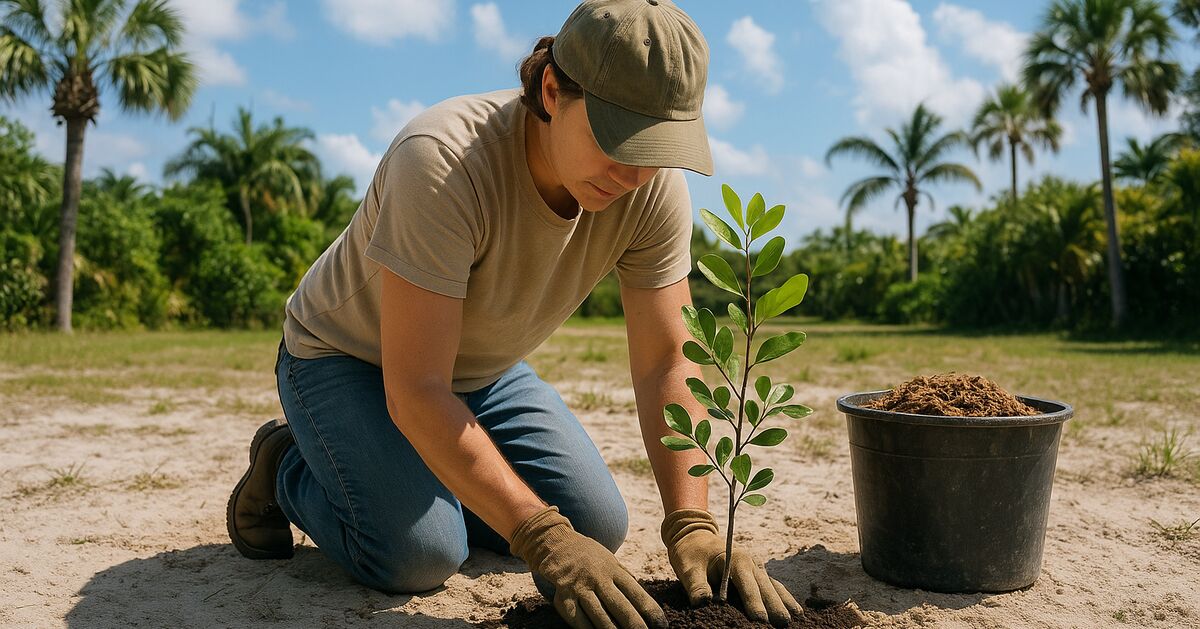
Sandy soil and a Gulf breeze sound like paradise, and in many ways they are. But that same fast-draining, low-nutrient sand that lines the yards of Sarasota, Venice, Osprey, Nokomis, Englewood, and the barrier islands gives new trees almost nothing to hold onto unless you choose species and placement with a little care. Get it right and you plant once. Get it wrong and a stressed, root-bound, or poorly sited tree becomes a hazard that eventually needs to come down. This guide walks through the whole decision, from soil reality to species to the exact spot in the yard, so your investment has the best possible chance of outlasting you.
What sandy Gulf-coast soil actually does to a tree
Most of Southwest Florida sits on ancient marine sediment. The top several feet is often fine quartz sand with very low organic matter, low cation exchange capacity (meaning nutrients wash through quickly), and drainage that can swing between bone-dry in a drought and briefly saturated after a heavy rain. A few miles inland, especially toward North Port or Port Charlotte, you may hit pockets of clay or muck, but the default near the coast is sand.
For a tree, this means a few things:
- Roots spread wide, not deep. Water and nutrients are near the surface, so most of a tree's structural roots stay in the top 18 to 24 inches of soil. That wide, shallow plate is what makes oaks and pines more vulnerable to wind than many homeowners expect.
- Nitrogen and phosphorus flush out fast. What you apply this week may be gone before a tree can fully use it, so slow-release fertilizers and compost amendments matter more here than in heavier soils.
- Salt tolerance is non-negotiable near the water. If your yard is within a few blocks of the Gulf, a bay, or a tidal creek, salt spray and occasional salt-laden flooding can kill species that look perfectly healthy in an inland yard.
- Heat load is higher. Sandy soil reflects and holds heat. A tree planted in open sand with no mulch will be fighting temperature extremes at the root zone that the same tree in loamy soil would never experience.
None of this means you cannot grow a beautiful, large canopy tree. It means your species list is not unlimited, and placement and after-planting care matter a great deal.
Start with the right species list
Florida-Friendly Landscaping guidance from UF/IFAS is a reasonable starting place, but the list below is drawn from what actually performs well in the specific sand-and-salt environment of the Gulf coast barrier islands and the communities just behind them.
Large canopy trees (mature height above 40 feet)
- Live oak (Quercus virginiana). The gold standard for Southwest Florida. Drought-tolerant once established, salt-tolerant, and long-lived. Its wide canopy means you need to think hard about placement (more on that below), but no other species gives you the same combination of shade, resilience, and longevity. Because live oaks develop significant structural roots, the early pruning decisions you make matter enormously. Our post on structural pruning on a young tree: the cuts that decide its next thirty years explains exactly why those first few years of pruning are so consequential.
- Slash pine (Pinus elliottii). Native to this region and adapted to periodic saturation followed by drought. Grows fast, which homeowners love, but requires space because the root system eventually spreads well beyond the drip line.
- Bald cypress (Taxodium distichum). Ideal for low-lying areas or yards that hold water seasonally. Surprisingly wind-resistant for its size because it tapers at the base and has flexible wood. Keep it out of spots that stay perpetually dry.
Medium trees (20 to 40 feet)
- Dahoon holly (Ilex cassine). Native, moderate salt tolerance, attractive berries that draw birds. Works well as a specimen or privacy planting.
- East Palatka holly (Ilex x attenuata 'East Palatka'). A hybrid that handles both wet and dry sandy conditions better than most hollies.
- Southern magnolia (Magnolia grandiflora). Tolerates sandy soil with adequate irrigation during establishment. The surface roots can be assertive, so give it room from walkways and foundations.
- Gumbo limbo (Bursera simaruba). An underused native that handles salt spray and dry sand beautifully. Its flexible trunk actually bends in hurricane-force wind rather than snapping, which is a meaningful advantage in our area.
Smaller trees and large multi-stem shrubs (under 20 feet)
- Yaupon holly (Ilex vomitoria). Tough, native, very salt-tolerant, and can be trained as a small tree or kept as a large shrub.
- Wax myrtle (Morella cerifera). Fast growing, salt-tolerant, great wildlife value. Often used as a privacy screen but can be limbed up into a small tree.
- Simpson's stopper (Myrcianthes fragrans). Fragrant, native, and well-suited to the dry sandy conditions common in Siesta Key, Casey Key, and Manasota Beach yards.
Species to approach with caution in this environment
- Laurel oak (Quercus laurifolia). Shorter-lived than live oak and more prone to internal decay. Worth knowing that laurel wilt disease is an additional threat to this genus in our region. Our post on laurel wilt disease: how to spot it and what to do next covers the warning signs.
- Royal palm (Roystonea regia). Elegant but not native, and the root ball stays relatively small, which can mean poor anchorage in sandy soil during a major storm.
- Exotic ficus species. Aggressive surface roots cause problems near pavement, foundations, and utility lines. Their eventual size is routinely underestimated at the nursery.
The siting decisions that matter most
Choosing the right species is only half the work. Where you put that tree in the yard often determines whether it thrives or becomes a problem that needs our tree removal and trimming services years down the road.
Distance from the house
A common rule of thumb is to plant large trees (those that will exceed 40 feet) no closer than 15 to 20 feet from the foundation. Medium trees can be a bit closer, around 10 to 15 feet. These distances are not arbitrary. In sandy soil, structural roots spread outward roughly one to one-and-a-half times the mature height of the tree, meaning a 60-foot live oak will have roots extending 60 to 90 feet from the trunk. Most of those roots stay shallow. They follow the path of least resistance through sand, and that path sometimes leads toward an irrigated lawn, a leaky pipe, or a paved surface that stays cool and damp.
Distance from utilities
The single biggest and most expensive siting mistake homeowners make is planting a large tree under or near overhead utility lines. A tree that eventually needs to be pruned away from lines will never look natural again, and the pruning required to maintain clearance often conflicts with proper ANSI A300 crown reduction guidelines. If your planting spot is within 20 feet of overhead lines, commit to a species that stays under 25 feet.
Prevailing wind and the Gulf coast exposure
Homes on or near the water in Englewood, Placida, Manasota Beach, or Casey Key face a more direct wind load than inland yards. For those sites, lean toward species with flexible wood (gumbo limbo, cypress) or the deep root establishment that a well-sited live oak eventually develops. Avoid large, fast-growing trees with brittle wood (some camphor, Brazilian pepper, and mahoe fall into this category) in exposed locations.
Sun, shade, and what's already there
Think about how the mature canopy will affect the rest of your yard. A live oak planted on the west side of the house will eventually shade the afternoon sun off your walls, which is a real cooling benefit in Sarasota and North Port summers. That same tree planted on the south side may shade a vegetable garden or solar panels you are planning. Walk the yard at different times of day, note where the sun travels, and put the tree where its mature shade will do the most good.
Planting in sandy soil: what to do differently
Sandy soil asks for a few modifications to standard planting practice.
Dig wide, not just deep. The planting hole should be two to three times the diameter of the root ball and only as deep as the root ball itself. You want the root flare (the point where the trunk widens at the base) sitting at or slightly above grade. Burying the root flare is one of the most common planting mistakes in Florida and leads to slow decline. Our detailed post on root collar excavation and air spading explains what happens when the flare is buried and how to diagnose it in existing trees.
Backfill with native soil. Resist the temptation to amend the backfill with a lot of compost or potting mix. The roots need to transition into the native sand, not stay cocooned in a rich pocket. A light amendment on the surface layer is fine, but the hole itself should be refilled mostly with what came out of it.
Mulch generously and correctly. A 3-to-4-inch ring of organic mulch extending to the drip line (or as far as practical) is one of the highest-value things you can do for a new tree in sandy soil. Mulch holds moisture, moderates soil temperature, adds organic matter as it breaks down, and keeps mowers and string trimmers away from the trunk. Keep the mulch a few inches clear of the trunk itself. Mulch piled against the bark holds moisture and promotes fungal problems.
Water slowly and deeply. Sandy soil drains fast, which means a quick overhead spray wets the top inch and then runs away. A slow drip or soaker hose applied for an extended period gets water down to where the roots actually are. During the first growing season, plan on watering two to three times per week in dry weather. Once a tree is established (usually 12 to 18 months for smaller trees, 2 to 3 years for larger ones), it can rely mostly on rainfall.
Skip the stakes unless you need them. Staking is often overdone. A tree that can sway a little in the breeze develops a stronger trunk taper. If you do stake (appropriate for larger trees or very exposed sites), use wide, flexible straps and remove the stakes after the first year.
After planting: the first three years
The establishment period is when a new tree is most vulnerable, and it is when the fewest homeowners pay attention.
Watch the root flare. If settling causes it to go below grade, correct it early. Watch for signs of nutrient deficiency common in our sand, especially interveinal yellowing on the leaves (often manganese or iron deficiency in palms; nitrogen in broadleaf trees). A slow-release granular fertilizer formulated for Florida trees, applied according to the label, is usually sufficient.
Think about early pruning, but lightly. The first couple of years are not the time for major crown work. Remove only dead, broken, or crossing branches and let the tree develop its canopy. Once it is established, structural pruning by someone following ANSI A300 standards will set the architecture that determines how the tree performs for the next several decades. Michael Calabro (ISA Certified Arborist, certificate FL-362432A) regularly works with homeowners in Sarasota, Venice, Osprey, and the surrounding communities to build that early crown structure correctly.
Working with a local arborist before you plant
A species that thrives in one Sarasota yard might struggle two miles away because of soil depth differences, proximity to a tidal slough, or the presence of old fill material. If you are spending real money on a tree and you want it in the right spot, a site visit before you plant is time well spent. Our team covers the full Gulf coast area from Sarasota and Siesta Key down through Venice and Nokomis to Englewood and North Port. You can also browse our full service area and locations to see whether we cover your neighborhood.
An arborist can identify soil conditions that are not obvious from the surface, flag utility conflicts you might not have noticed, suggest species that work for your specific microclimate, and help you think through the eventual mature size so the tree you love at year one is still an asset at year twenty.
If you have questions before you are ready to plant, our frequently asked questions page covers a lot of the basics, and the contact page is the fastest way to reach us directly.
The short version
Pick a species native or well-adapted to Southwest Florida's sandy, sometimes salty conditions. Give large trees plenty of room from the house, hardscape, and utilities. Plant at the right depth, mulch well, and water slowly during the first couple of seasons. Then step back, prune lightly and correctly in the early years, and let the tree do what trees do. Done right, a live oak or bald cypress planted today could be shading your grandchildren's yard without ever becoming a problem. That is the whole point.
Got a tree that worries you?
Free, no-pressure on-site estimate across Sarasota & Charlotte Counties.