
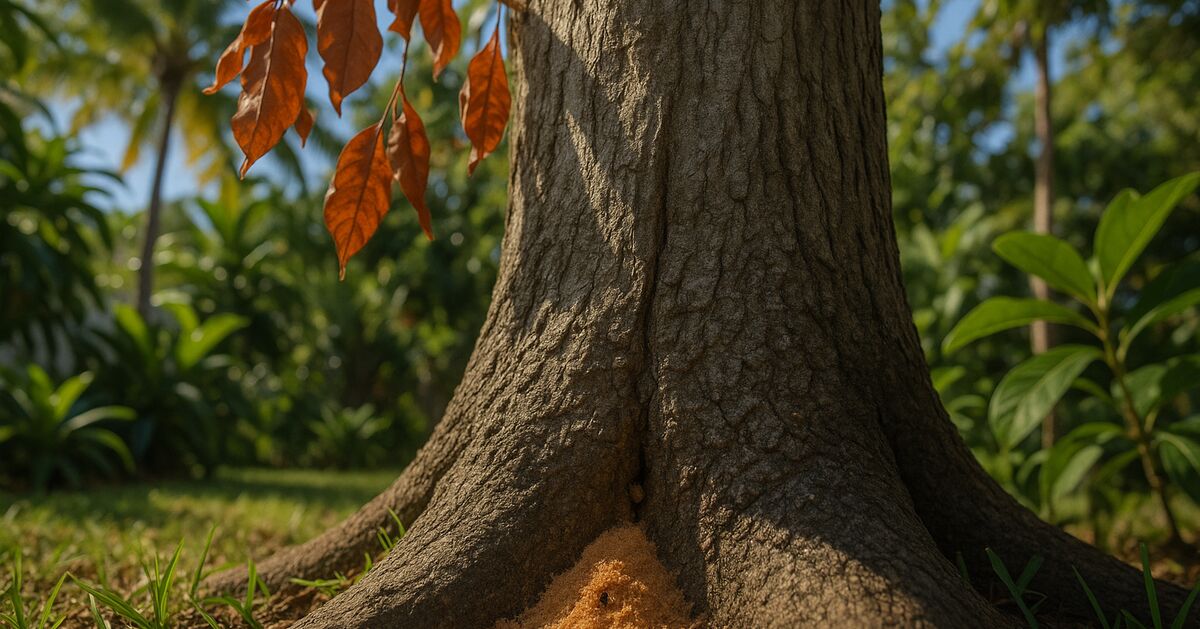
A perfectly healthy-looking avocado tree can be dead within weeks. That is not an exaggeration - laurel wilt disease moves that fast, and by the time most homeowners in Sarasota, Venice, North Port, or Englewood notice something is wrong, the tree is often beyond saving. Understanding what this disease is, how it travels, and what you can actually do about it is the difference between losing one tree and losing every susceptible tree on your property.
What laurel wilt disease actually is
Laurel wilt is a vascular disease caused by a fungus called Raffaelea lauricola. The fungus does not travel on its own - it is carried by the redbay ambrosia beetle (Xyleborus glabratus), a tiny invasive beetle originally from Asia that arrived in the United States around 2002 and has been spreading through the Southeast ever since.
Here is how the cycle works. A female beetle bores into the wood of a host tree, creating a small gallery where she lays her eggs. She carries the fungal spores with her. As the fungus grows inside the tree's water-conducting tissue (the xylem), it essentially clogs the plumbing. The tree can no longer move water from its roots to its canopy. It wilts, and then it dies - not over months, but often within four to eight weeks of the first visible symptoms.
The beetle is so small (roughly 2 millimeters) that most people never see it. What they see instead is the damage it leaves behind.
Which trees are at risk in Southwest Florida
Laurel wilt only affects trees in the Lauraceae family. In our area, that means two species matter most to homeowners:
- Redbay (Persea borbonia) - A native tree common in hammocks and coastal areas throughout Sarasota, Osprey, Nokomis, Casey Key, and Englewood. Many homeowners have redbay on their property without realizing it, especially on lots that back up to natural areas.
- Avocado (Persea americana) - The backyard avocado is one of the great joys of living in Southwest Florida, and it is also one of the most vulnerable hosts. The disease has devastated commercial avocado groves in South Florida, and residential trees throughout Charlotte and Sarasota counties are at risk.
Sassafras is also a laurel family member, but it is rare in our immediate area. Swamp bay (Persea palustris) is also susceptible and grows in wetland margins throughout the region. If you live near a preserve, a retention pond, or a natural drainage area anywhere from Placida and Port Charlotte up through Laurel and Siesta Key, there is a real chance laurel wilt is already present nearby.
Early warning signs you need to know
The challenge with laurel wilt is that it looks like a lot of other tree problems at first - drought stress, root damage, overwatering. Here is what distinguishes it:
Rapid wilting of leaves that stay on the branch. Most tree diseases or drought stress cause leaves to yellow before they drop. With laurel wilt, leaves turn brown and stay attached to the branch. The tree looks singed, almost as if it went through a fire. Arborists sometimes call this "flagging."
Wilting that starts at branch tips and moves inward. You may notice the outermost leaves on a branch going brown while the base of the branch still looks green. This moves quickly toward the trunk.
Blue-black or purple streaking in the wood. If you cut into an affected branch (one that still has attached brown leaves), the sapwood - the outer ring of wood just under the bark - will show dark blue, purple, or black streaking. This discoloration is the fungal colonization of the xylem. It is the single most reliable diagnostic sign.
Toothpick-sized boring dust. Look at the bark of the main trunk and larger branches. The redbay ambrosia beetle leaves behind tiny piles of very fine, toothpick-like boring dust or small tubes of compacted frass pushed out of entry holes. The entry holes themselves are barely visible - about the diameter of a ballpoint pen tip.
No response to watering. If you have been watering a wilting tree and nothing is improving, that is a meaningful clue. The problem is not water availability - it is that the tree cannot use the water in the ground because its vascular system is blocked.
If you see the combination of rapid browning with leaves attached and blue-black streaking in the wood, treat it as laurel wilt until proven otherwise.
How the disease spreads from tree to tree
Understanding transmission is important because it shapes what you can and cannot do to protect your remaining trees.
The primary vector is the beetle itself. Beetles emerge from an infected tree carrying spores and then fly to a new host. They can travel meaningful distances on their own, but the bigger risk in residential neighborhoods is movement of infected wood. When homeowners cut down a dead redbay or avocado and leave the wood on-site, or worse, move it to another part of the yard or give it away as firewood, they may be spreading beetle populations and spores to new areas.
Firewood transport is one of the documented drivers of ambrosia beetle spread across the country. Do not move wood from a tree you suspect has laurel wilt. Do not chip it and spread the chips as mulch near other susceptible trees. The safest approach is to have infected wood removed promptly and processed or disposed of in a way that eliminates the beetle population inside.
Root-to-root transmission is also possible when tree roots from neighboring trees are touching or grafted together, which can happen between mature trees planted close together. This pathway is less common in typical residential settings but worth knowing about.
What you can do to protect healthy trees
Here is the hard truth: once a tree is infected with laurel wilt, there is no cure. There is no spray you can apply to the canopy, no fertilizer program, no pruning that will reverse the fungal colonization. A tree with active laurel wilt is a dying tree.
What you can do is focus on protection of trees that are not yet infected.
Propiconazole trunk injection. The only management tool with meaningful documented results for avocado trees is prophylactic injection of a systemic fungicide, typically propiconazole, directly into the trunk. This is a preventive measure, not a cure. It must be done before infection. The fungicide moves through the xylem and can suppress the Raffaelea fungus if the beetle introduces it. Injections need to be repeated on a schedule because the treatment does not last indefinitely. This is a job for a professional - improper injection technique can damage the vascular tissue you are trying to protect.
Remove infected trees quickly. Every infected tree on or near your property is a source of beetles that can spread to your healthy trees. Prompt removal limits that reservoir. Our tree removal and care services include handling diseased wood safely, which matters specifically in a situation like this.
Avoid wounds during high-risk periods. Fresh pruning cuts and mechanical wounds can attract ambrosia beetles. If you have healthy avocado or redbay trees, try to schedule any necessary pruning outside of the warmest months when beetle activity is highest. When pruning is necessary, clean cuts that close properly are much better than ragged wounds.
Do not move potentially infected wood off-site. If you have a redbay or avocado that has died or is dying, have the wood processed on-site or hauled away by a professional rather than stockpiling it or sharing it.
Monitor regularly. Walk around your avocado and redbay trees every few weeks during spring and summer. Look for the early flagging symptoms and the boring dust at the base of the trunk. Earlier detection gives you more time to protect neighboring trees.
What to do if you think your tree is infected
First, do not panic-prune. Cutting branches off an infected tree does not stop the disease, and it generates fresh wounds that can attract more beetles.
Second, get a professional assessment. The blue-black streaking in the wood is the clearest diagnostic indicator, but a trained arborist can also assess whether what you are seeing is actually laurel wilt versus drought stress, another fungal issue, or root damage. Misidentification leads to wasted effort.
Third, think about the other susceptible trees nearby. If you have one avocado and one redbay in the yard and one is infected, the other is already at elevated risk. A conversation about protective injections for the healthy tree becomes urgent, not optional.
Fourth, plan for removal. Our team serves homeowners across the region, from North Port tree removal and surrounding areas to Venice tree care and communities all along the coast. If you have a confirmed or suspected laurel wilt case, timely removal is genuinely important - not just for the aesthetics of your yard but for the health of nearby trees.
You can also browse our frequently asked questions for general guidance on what to expect from a tree removal process.
Replanting after losing an avocado or redbay
If you lose a tree to laurel wilt, replanting with another avocado or redbay in the same spot carries real risk as long as beetle pressure exists in the area. The pathogen can persist in root debris in the soil.
For redbay, there are currently no commercially available resistant varieties. For avocado, research into resistant rootstocks is ongoing, but nothing is widely proven yet for our area.
Replanting with a different species entirely is often the practical choice in the near term. There are beautiful, low-maintenance native trees and fruiting trees that do well in Southwest Florida's sandy soils and humid climate. A qualified arborist can suggest species appropriate for your specific lot, light conditions, and soil. For more on what to expect during and after any tree removal and replanting process, our post on what happens to your yard after a tree is removed covers the practical questions in detail.
The bigger picture for our region
Laurel wilt has already dramatically reduced the redbay population in parts of Florida and the Southeast. In coastal hammock ecosystems near Osprey, Casey Key, and Nokomis, redbay plays an ecological role - it is a larval host plant for the palamedes swallowtail butterfly, among other connections. The loss of redbay at a landscape scale has real effects beyond any individual yard.
For homeowners with avocado trees, this disease represents a genuine threat to trees that often have real sentimental and practical value. A mature backyard avocado tree that has been producing fruit for a decade or more is not easily replaced.
Our Sarasota tree care team and crews across Englewood and surrounding communities are familiar with laurel wilt and can help you assess your trees, plan for removal of infected specimens, and discuss protective options for healthy ones.
If you are not sure what you are looking at - or you just want a second set of eyes on a tree that does not look right - the right move is to have someone come take a look before the situation becomes an emergency. You can reach us through our contact page to schedule an assessment.
The best outcome here is catching it early, acting on what you find, and protecting everything around it. Laurel wilt does not slow down on its own, but informed homeowners who move quickly have the best chance of keeping their healthy trees standing.
Got a tree that worries you?
Free, no-pressure on-site estimate across Sarasota & Charlotte Counties.