
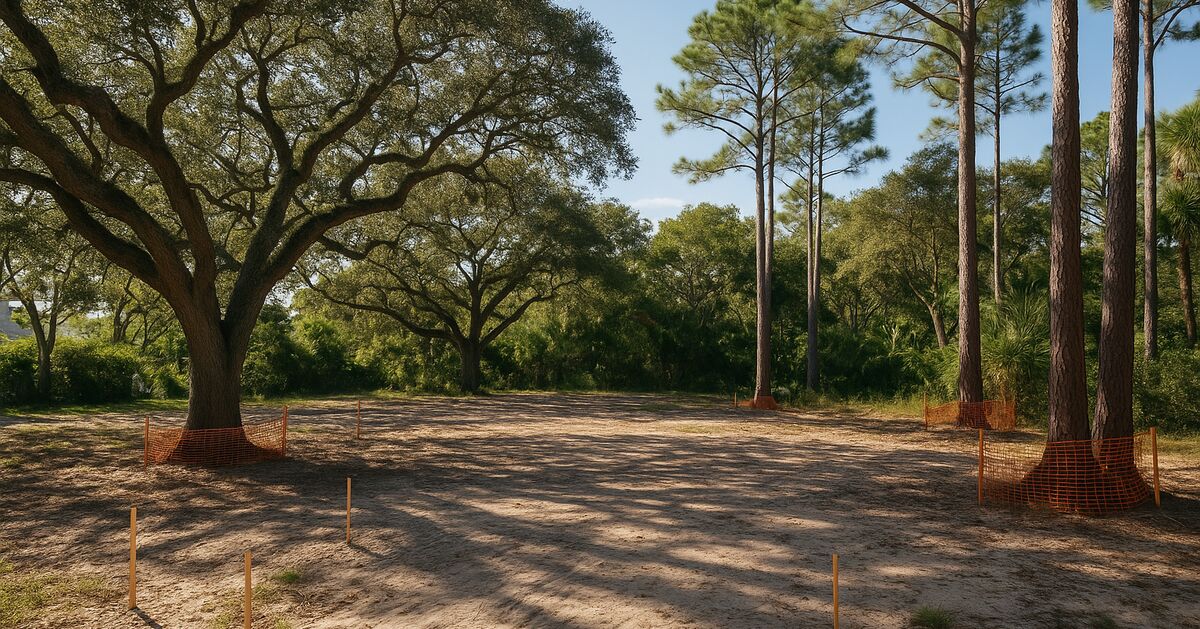
Every tree on a vacant lot looks like a problem to a builder and a treasure to a future homeowner. The truth is most lots in Sarasota, North Port, Englewood, or Venice sit somewhere in the middle, and the trees you keep now will shape your property for the next fifty years. Getting this right before the first stake goes in the ground is one of the smartest investments you can make.
This post walks through the whole decision process: how to read a tree before construction begins, what local rules apply, which species deserve serious thought before you cut, and how to protect the trees you decide to keep while heavy equipment is rolling around them.
Why the decision matters more before construction than after
Once a house is built, your options shrink fast. A live oak that sits fifteen feet from a finished lanai cannot be removed the same way one in the middle of an empty lot can. Access is tighter, the risk of damage to structures goes up, and the cost follows. More importantly, trees that survive a construction project intact often take two to five years to show stress injuries, so a tree that looks fine at your closing ceremony can be visibly declining by the time you've finished decorating the living room.
The reverse is also true. A tree you saved in haste because it looked beautiful may be structurally compromised, rooted in a way that conflicts with your septic field, or simply the wrong species for that location. Removing it later means paying for the removal plus repairing whatever it damaged.
Making deliberate decisions at the start, with an arborist who can evaluate each tree on its own merits, is nearly always cheaper than reacting to problems after the fact.
Start with what the local jurisdiction requires
Before you make a single cut, check the permit rules for your municipality or county. This is not optional, and the rules vary meaningfully across the area we serve.
- Sarasota County protects certain specimen trees by size and species. Removing a protected tree without a permit can result in substantial fines and required mitigation planting.
- The City of Sarasota has its own tree ordinance, separate from the county, that covers canopy requirements on developed lots.
- North Port and Venice each enforce their own codes. Venice in particular has active code enforcement around oak removal.
- Charlotte County, which covers areas like Englewood, Port Charlotte, and Placida, uses a different permit structure than Sarasota County.
The general rule across all of these jurisdictions is that protected trees (commonly live oaks, slash pines, and sabal palms above certain trunk diameters) require a permit to remove, and some removals require mitigation in the form of replacement planting or a fee paid into a tree bank. Our frequently asked questions page covers the permit question in more depth.
One practical note: the permit requirement applies even on a vacant lot you own outright. Owning the land does not automatically give you the right to clear every tree on it.
How to evaluate each tree before you decide
Not every tree is worth saving, and not every tree should be removed. Here is the framework an ISA Certified Arborist uses when walking a pre-construction lot.
Structural integrity
A tree with poor structure is a liability from day one of occupancy. The things to look for include co-dominant stems (two trunks of roughly equal diameter competing for dominance), included bark in major crotches, significant lean toward where the structure will sit, and signs of decay at the base or in major scaffold limbs. A tree with one or two of these issues may still be saveable if it's otherwise healthy and the issue can be addressed. A tree with several of them is a risk you would be taking on for the life of the building.
Our post on cabling and bracing explains when hardware can correct some of these structural problems, which is relevant for a tree you want to keep but that shows mild co-dominance.
Species and longevity
Florida has a wide range of native and non-native trees, and species matters a great deal when you're making a fifty-year decision.
Worth serious effort to save:
- Live oak (Quercus virginiana) - the gold standard of Florida shade trees. Deep canopy, long-lived, and well-adapted to sandy coastal soils. A large live oak adds measurable value to a finished property.
- Sabal palm (Sabal palmetto), Florida's state tree, which is also protected under state law in certain contexts. These transplant reasonably well and can often be relocated on the same lot rather than removed.
- Slash pine (Pinus elliottii) in good health, particularly mature specimens that have survived multiple hurricane seasons without failure.
Evaluate carefully before keeping:
- Laurel oak (Quercus laurifolia) - shorter-lived than live oak, more prone to decay. Worth keeping if young and healthy, less so if it's mature and near the footprint.
- Laurel trees in general deserve extra scrutiny right now because of disease pressure. Our post on laurel wilt disease explains why this is a real concern in Southwest Florida.
- Camphor (Cinnamomum camphora) - invasive, brittle, not worth designing around.
- Brazilian pepper (Schinus terebinthifolia) - invasive and should be removed as a matter of course.
- Melaleuca (Melaleuca quinquenervia) - invasive, highly flammable when dry, and actively regulated in Florida.
Root zone and construction footprint
Even a tree you plan to keep will suffer if its root zone is compromised during construction. The critical root zone (CRZ) of a tree is roughly the area under its drip line, though the actual feeder roots often extend well beyond that. Heavy equipment compacting soil inside the CRZ, trenching through it for utilities, or fill soil being placed over it can injure or kill a tree that looks perfectly fine the day it happens.
If your building footprint, driveway, septic system, or utility runs will necessarily pass through the critical root zone of a tree you're considering keeping, be honest about what that means. A tree that loses 40 to 50 percent of its root zone to construction disturbance is fighting an uphill battle from day one.
Position relative to the structure
Think about where the finished house, garage, pool, and driveway will sit, then think forward twenty years. A live oak that is currently twenty feet from the planned foundation may be a beautiful specimen, but in twenty years its surface roots will be at or under the driveway. A slash pine positioned so its crown will overhang the roof is a liability during every hurricane season for as long as the house stands. Our tree and land services page covers the kinds of work we do both before and after a home is built.
This is not an argument for removing healthy trees. It is an argument for thinking clearly about spacing and placement, and for sometimes relocating a tree rather than simply cutting it.
Protecting the trees you decide to keep
Deciding to keep a tree is only the first step. The tree then has to survive the construction process, which is genuinely hard on roots, soil structure, and bark.
Before any equipment arrives:
- Have the trees you're keeping clearly marked with flagging tape and, ideally, physical barriers. Temporary fencing around the critical root zone is the most effective method.
- Provide the general contractor and all subcontractors with a written list of trees to protect. Verbal instructions get forgotten when there are six subcontractors on site over six months.
- Document the current condition of protected trees with photographs. This gives you a baseline if you need to make a claim later.
During construction:
- Keep all equipment, material storage, and vehicle parking outside the fenced critical root zone. Soil compaction from even a single pass of a loaded concrete truck can cause serious root damage.
- If trenching for utilities or irrigation cannot avoid the root zone entirely, hand-dig or use air-excavation methods near the trunk. This protects roots that a machine would simply sever.
- Avoid placing fill soil inside the root zone. Burying roots under even a few inches of additional soil changes soil oxygen and moisture levels in ways that damage the tree over time. Our post on root collar excavation and air spading explains what happens when roots are buried too deep, which is exactly what fill soil does.
After construction is complete:
- Have a qualified arborist assess the trees that were near the construction zone. Symptoms of construction stress (thinning canopy, early leaf drop, dieback of branch tips) often appear one to three growing seasons after the injury, not immediately.
- Mulch the root zone generously once work is complete. This helps restore soil biology that compaction disrupts.
- Do not fertilize stressed trees aggressively right after construction. It is counterintuitive, but a tree that has lost root function cannot take up fertilizer effectively, and excess fertility can cause other problems.
When removal is clearly the right call
There are trees where the decision is straightforward.
Any tree with active Ganoderma conk at the base should come down before construction begins. Ganoderma butt rot is a fungal disease that destroys the structural wood at the base of palms (and some hardwoods), and a tree with an active conk can fail without warning. Do not build near one.
Trees with large cavities in the trunk or major limbs, particularly those positioned where they would overhang the roofline or fall toward the structure, should be removed before construction. The construction process adds stress; a tree that is marginally stable before equipment arrives may not remain so.
Invasive species, as noted above, should be removed as a matter of routine. They have no ecological value on a managed lot and in some cases (Brazilian pepper, melaleuca) their removal is encouraged or required under Florida law.
Finally, any tree whose position relative to the building footprint makes its long-term presence genuinely incompatible with the structure should come down now, before the structure exists, when removal is safest and least expensive.
The role of a pre-construction arborist assessment
The most useful tool a lot owner has before breaking ground is a formal tree assessment from an ISA Certified Arborist. Michael Calabro (ISA Certified Arborist, certificate FL-362432A) performs these assessments for lots across our service area, from Sarasota to Osprey and south through Venice, Nokomis, and North Port.
A formal assessment gives you a written record of each tree's condition, species, approximate size, structural concerns, and a recommendation for each one. That document is useful for conversations with your builder, for permit applications, and as a record if a dispute arises later about tree protection during construction. The work is evaluated against the ANSI A300 Tree Care Standards, which provide the technical basis for decisions about retention, structural risk, and pruning needs.
The cost of this assessment is almost always a small fraction of what a single unexpected tree removal costs after a house is built, or what a structural failure costs if a tree that should have come down is left in place.
A practical sequence for lot clearing
Here is a reasonable order of operations for a lot in our area:
- Engage an arborist before you finalize the site plan. Sometimes the plan can be adjusted slightly to save a significant tree without compromising the build.
- Pull the required permits for any protected tree removals. Your arborist or a permit expediter can help with this.
- Remove invasive species, dead trees, and trees the assessment identifies as hazardous or incompatible with the build.
- Install tree protection fencing around all retained trees before any equipment arrives.
- Proceed with site clearing and grading, keeping equipment out of protected zones.
- After construction, have retained trees reassessed and begin a monitoring and care program.
The lots we work on across Siesta Key, Laurel, Casey Key, and Manasota Beach often have mature trees that are genuinely irreplaceable. A fifty-year-old live oak cannot be bought and installed the way a sod installation can. The decisions made at the clearing stage are the ones that determine whether that tree is still shading the back porch in 2075.
If you're planning a build and want a professional set of eyes on the trees before you commit to a site plan, get in touch with our team and we can schedule a pre-construction assessment. You can also browse the full range of tree care and removal services we offer throughout Southwest Florida.
Got a tree that worries you?
Free, no-pressure on-site estimate across Sarasota & Charlotte Counties.