
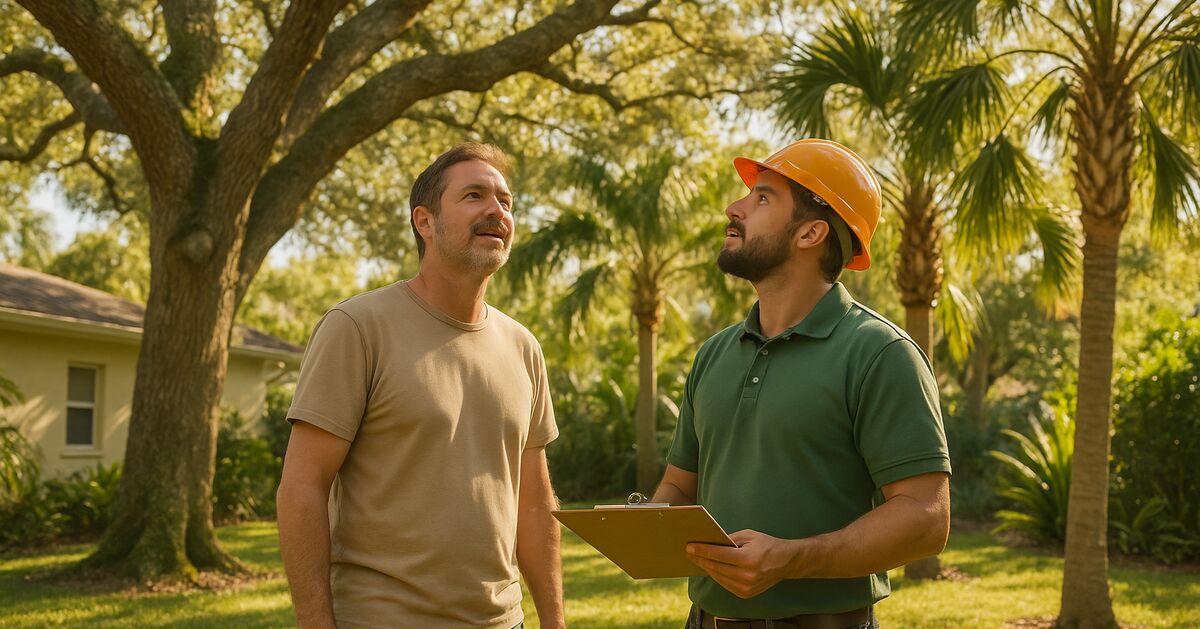
Hiring someone to work on a tree sounds simple until the job goes sideways and you discover you're the one holding the bill. A little homework before anyone swings a chainsaw on your property in Venice, North Port, Osprey, or Englewood can protect your wallet, your yard, and your legal standing. These five questions are not bureaucratic box-checking. Each one gets at something that actually changes the outcome for you.
1. Do you carry both general liability AND workers' compensation - and can I see the certificates today?
This is the first question, not the last, because it's the one most homeowners skip. General liability covers damage to your property if something goes wrong. Workers' compensation covers the crew if someone gets hurt on your land. You need both. One without the other leaves a gap that can land a lawsuit on your doorstep.
Florida law requires employers with four or more employees in most industries to carry workers' compensation, and the construction industry - which tree work falls under - has a one-employee threshold per the Florida Division of Workers' Compensation. That means even a two-person crew should be covered. But the requirement and the reality don't always match, especially among smaller operations.
Ask to see the actual certificates of insurance before work begins, not a verbal promise. A reputable tree service will hand them over without hesitation. The certificate should list you, the property owner, as a certificate holder so you get notified if the policy lapses. If a contractor hesitates or offers to "send them later," that hesitation is worth paying attention to.
We've written a full breakdown of exactly why both coverages matter in our post on what workers' comp means for you as the homeowner. Read it before you sign anything.
2. Who holds the ISA certification, and what is the certificate number?
The International Society of Arboriculture (ISA) certifies individual arborists, not companies. That distinction matters. A company can say it employs a certified arborist without that person ever setting foot on your property.
When you ask this question, you want a name and a certificate number. Both are public. The ISA maintains a searchable online registry where you can type in a name or number and confirm that the certification is current, not expired. This takes about ninety seconds and is completely free.
For example, at Eagle Eye Tree and Land Services, the ISA Certified Arborist is Michael Calabro, certificate number FL-362432A. You can verify that directly through the ISA's registry. That's the kind of transparency you should expect from anyone quoting your tree.
Certification signals that someone has studied tree biology, proper pruning technique, risk assessment, and soil science to a recognized standard. It doesn't make a person infallible, but it does mean they've been tested on the science behind what they're proposing to do. For a more detailed breakdown of how to verify credentials and what to look for, see our post on how to check whether the arborist quoting your tree is actually certified.
3. Do you top trees?
This question is a quick, effective filter. Topping, which means cutting back the main trunk or scaffold branches to stubs without regard for branch attachment points or the tree's structure, is one of the most harmful things a person can do to a tree. This practice tends to leave large open wounds that decay, encourages weak regrowth that is structurally inferior to natural branches, and can weaken or kill trees over time. The ANSI A300 Tree Care Standards - the standard our work is performed to - do not recognize topping as an acceptable pruning method.
If a contractor says yes, they top trees, or if they describe it as "reducing the height" without mentioning crown reduction to a lateral branch, move on. Legitimate crown reduction, as defined in the ANSI A300 standards, involves cutting back to a lateral that is large enough to assume the terminal role. It's selective, purposeful, and done with an understanding of how the tree will respond. That is a very different thing from running a saw straight across the canopy.
The right vocabulary to listen for: crown cleaning (removing dead, dying, or crossing branches), crown raising (removing lower limbs for clearance), crown reduction (reducing overall size back to live laterals), and structural pruning (training a young tree's architecture). If a contractor uses those terms correctly and can explain what they mean for your specific tree, that's a good sign.
For a deeper look at how good structural work shapes a tree's future, see our post on structural pruning on a young tree and the cuts that decide its next thirty years.
4. How is debris handled, and what happens to the stump?
Debris and stump handling are two areas where scope ambiguity is common in estimates, and where homeowners in Venice, North Port, Nokomis, and Englewood sometimes discover the job isn't finished the way they expected.
On debris: ask specifically whether all wood, branches, and chips will be removed from the property, or whether the crew plans to leave chip piles or logs for you to deal with. Some contractors chip material on-site and haul it. Others chip and leave it (which can actually work fine as mulch if you want it). Some leave logs for firewood, which can be a bonus or a burden depending on your situation. Know in advance which scenario applies to your yard.
On stumps: tree removal and stump grinding are typically separate line items. A contractor who quotes "tree removal" may mean exactly that - they bring the tree down and leave a stump at grade. Stump grinding is usually a separate service that grinds the stump a few inches below grade so you can grow grass over the spot or replant. Full stump removal, meaning pulling the root ball, is a more intensive operation and significantly more disruptive to the surrounding soil.
Ask clearly: "Does your quote include stump grinding? If not, what will be left, and at what height?" Then ask about the grinding depth and what happens to the grindings (they're usually left as mulch in the hole, which is fine). North Port and Port Charlotte properties tend to have more root spread in sandy soil, so it's worth asking how far out the grinder will go from the base.
5. Will the scope of work be in writing before you start?
A verbal agreement is not a contract. In the tree care business, scope disputes - "I thought you were going to take that limb all the way back," "I didn't agree to remove that branch" - are avoidable when everyone signs off on a written scope before the crew unloads their equipment.
A written scope doesn't need to be a legal document. It can be a simple one-page proposal that spells out:
- Which tree or trees are being worked on, and what operation is being performed (crown cleaning, crown reduction, removal, stump grinding, etc.)
- What will be removed from the property and what will be left
- Whether the stump is included
- The agreed price
- Any conditions (access to the yard, where the chipper will be parked, etc.)
Both parties sign it, and both parties keep a copy. That paper protects the homeowner if the crew doesn't finish what was agreed, and it protects the tree service if the homeowner later disputes the scope.
In Sarasota County and Charlotte County, where many properties are wooded and tree work can be substantial, a written scope also helps when you're comparing multiple quotes. If you've received estimates from three different crews and only one of them wrote down what they're actually doing, you can't meaningfully compare the prices.
For a deeper read on how to parse what's in an estimate, our post on what an arborist actually looks at during a tree assessment explains what's happening on the professional's side of the equation, which helps you ask better questions.
A note on permit requirements
Depending on where your property sits - Venice, North Port, Sarasota city limits, unincorporated Sarasota County, or Charlotte County - a permit may be required before certain trees can be removed or significantly pruned. Requirements vary by jurisdiction and by species. A reputable tree service operating in this area should know the local codes and should either pull the permit on your behalf or advise you clearly on whether one is needed.
If a contractor tells you permits are never required in this area, that isn't accurate. Ask them specifically: "Is a permit required for this job, and if so, who is responsible for obtaining it?" The answer tells you a lot about how familiar they are with local regulations.
Putting it together before you call
If you're in Venice, North Port, Osprey, or anywhere else we serve along the Gulf Coast, these five questions give you a solid framework before you pick up the phone:
- Show me both insurance certificates (general liability and workers' comp).
- Who is the ISA Certified Arborist on your team, and what's the certificate number?
- Do you top trees, or do you work to ANSI A300 pruning standards?
- What exactly happens to the debris and the stump - is grinding included?
- Will I receive a written scope of work before the job starts?
A contractor who finds these questions annoying is telling you something worth knowing. A contractor who answers them easily and transparently is demonstrating that they operate in a way that protects both their clients and their crew.
You can learn more about how we approach tree care across our service area or read through frequently asked questions we hear from homeowners in Venice, North Port, Sarasota, and beyond. When you're ready to talk through a specific tree, the contact page is the fastest way to reach us.
Good tree work isn't complicated to find. You just have to know what to look for before the chainsaw starts.
Got a tree that worries you?
Free, no-pressure on-site estimate across Sarasota & Charlotte Counties.