
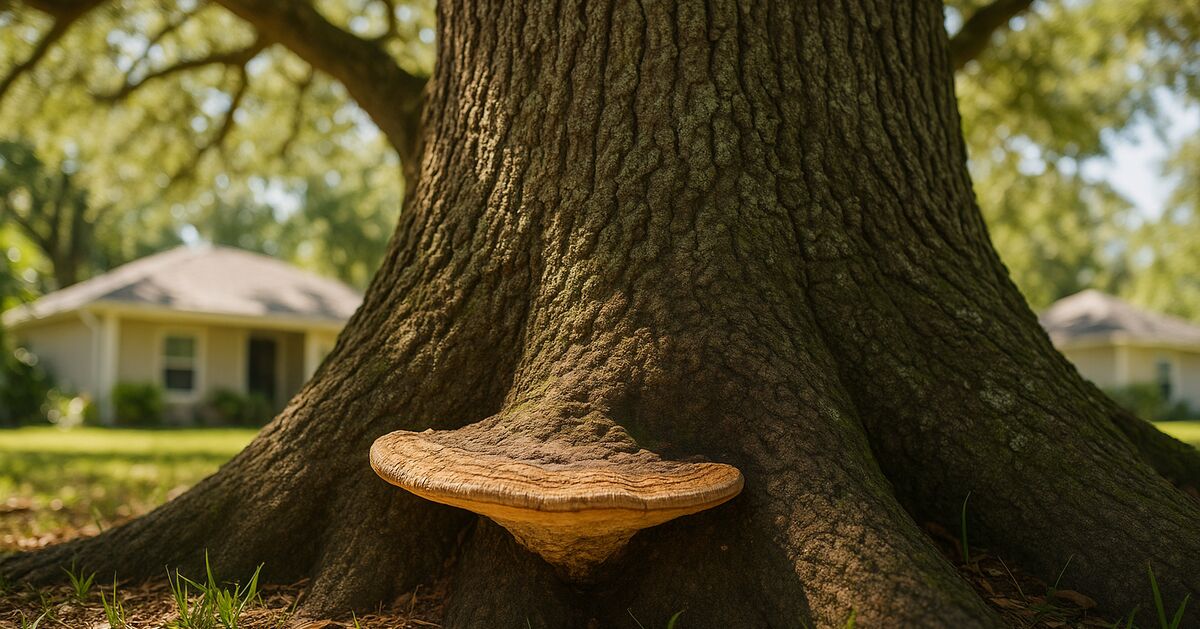
A shelf mushroom growing from your oak's trunk stops most homeowners cold. Is the tree coming down? Is it fine? The honest answer is: it depends on details that only a close look can settle, and those details matter a lot on the Gulf Coast, where a compromised tree and a tropical storm can meet with serious consequences.
This post walks through the three most common warning signs homeowners notice, including fungal conks, cavities, and cracks, and explains what each one can and cannot tell you about whether a tree is structurally sound.
What a fungal conk actually is
A conk is the fruiting body of a wood-decay fungus. Think of the mushroom you see in the grocery store: the mushroom is not the organism itself, it is the reproductive structure that appears when the organism has grown large enough to reproduce. The same is true of a conk on a tree. By the time you can see it with your eyes, the fungal colony inside the wood has typically been active for years.
Wood-decay fungi fall into two broad categories, and the distinction matters for risk assessment.
White-rot fungi break down both lignin and cellulose. They tend to leave wood looking pale, stringy, and spongy. The wood loses strength relatively evenly as the process advances.
Brown-rot fungi break down cellulose while leaving lignin largely intact. Brown-rot decay leaves wood that looks dark and breaks into small cubical chunks. Structurally, brown-rot wood can lose load-bearing capacity while still appearing solid to a casual glance, which is part of what makes it dangerous.
The location of a conk on the tree tells you a great deal. A conk at or near the base of the trunk (the butt, in arboricultural terminology) suggests decay in the root system or the lower trunk, where the tree's structural foundation lives. That is a higher-risk finding than a conk high in a secondary branch. Similarly, multiple conks at different heights on the same trunk suggest the fungal colony is widespread, not isolated.
Ganoderma species are a particular concern in Florida. If you have a palm, you have likely heard of Ganoderma butt rot. For palms, any Ganoderma conk near the base is a serious finding because palms lack the ability to compartmentalize decay the way broadleaf trees do. For oaks, laurels, and other hardwoods, the picture is more nuanced, but Ganoderma is still worth taking seriously given how aggressively some species colonize the root flare area.
When a cavity is cosmetic vs. when it is structural
Cavities form when decay that starts in a wound, a broken branch, or a crack progresses over time. A living tree responds to wounding by compartmentalizing the injured tissue, walling it off through a process described in the research of Dr. Alex Shigo as CODIT (Compartmentalization of Decay in Trees). CODIT is the reason that a tree can have a significant hollow and still stand for decades: the walls the tree builds between healthy and decayed wood can be remarkably effective.
That said, CODIT has limits. Several factors push a cavity from the cosmetic category into the structural concern category.
- Wall thickness. The ratio of sound wood thickness to the diameter of the hollow is a key variable. A commonly used field guideline is that a remaining wall of sound wood less than about one-third of the trunk diameter warrants careful evaluation. Thinner walls mean less bending strength, especially in wind.
- Cavity location. A cavity at the root flare or in the lower third of the trunk is far more concerning than one in an upper limb. Lower trunk and root failures lead to whole-tree failures, not just branch drops.
- Cavity opening orientation. A cavity that opens toward the direction of prevailing wind, or toward a structure the tree could fall on, adds consequence to the equation even if the structural loss is moderate.
- Active vs. closed. A cavity with dry, well-defined walls and callus wood rolling over the edges is behaving differently than one that is wet, soft to the touch, and expanding. Wet, soft cavities usually indicate active decay.
- Presence of fruiting bodies inside the cavity. If you shine a light inside and see conks, mycelium (white or rust-colored threads), or heavily discolored wood, that cavity is not stable.
One thing that comes up often in conversations with homeowners in Osprey, Nokomis, and the older established neighborhoods of Venice is the question of whether filling a cavity helps. The short answer, supported by current ANSI A300 tree care guidance, is that filling cavities with concrete or foam is no longer recommended. It does not restore structural strength, and it can actually mask ongoing decay by hiding the interior from future inspection.
Cracks: the ones that matter and the ones that do not
Cracks in bark and wood are probably the most misread sign of all. Many cracks are normal or at least benign. Others are a direct window into a failure that may already be underway.
Bark cracks that are not a major concern:
- Vertical cracks that follow the grain of young, fast-growing trees are usually growth cracks that close as the tree matures.
- Sun scald cracking on the southwest-facing side of a thin-barked tree (common in trees transplanted from shaded nurseries into full Florida sun) is a wound response, not a decay event. It does warrant monitoring, but by itself it is not a structural finding.
- Rough, furrowed bark that separates at the ridges is normal on mature live oaks and slash pines.
Cracks that deserve professional evaluation:
- Seam cracks that run vertically along the trunk and open and close with moisture changes can indicate included bark, a structural weakness where two co-dominant stems have grown together with bark tissue pinched between them. Included bark is generally considered a failure point in wind events, and it is often observed on live oaks along the Gulf Coast.
- Horizontal cracks or cracks that cross the grain of the wood are a higher-order concern. They can indicate compression failures in the wood, meaning the wood has already begun to buckle under load.
- Cracks accompanied by staining (dark, wet streaks running down the bark, sometimes with a sour or fermented smell) suggest a condition called slime flux or wetwood, which is bacterial, not fungal, but worth noting because it often co-occurs with decay entry wounds.
- Cracks at branch unions that extend into the branch collar zone can indicate a union that is failing. This is especially common on multi-stem trees where one stem has begun to shed bark at the union.
- Through-cracks, visible from one side of the trunk to the other when you sight along the trunk, are an urgent finding.
For homes in low-lying areas of North Port, Englewood, and Port Charlotte, where soils can be saturated for weeks after a major rain event, root zone changes are worth watching for. Saturated soils can reduce the anchoring function of root systems, so a crack pattern combined with a subtle lean that was not there before the rainy season may point toward root system compromise rather than trunk decay.
How a trained eye puts it together
None of these signs is evaluated in isolation by a competent arborist. The ANSI A300 Part 9 standard (Tree Risk Assessment) describes a systematic process that considers the likelihood of failure, the likelihood of a target being struck, and the consequences of that strike. A conk on a branch over an empty side yard is a very different risk profile than the same conk on a trunk leaning toward a screened lanai.
During an assessment, you should expect the arborist to physically examine the root flare (not just the trunk at chest height), probe suspect areas, assess crown condition as a secondary indicator of root and vascular system health, and consider site factors like prevailing wind direction, soil type, and proximity to structures.
ISA Certified Arborists are individually credentialed to perform this kind of evaluation. Michael Calabro (ISA Certified Arborist FL-362432A) carries that credential and applies it to assessments across our service areas throughout Sarasota and Charlotte Counties. ISA certifies individuals, not companies, so when you are shopping around it is worth asking specifically which individual on the team holds the certification, not just whether the company is affiliated with ISA.
Our post on what an arborist actually looks at during a tree assessment goes deeper on the full site visit process if you want to know what to expect before someone arrives.
Common mistakes homeowners make when evaluating these signs themselves
A mistake that comes up again and again when homeowners describe what they observed before a tree failed is assuming that because a tree has "always had that crack" or "had that hollow for years," it must be fine. Trees can and do stand with significant decay for long periods. The problem is that the progression of decay is not linear and is not visible from outside the tree. A wall of sound wood that was adequate last year may not be adequate after a drought weakens the root system or after a wet season accelerates fungal growth.
Another common error is focusing on the most visible sign and missing the context. A small conk on the trunk may be far less significant than barely-visible crown dieback in the upper canopy combined with a subtle lean. What an arborist actually looks at during a tree assessment covers why crown condition often tells the story that the trunk alone cannot.
Finally, homeowners sometimes confuse a diagnosis with a death sentence. Not every conk, cavity, or crack means removal. Sometimes crown cleaning (removing dead, dying, or diseased branches per ANSI A300 Part 1 terminology) reduces the load on a compromised stem enough to significantly reduce risk. Sometimes cabling and bracing can support a co-dominant stem with included bark. The full range of tree care services we provide is designed precisely to give trees the best chance while being honest when removal is the only responsible option.
What to do if you spot something concerning
If you are seeing one or more of the signs described here, the right move is to have the tree evaluated before hurricane season puts it under load. Here is a practical sequence:
- Photograph what you see. Date the photos. Note approximately how large the conk or cavity is and where on the trunk it appears.
- Note any recent changes. Has the tree developed a lean? Has the crown thinned? Has there been recent construction, grade change, or soil compaction near the root zone? All of these are relevant history.
- Keep people and vehicles away from the drop zone if the signs are severe (through-cracks, multiple basal conks, significant lean toward a structure).
- Get a professional assessment from someone who will document findings, explain the risk rating, and give you options rather than just a removal quote.
If you are in the Sarasota area, our Sarasota tree care team can schedule an assessment. Homeowners farther south toward Venice and Englewood are covered as well. Our contact page is the fastest way to get on the schedule.
For more on what a detailed decay investigation involves when a probe is used, our post on how to read a wood decay report explains what the numbers mean and what options typically follow different findings.
A final note on Florida's storm season
The Gulf Coast gives trees a hard test every year. Salt wind, periodic saturation, and the occasional named storm all stress root systems and create wound entry points for fungi. A tree that passed a casual look-over in March may be in a meaningfully different condition by the time August arrives. Scheduling a professional evaluation in late winter or early spring, before the rainy season and before the peak of hurricane season, gives you the most options. Findings that might lead to a careful crown reduction or targeted removal are always easier to act on when you have a few weeks of dry weather ahead of you rather than a storm bearing down.
If you are not sure whether what you are seeing warrants a call, reach out and describe it. We would rather spend five minutes on the phone telling you something is fine than have a homeowner in North Port or Siesta Key second-guess themselves until it is too late.
Got a tree that worries you?
Free, no-pressure on-site estimate across Sarasota & Charlotte Counties.