
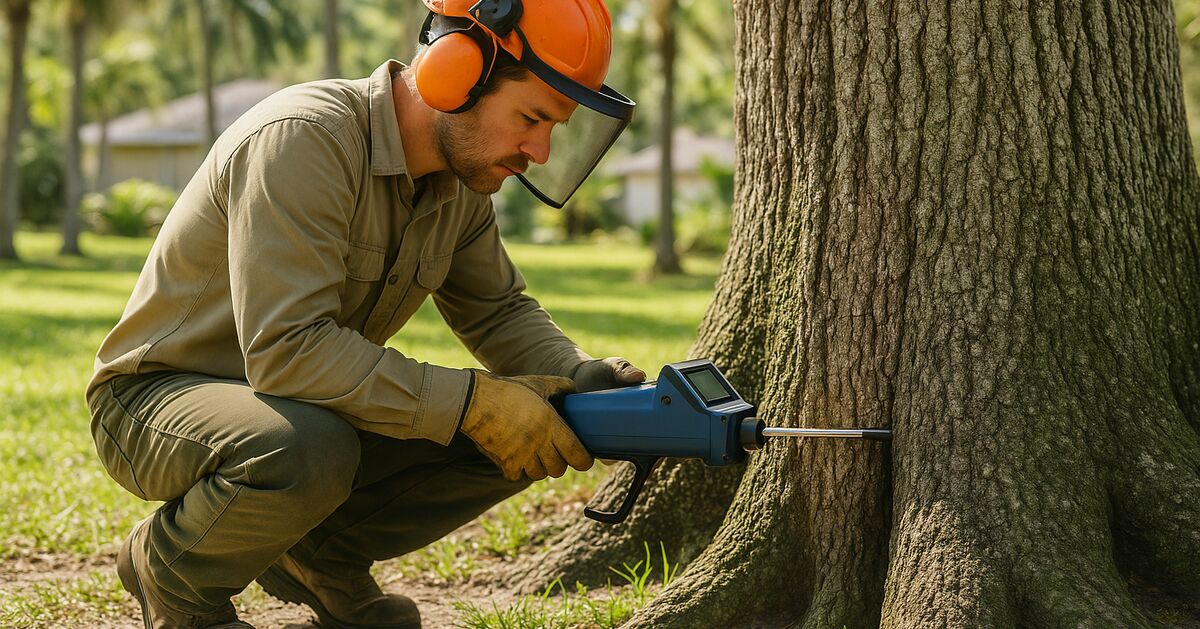
Decay in a standing tree is invisible from the street, and that invisibility is exactly what makes a probe report so valuable, and so confusing, to a homeowner reading it for the first time. Words like "advanced column," "sound shell," and "percent cross-section" can feel clinical and opaque when what you really need to know is: how worried should I be, and how long do I have?
This post walks through how professional decay assessment works, what the findings actually measure, what the numbers mean in practical terms, and how to have a useful conversation with your arborist once you have a report in hand. It is written for homeowners in Sarasota, Venice, North Port, Osprey, Nokomis, Englewood, and the surrounding communities we serve, where hot, humid conditions and sandy soils create a specific decay environment worth understanding.
Why arborists probe trees in the first place
External signs of decay, including conks, bark cracks, cavities, and dead branch tips, tell only part of the story. A mature live oak on a Siesta Key property, or a slash pine in North Port, can have a substantial internal column of decay while still looking reasonably healthy from the outside. The structural danger in that scenario is real: the tree's load-bearing cross-section has been reduced even though the canopy still produces leaves.
The ANSI A300 Tree Care Standards, which guide professional tree assessment and care practices, describe the evaluation of wood condition as a core component of any risk assessment. Probing gives the arborist information below the bark that no visual inspection can provide.
The two most common tools are a simple steel sounding mallet (used to detect hollow areas by listening for a dull thud versus a sharp ring) and a resistograph or similar micro-drill resistance tool. A resistograph drills a very fine needle into the wood and records the resistance the needle encounters, producing a paper or digital trace. Dense, sound wood resists the needle; soft or hollow wood lets it pass with almost no resistance. That trace is the core of your report.
Reading a resistograph trace: the basics
A resistograph trace looks like a jagged line moving across a graph from the bark inward to a target depth. Here is what the key features of that line mean:
- High, consistent peaks near the entry point indicate sound sapwood, the outer wood that is still hydraulically active and structurally intact.
- A sudden drop in the trace means the needle encountered decayed or hollow material. The depth at which the drop begins tells the arborist where decay starts from the surface.
- A flat line at the bottom of the graph means the needle found little to no resistance, indicating a hollow void or advanced wet rot.
- A partial recovery of the trace toward the center or far side can mean there is residual sound wood on the opposite side of the decay column, which affects the structural calculation significantly.
When your report refers to a "decay column," it is describing the zone of compromised wood the needle passed through. When it gives a dimension in inches or centimeters, that is how wide that column measured along the drill path.
The sound-shell calculation: the number that matters most
Once the decay column is mapped, the arborist calculates what is often called the "sound shell" or "residual wall thickness." This is the amount of structurally competent wood remaining between the decay and the outer bark. It is often expressed as a ratio or percentage of the total trunk diameter.
Arborists generally understand that when decay has consumed a significant portion of the trunk's cross-section, mechanical strength can drop substantially, since a tree's bending strength relies heavily on its outer rings. A hollow center is less concerning than decay that has eaten into the outer third of the trunk.
Many arborists use a rough guideline that a residual sound shell under about one-third of the total radius raises concern, though this varies by species and situation. When the decay column is wide relative to total trunk diameter, risk escalates. When substantial sound wood remains on the outside, the tree may be structurally serviceable for longer, depending on other factors.
Your report may state this as a percentage: for example, "approximately 35 percent cross-sectional area affected." That figure alone does not tell you everything. The location of the decay in the trunk (butt rot at ground level is far more serious than a column mid-trunk), its vertical extent, and whether the tree has any other defects all feed into the final risk rating. This is why you want the full picture from a qualified arborist who can walk through the assessment findings with you.
Decay location changes everything
A decay column that begins at the root flare or within the bottom two feet of the trunk, what arborists call "butt rot," is a fundamentally different situation than mid-trunk decay. Butt rot compromises the structural base of the lever. When a storm applies lateral load to the canopy, the bending stress is highest right at ground level. A weakened base has almost no room to compensate.
Some fungal pathogens seen in Southwest Florida, including Ganoderma species, tend to attack the butt zone of trees. If you have already read about Ganoderma in palms on this blog, the principle is the same in hardwoods: the base is ground zero, and by the time conks appear, decay is already well established. A resistograph inserted at the base of a symptomatic oak in Osprey or Englewood will often reveal a decay column far larger than the exterior signs suggested.
Mid-trunk decay above the root flare is still serious, particularly in tall trees, but it may offer more management time depending on the extent and the tree's species. Certain species, including live oaks, compartmentalize decay fairly well. Compartmentalization of Decay in Trees (CODIT), the model developed by Dr. Alex Shigo, describes how trees chemically wall off decay rather than healing it. A well-compartmentalizing tree can stabilize a decay column for years; a species that compartmentalizes poorly may see rapid spread.
What the ratings in a formal risk report mean
If your arborist is following the ISA's Tree Risk Assessment Qualification (TRAQ) framework, which the ANSI A300 Part 9 standard supports, the report will assign ratings to three components: the likelihood of failure, the likelihood that any failure strikes a target (your house, a parked car, a person), and the consequences if it does.
Those three components combine into an overall risk rating, typically expressed as: Low, Moderate, High, or Extreme.
- Low means the tree may have a defect but the probability of failure under normal conditions is small, or the target is rarely occupied. No immediate action is required, though monitoring is appropriate.
- Moderate means there is a meaningful probability of failure or a significant target. Mitigation, whether pruning to reduce the load, cabling, or more frequent monitoring, is warranted.
- High means failure is plausible under conditions that occur in Florida regularly (afternoon thunderstorms, tropical weather, wet soil). The report will typically recommend action within a defined window, not necessarily immediate removal.
- Extreme means the combination of failure likelihood and consequence is urgent. This rating should trigger action measured in days, not months.
Notice that "High" does not automatically mean "cut it down today." The rating is about risk, and risk can sometimes be reduced by other means. Our full range of tree care services includes cabling and structural pruning options that can bring a Moderate or even some High-rated trees into an acceptable range without removal.
The phrase "monitor and re-evaluate" and what it actually means
A report recommendation to "monitor and re-evaluate in 12 months" is not a dismissal. It means the current evidence does not justify the cost and loss of an immediate intervention, but it also means the tree's condition is not stable enough to ignore. Decay is biological and progressive. A column that measured 20 percent of the cross-section this year may be 30 percent by next summer, or it may barely change if the tree is compartmentalizing effectively.
For homeowners in areas like Laurel, Nokomis, or Casey Key, where large oaks or pines sit near pool cages, driveways, or screened lanais, a 12-month monitoring recommendation should be taken seriously. Mark your calendar. Have the follow-up done. And if you notice new symptoms between assessments, such as fresh fungal conks, new cracks, increased lean, or dieback in the crown, call before the scheduled re-evaluation.
What to ask your arborist after receiving a report
You are not expected to interpret a resistograph trace on your own. But you are entitled to a plain-language explanation, and there are specific questions worth asking:
- Where in the trunk is the decay, and what is the measured sound-shell thickness at the worst point?
- Is the decay active (soft, wet, with visible fungal mycelium) or arrested (dry, firm)?
- What species of decay fungus is likely involved, and how aggressively does it typically spread in this tree species?
- How does this tree's root zone look? Is there any sign of root decay or root loss that compounds the structural risk?
- If removal is recommended, is the recommendation based on the decay alone, or is it the combination of decay, target, and other defects?
- If you are recommending monitoring, what specific change in condition should prompt me to call sooner?
These questions help you understand whether you are dealing with a slow-moving situation or one that is approaching a threshold. Our FAQ page covers a number of related questions homeowners commonly bring to us.
Species matter in Southwest Florida
The trees that dominate yards from Manasota Beach to Port Charlotte each have their own decay profiles. Live oaks (Quercus virginiana) are generally thought to compartmentalize decay relatively well, which may allow them to tolerate moderate internal decay columns for longer periods if the sound shell remains adequate. Slash pines (Pinus elliottii) tend to be less forgiving; once decay enters the heartwood through a wound, the tree's resinous defenses can eventually be overcome, and progression may speed up after heavy rain saturates sandy soils.
Sabal palms present a different challenge entirely. Palms do not have secondary growth; their trunk is essentially a bundle of vascular fibers, not rings of wood. They do not compartmentalize in the CODIT sense. Decay in a palm that has entered the central growing meristem is terminal. A resistograph is rarely the primary tool for palms; instead, proper palm assessment focuses on crown health, petiole attachment strength, and base integrity.
How assessment translates into a timeline recommendation
After reviewing the probe trace, the decay location, the species, the CODIT response, the target zone, and any other structural defects, the arborist should be able to give you a practical recommendation: act now, act within the season, monitor for one cycle, or simply continue normal care.
That recommendation should be written in the report, not just spoken at the end of a site visit. If you received a verbal assessment only, ask for a written summary. A written report gives you documentation, helps you communicate with your insurance carrier, and gives any subsequent arborist a baseline for comparison. Our locations page can help you confirm we serve your neighborhood if you want a second opinion or a follow-up assessment from a different perspective.
When a report recommends removal on a timeline, take the timeline seriously but also understand that "within 90 days" is different from "this afternoon." Use the window to plan properly: understand the scope, confirm the contractor is working to ANSI Z133 safety standards (the safety standard for arboricultural operations), and, if the tree is large or in a confined space, ask whether a crane will be involved in the removal process. Understanding when a crane is required can help you evaluate whether the quote you receive makes sense for the situation.
A word on who should be reading the probe
ISA certifies individual arborists, not companies. Michael Calabro, ISA Certified Arborist FL-362432A, is the certified professional behind our assessments. When you receive a decay report from us, it reflects a trained individual's interpretation of the findings, not a generic printout. If you are getting a report from any other firm, it is worth asking whether the person conducting the assessment is individually certified and, if so, under what credential and number. That is how you verify accountability.
A probe report is not the end of the conversation. It is the beginning of an informed one, and for the trees around your home in Sarasota, Venice, North Port, or anywhere along this coastline, that conversation is worth having carefully and completely.
Got a tree that worries you?
Free, no-pressure on-site estimate across Sarasota & Charlotte Counties.