
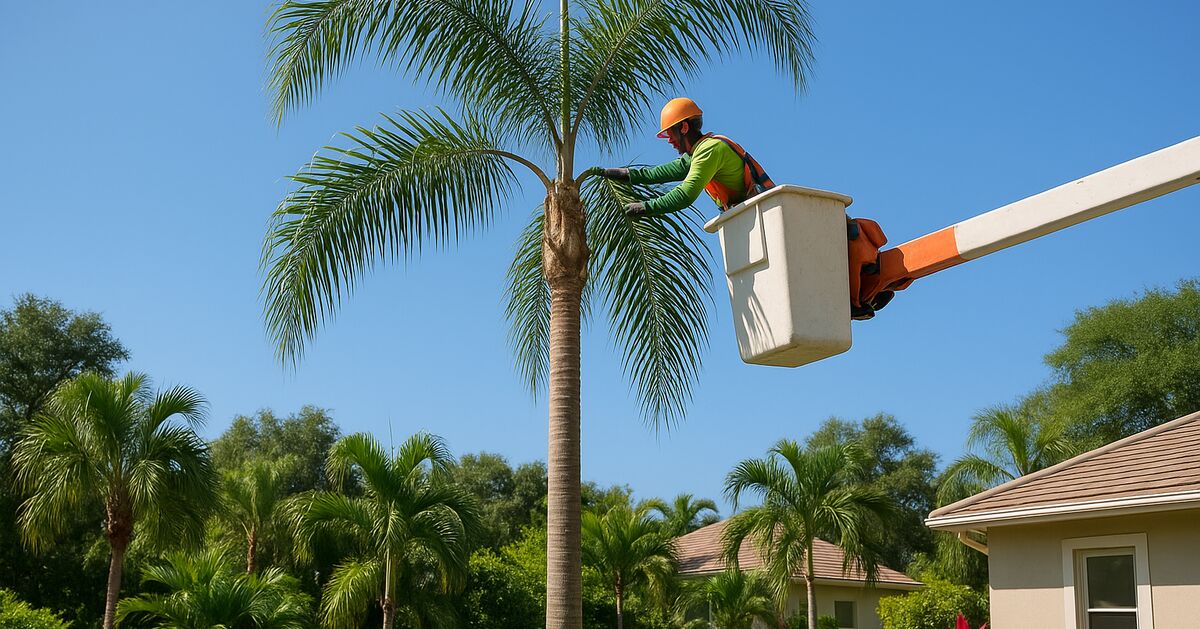
Grab a ladder and a pruning saw and you can hack a palm into shape in twenty minutes. The problem is that "shape" can quietly kill the tree over the next few years, or leave it structurally weak heading into the next hurricane season. Palm pruning is one of those tasks where the wrong approach looks fine on the outside while causing genuine damage underneath.
This guide walks through what to cut, what to leave, what to do with the tools you use, and how often the whole job should happen. It draws on the ANSI A300 Part 6 standard, which covers palms specifically, and on guidance from the University of Florida IFAS Extension, which has studied palm culture in this climate for decades.
Why palms are not like broadleaf trees
Before getting into the cuts themselves, it helps to understand what makes palms structurally different from the oaks and pines you may be used to thinking about.
A broadleaf tree has a vascular cambium, a thin layer just beneath the bark that regenerates and heals wounds over time. Palms do not. A palm is a monocot, which means its vascular bundles run through the entire trunk as a fixed structure. A wound on a palm trunk does not heal or close over the way it does on an oak. The tissue stays damaged, which is exactly why the style of cut matters so much.
The second key difference is the growth point. A palm has a single terminal bud at the top of the trunk, called the meristem or "heart." Every frond that will ever grow from that palm comes from this single point. Damage it through overly aggressive pruning, a careless cut, or a climbing spike, and the palm cannot recover. A palm with a destroyed meristem is a dead palm, even if it takes months to show it.
What a healthy frond looks like versus a dead one
The practical question when you are standing at the base of a palm is: which fronds actually need to come off?
Green fronds are doing photosynthetic work. They are producing the sugars that keep the palm alive, developing new fronds, and supporting root growth. Removing green fronds removes that energy. The ANSI A300 Part 6 standard advises against removing green fronds unless there is a specific structural or safety reason to do so.
Yellow or orange fronds are in transition. They have stopped photosynthesizing efficiently, but they are still translocating nutrients back into the palm before they die. Removing them early takes those nutrients away before the palm can reclaim them. In general, a frond that is still attached and not fully brown has not finished its useful life.
Brown, fully dead fronds hanging at or below horizontal are the ones to remove. They offer no biological benefit to the palm, and they can harbor pests including the palm weevil, which is a serious concern here in Southwest Florida. Fully dead fronds that hang down tightly against the trunk are sometimes called a "skirt," and removing that skirt is reasonable maintenance.
Flower stalks and fruit clusters can also be removed if the palm is a species that produces heavy fruit (a queen palm dropping seed pods on a patio, for example) or if the fruit itself poses a slip or injury hazard. Removing flower stalks before fruit develops is easier and puts less stress on the palm than removing heavy mature fruit clusters.
A simple, practical test: if you can pull a frond off with moderate hand pressure, it is ready to go. If it resists, it is not.
The "hurricane cut" and why it causes harm
A practice that comes up again and again in owner forums and neighborhood Facebook groups is the so-called hurricane cut, sometimes called a severe or "rocket" cut, where every frond except a tight cluster at the very top is removed before storm season. The thinking is that less foliage means less wind resistance.
University of Florida IFAS research on this subject is worth quoting directly: severe over-pruning stresses the palm, reduces its ability to produce new growth, and actually concentrates weight at the top of the trunk rather than distributing it. A properly-leafed palm flexes through wind loading in a way that a heavily pruned one with a top-heavy cluster cannot.
Beyond the physics, there is a biological cost. Removing green fronds means the palm has to draw on stored reserves to push out new growth. Do that year after year and the palm gradually weakens. You may notice the trunk diameter tapering, sometimes called "pencil-pointing," in the years after repeated over-pruning. That narrowing is structural weakness made visible.
The ANSI A300 Part 6 standard sets a practical guideline: prune only fronds that fall below the horizontal plane of the crown, meaning the nine-o'clock to three-o'clock position when you view the crown from the side. Fronds at or above horizontal are contributing to the palm's health and should stay.
How to make the cut correctly
Once you have identified the fronds to remove, the cut itself matters. Here are the specifics:
- Cut the frond close to, but not flush with, the trunk. Leave a small stub of a few inches rather than cutting right into the boot (the fibrous base attached to the trunk). Cutting into the boot damages the trunk tissue underneath, which, as noted above, does not heal.
- Do not peel or pull boots off the trunk. Some homeowners pull the dried boot material away to make the trunk look "clean." That peeling damages the underlying trunk tissue and can open pathways for fungal infection and insects.
- Never use climbing spikes on a palm you intend to keep. Spike wounds penetrate the vascular bundles that run through the entire trunk. Unlike with a broadleaf tree (where spike use is also problematic for different reasons), palm spike wounds go directly into living conducting tissue and do not close. A reputable crew will use a bucket truck, an aerial lift, or a ladder rather than spikes. If you see a crew strapping on spikes before climbing a palm you want to preserve, that is the moment to stop the job.
- Disinfect your tools between palms. This is not optional in Southwest Florida. Fusarium wilt, a fungal disease that moves from infected palms to healthy ones on contaminated blades, is present in this region. The University of Florida IFAS Extension recommends disinfecting pruning tools with a bleach solution (one part bleach to nine parts water) or isopropyl alcohol between each palm. It takes thirty seconds and can be the difference between one sick palm and a row of dead ones.
How often do palms actually need pruning?
The honest answer is: less often than most homeowners think, and far less often than many lawn-care crews suggest.
For a palm that is not producing fruit that creates a hazard, and that is not dropping fronds onto a structure or path, a single annual pruning is often enough. Some species in low-maintenance settings go two years between prunings with no problem.
Where the pruning schedule tends to creep up is when a crew is on a monthly or bi-monthly contract and trims a little something every visit. That pattern, trimming green fronds to make the palm look "clean" after each visit, is exactly how cumulative over-pruning happens. If someone is touching your palms more than once a year, it is worth asking what specifically they are removing and why.
Palms near structures in Sarasota, Venice, Englewood, or North Port may warrant two trims per year if they are heavy seed producers dropping fruit on a pool cage or lanai, but the answer is still not "as often as possible."
Species notes for Southwest Florida
Different palms common to this region have slightly different maintenance needs:
Sabal palm (cabbage palm) - Florida's state tree and the most common native palm here. Sabal palms self-prune old fronds naturally in many conditions. They do not need aggressive trimming. The boots often stay attached naturally and form a characteristic crosshatch pattern on the trunk; do not peel them.
Queen palm - Non-native and popular in Englewood, North Port, Port Charlotte, and throughout the area. Queen palms produce heavy seed clusters that can be messy and are worth removing before they fully develop. They can also be prone to trunk rot and nutrient deficiencies, so it's worth keeping an eye on their overall health during any pruning visit.
Canary Island date palm - Large, stately palms with sharp spines on the frond bases. Pruning these safely requires the right protective gear and careful technique. The characteristic "pineapple" cut at the crown is aesthetic, not horticultural, and removing more than dead material is not necessary for the palm's health.
Washingtonia palm - These tall palms produce a heavy skirt of dead fronds that builds up over time. Removing the skirt is reasonable maintenance, particularly where the accumulated material is a fire concern or pest habitat.
Areca palm - More of a clumping shrub-form palm used as a privacy screen. Dead canes can be removed at the base. Over-thinning removes the screening effect and stresses the clump.
If you are not certain which species you have, our post on choosing and siting a new tree for sandy Gulf-coast soil covers the common palms of this region and their site requirements in more detail.
Nutritional deficiencies show up at pruning time
One reason to have a knowledgeable person look at your palms when they are pruning rather than just a crew swinging blades is that palms in Sandy Southwest Florida soil are prone to specific nutritional deficiencies that show up as visible symptoms on fronds. Potassium deficiency causes frizzled, necrotic older fronds. Magnesium deficiency shows as a broad yellow band on older fronds with green at the tip. Boron deficiency causes distorted new growth at the tip of the crown.
A crew that simply removes affected fronds without noting the symptom pattern is taking away the diagnostic evidence. The deficiency continues, and the next set of fronds shows the same symptoms. Identifying the pattern and addressing it through appropriate slow-release fertilization (UF/IFAS recommends 8-2-12 or similar palm-specific formulas with micronutrients) is the durable fix.
When to call in an ISA Certified Arborist for your palms
Most healthy palms in routine condition can be maintained by a knowledgeable crew following ANSI A300 Part 6 guidelines. But there are situations where having a certified arborist assess the tree before any work happens is the right call:
- The palm is large, over a structure, or close to power lines
- You have noticed the crown leaning, thinning, or producing smaller new fronds than in past years
- There are visible signs of disease, unusual discoloration, or soft spots at the base of the trunk
- A previous crew did an aggressive cut and you want to understand whether the palm is recovering
- You are trying to determine whether a palm is worth treating or should come down
Michael Calabro (ISA Certified Arborist, certificate FL-362432A) provides assessments for exactly these situations. ISA certifies individuals rather than companies, so when you are evaluating any service, it is worth confirming which specific person holds a current ISA credential. Our post on how to check whether the arborist quoting your tree is actually certified walks through how to verify that in about two minutes.
For a broader look at what an arborist actually examines when they walk your property, see what an arborist actually looks at during a tree assessment.
What to expect from a professional palm pruning job
A well-run palm pruning visit should include:
- A brief visual assessment of each palm before cuts begin
- Tool disinfection between palms (ask if you do not see it happening)
- Cuts that leave small stubs rather than cutting into the trunk
- Removal of all dead fronds, seed clusters if agreed upon, and any fronds hanging below horizontal
- No removal of green fronds that are at or above horizontal
- Clean removal of all debris from the site
What it should not include is crews with climbing spikes, fronds stripped right to the trunk, or a dramatically skinned appearance that leaves only a small tuft at the top.
Serving palms across Southwest Florida
We work with palms throughout our service area: from the beachside properties on Siesta Key where Sabal and Queen palms are everywhere, through Nokomis and Osprey, south through Venice and Englewood, and into Port Charlotte and Placida. Each area has its own mix of species and conditions, and we bring the same ANSI A300-grounded approach to all of them.
If you have palms on your property that are overdue for attention, or if a previous crew left them looking rough and you want a second opinion, the contact page is the fastest way to get a conversation started. You can also browse the full list of what we do on the services page.
Palms are genuinely low-maintenance trees when they are managed correctly. The goal of good palm pruning is to do less, not more, and to do what you do cleanly and carefully.
Got a tree that worries you?
Free, no-pressure on-site estimate across Sarasota & Charlotte Counties.