
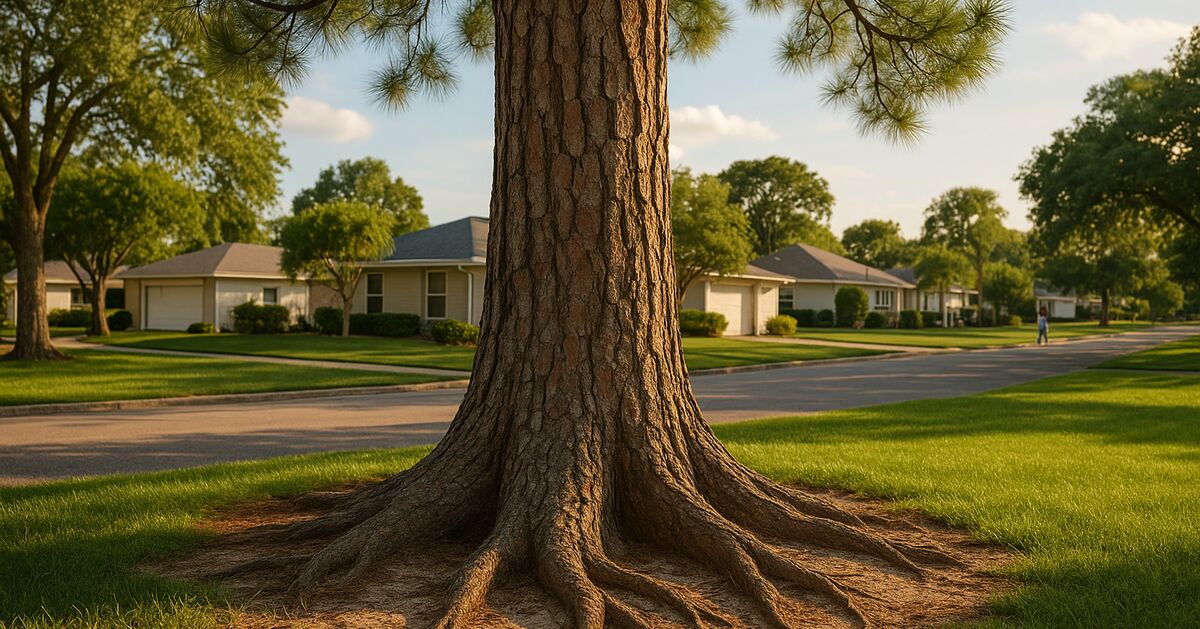
Slash pines in Rotonda West and Port Charlotte tip over at the root ball more often than they snap at the trunk, and that fact surprises a lot of homeowners who are looking up at a perfectly green canopy and thinking the tree is fine. The problem is almost entirely underground, and it is tied to the specific soils, drainage patterns, and conditions that define this corner of Charlotte County.
This post explains why root-zone failure is the dominant failure mode for slash pines here, what drives it, and what warning signs you can actually see before a tree falls.
The tree itself: why slash pine is both tough and vulnerable
Slash pine (Pinus elliottii) is native to Florida's flatwoods and is well-adapted to the state's wet-dry cycle. It grows fast, tolerates periodic flooding, and handles sandy soil reasonably well. In its natural habitat it develops a lateral root system that spreads wide and relatively shallow, with a few vertical sinker roots anchoring it deeper. That spread is what gives the tree its stability.
The problem is that the natural flatwoods habitat is not the same thing as a platted subdivision built on former wetlands and filled, compacted spoil material. Rotonda West and much of Port Charlotte were developed on land that was extensively ditched and graded. The soils are a patchwork of native flatwoods sand, marl, muck, and fill, often within feet of each other. That patchwork matters enormously to a root system.
Why the root zone fails first
Soil saturation and anaerobic conditions
Slash pine tolerates brief flooding, but when the root zone stays wet for extended periods, the soil becomes anaerobic (oxygen-poor). Fine feeder roots die off first, then structural roots begin to decay. The fungal pathogens that cause root rot, including Phytophthora species and various wood-decay fungi, thrive in warm, saturated, low-oxygen soil. You can read more about how those organisms advance through wood in our post on fungal conks, cavities, and cracks explained.
Charlotte County's flat topography means that water drains slowly and the water table sits close to the surface across much of Rotonda West and Port Charlotte, especially during the rainy season (June through September). A root system that is stressed by repeated saturation loses its grip on the soil before any visible symptoms appear above ground.
The fill-soil problem
Much of the residential land in these communities was built up with fill material to meet finished-floor elevation requirements. Fill is often compacted during grading, and compacted soil has reduced pore space, which means poor drainage and poor oxygen movement. Slash pine roots encounter a hard layer below the loose surface sand and tend to flatten out even more than they normally would. A wide, shallow root plate in compacted fill over a high water table is a recipe for the whole tree to lever out of the ground in a wind event rather than flex and stay.
Root collar damage from chronic wetness
The root collar, where the trunk meets the soil, is particularly sensitive. When soil is mounded against the lower trunk or the grade has settled so the base of the tree sits in a low spot, moisture stays in contact with bark that is not designed to handle constant wetness. Over time this produces collar rot, which severs the vascular connection between roots and trunk and also creates an entry point for decay fungi. A tree can be structurally compromised at the root collar for years before the canopy shows any sign of stress. Our post on what an arborist actually looks at during a tree assessment covers what a trained eye looks for at the base of the tree, which is usually the first place we go when evaluating a pine.
Girdling and root-system interference
In platted lots, slash pines often grow in close proximity to driveways, curbs, irrigation lines, and buried utilities. Roots that encounter a hard barrier redirect, and redirected roots sometimes circle back and grow against other roots or against the base of the trunk. This girdling effect restricts the flow of water and nutrients and can mechanically constrict the tree as it grows. A girdled root system also anchors less effectively because the structural roots are not radiating outward symmetrically.
Why the trunk often looks fine right up until the failure
This is the detail that catches homeowners off guard. Slash pine bark is thick, and the trunk itself is resinous and relatively resistant to decay. When decay is concentrated in the root zone, the trunk can appear completely sound while the anchoring system below is severely compromised. The canopy may be full and green because the tree is still transporting water and nutrients through whatever functional root tissue remains.
A tree that has lost a large portion of its root system to rot can still look healthy from the street. Then a strong afternoon thunderstorm with high winds rolls through, and the tree levers out of the ground, root plate and all. This is a tip-up failure, not a snap failure, and it is characteristic of root-zone problems rather than trunk decay or structural branch failure. Per guidance from the USDA Forest Service, tip-up mounds (the crater left when a root plate lifts) are a recognized indicator of root-anchoring failure in managed landscapes and forests alike.
What you can see from the ground
You cannot see underground decay directly, but there are surface signs worth looking for:
- Soil mounding or lifting near the base. If the ground around the root flare is cracking, lifting, or looks humped on one side, the root plate may already be shifting.
- Lean that has changed. Slash pines are not perfectly vertical, but if a lean you have noticed for years seems to be increasing, that is worth having checked. Compare photos over time if you have them.
- Fungal fruiting bodies at the base or on surface roots. Conks, shelf fungi, or mushrooms at or near the root flare are a serious indicator of decay below. This is different from fungi appearing 20 feet up the trunk.
- Root flare buried or wet. If the base of the tree disappears straight into the soil without a visible flare, either the grade has risen or the collar is buried. Both conditions promote rot.
- Soft or spongy bark at the base. Press gently with a thumb. Sound pine bark is firm and does not compress. Soft or crumbly bark at the base indicates decay has reached the outer tissues.
- Epicormic sprouting low on the trunk. When a tree is stressed at the root zone, it sometimes responds by pushing new growth from dormant buds on the lower trunk. It is the tree's attempt to compensate for reduced root function.
None of these signs by themselves guarantee failure, and their absence does not guarantee safety. But any one of them, especially on a large pine within falling distance of a structure, is reason to have a professional evaluation before the next storm season.
What a proper assessment involves
A qualified arborist will look at the base of the tree before looking at anything else. They will probe around the root collar, check for soft tissue, look for fungal activity, and evaluate the lean and the surrounding soil conditions. In some cases a rubber mallet or a resistograph (a drill-based instrument that measures resistance through wood) can reveal internal decay that is not yet visible from outside. Our overview of tree trimming, removal, and care services explains the kinds of assessments we conduct before recommending any course of action.
Michael Calabro, ISA Certified Arborist FL-362432A, conducts assessments using the evaluation framework described in ANSI A300 Part 9 (Tree Risk Assessment). That standard guides how we document observable defects, estimate failure probability, and weigh consequences before making a recommendation. Not every tree with root-zone symptoms needs to come down, but some clearly do, and the difference matters.
Rotonda West specifically: a word about the canal lots
Rotonda West is a planned community built around an extensive network of drainage canals. Many lots back up to a canal or sit adjacent to a berm. Pines growing on canal banks or berm edges are in a particularly high-risk position. The bank soil is perpetually moist on one side, often undercut by water, and the tree's roots may have grown into the berm material for stability. When berms erode or canal banks slump, root systems lose their anchoring soil suddenly. A tree that was stable last year may be significantly undermined after a heavy wet season. If you have slash pines on or near a canal lot in Rotonda West, a yearly look at the base is a reasonable practice. Our Englewood tree care page and our service area page list the communities we serve in this part of Charlotte County.
What happens after a root-zone failure
When a large slash pine tips over at the root plate, the root ball can be quite large and extremely heavy. The damage radius is significant, as the crown can extend a considerable distance from the root plate. Structures, pool cages, fences, utility lines, and neighboring vehicles are all at risk. Cleanup is substantially more complicated than a simple trunk removal because the root ball itself must be dealt with, often requiring a crane or excavator in addition to the chainsaw work. Understanding the equipment involved helps set expectations; our post on what a crane does during tree removal walks through when and why that equipment is necessary.
What you can do to reduce the risk
- Keep the root flare exposed. Do not allow mulch, soil, or sod to build up against the base of the tree. The root flare should be visible. Mulch applied in a donut shape, not a volcano shape, starting a few inches away from the bark is appropriate.
- Avoid compacting soil over the root zone. Driving or parking over the area under the canopy repeatedly damages fine roots and compacts the anchoring soil.
- Address grade changes carefully. If you are regrading your yard, avoid filling around the base of existing pines. Even a few inches of new soil over the root collar can set off a slow decline.
- Get a professional look before storm season. The window between March and late May is a good time to have pines assessed before the June-through-November storm season begins. Catching a compromised tree before a named storm means you choose the timing and method of removal, rather than reacting to an emergency.
- Do not skip the base inspection after a wet season. The wet season ends, the canopy looks green and healthy, and the problem underground is already a year further along. A brief walk-around with fresh eyes in October or November is worth the time.
The bottom line
Slash pines in Rotonda West and Port Charlotte fail at the root zone because of a convergence of factors: shallow, laterally spreading root architecture, fill soils over a high water table, the flatwoods drainage patterns of Charlotte County, and the proximity of canals, compaction, and disturbed soil that comes with residential development. The trunk being sound is not sufficient reassurance. The root zone is where the tree is won or lost in a wind event.
If you have slash pines within striking distance of your house, screen enclosure, fence, or a neighbor's property, a professional evaluation is the only way to know what you are dealing with underground. Our team serves Port Charlotte, Rotonda West, North Port, Venice, Sarasota, and the surrounding communities. You are welcome to reach out to us to schedule a look before storm season arrives.
For a broader view of the services we offer, including assessments, structural pruning under ANSI A300 standards, and removal, visit our tree care services page.
Got a tree that worries you?
Free, no-pressure on-site estimate across Sarasota & Charlotte Counties.