
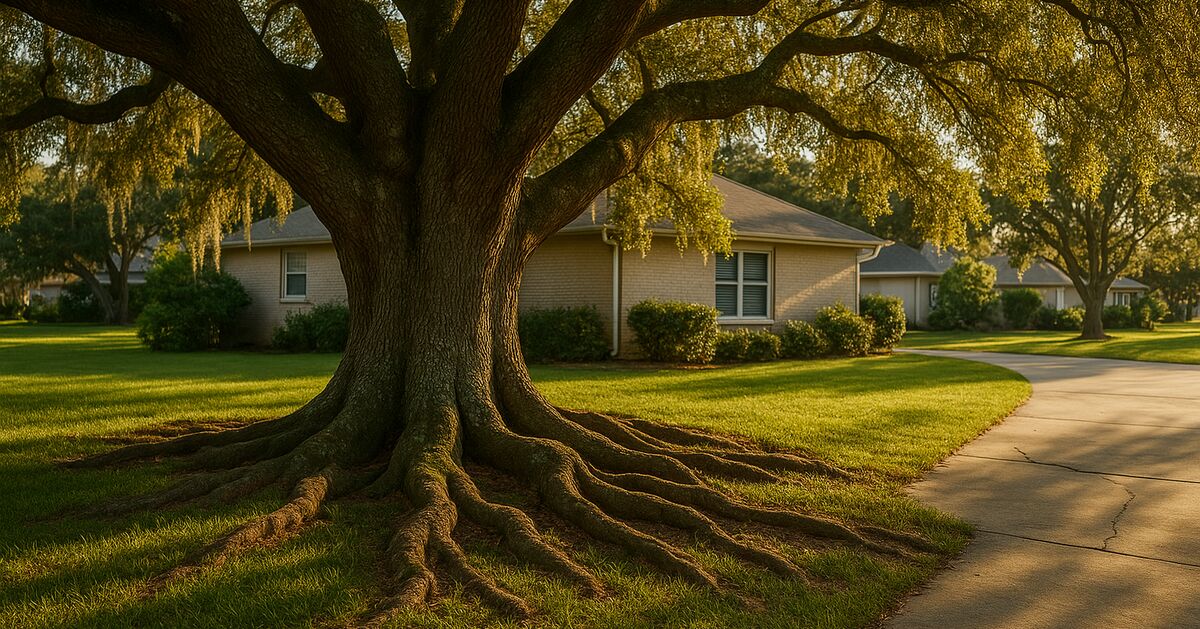
Barefoot in the backyard, you can feel the answer before you even look: a slight ridge in the lawn, a patch where the grass refuses to grow, a subtle hump pushing up at the edge of the driveway. Live oak roots have already been there a while. By the time the soil is showing you something, the root system is far larger than most homeowners expect.
Understanding what those soil signals actually mean, and what they tell you about where the roots are headed next, is one of the most practical things you can do as an owner of a large oak in Sarasota, Venice, Osprey, or anywhere along the Gulf coast. This post walks through the soil science, the visual cues, and what to do with what you find.
Why live oak roots behave differently from what you picture
People often picture tree roots as a mirror of the canopy above: a rounded mass descending straight down, roughly the same width as the drip line. Live oak roots do not work that way.
Quercus virginiana, the Southern live oak, is among the most laterally aggressive root systems in the Florida landscape. The roots are predominantly shallow, occupying the top 12 to 18 inches of soil, and they spread outward in all directions, often reaching two to three times the canopy radius. On a mature live oak with a 50-foot canopy spread, that can put active, moisture-seeking roots 75 feet or more from the trunk.
The reason is simple physics and biology. Florida soils are sandy, drain quickly, and hold oxygen well near the surface. Roots follow oxygen and moisture. In our coastal region from North Port to Englewood and Casey Key, the water table can also sit high, which discourages deep vertical growth. So the roots fan out horizontally, just under the surface, covering enormous ground.
Reading the soil surface: what each sign means
You do not need a soil probe to start reading a live oak's root presence. Walk the area methodically and look for these patterns.
Surface roots and visible ridges
When you can see a root at the surface, that root has been there long enough to have lifted the soil above it. That is not the leading edge of the system. It is the middle. The active root tips, still growing and still undiscovered, are farther out. A visible surface root running northeast from the trunk almost certainly means active root tips are another 10 to 20 feet farther in the same direction.
Grass die-off in specific arcs or bands
Turfgrass competing with a dense mat of feeder roots will thin and die. This happens for two reasons: the roots compete directly for water and nutrients, and the soil structure beneath becomes so dense with root mass that it affects drainage and aeration for the grass. If you see a crescent or arc of dead turf, trace its geometry back toward the trunk. That arc often marks a zone of high root density, not necessarily the outermost edge of the system.
Soil heaving near hardscape
Where a sidewalk, driveway, or pool deck shows cracking or lifting, the root underneath has been building pressure for years before the concrete gave. Roots do not break concrete so much as they grow into existing voids and expansion joints, then expand with annual girth growth until something moves. By the time you see the crack, the root is well-established below it. Our post on root barriers: how they work and when you need one goes into detail on how to manage this at the source.
Soil compaction patterns around the tree
This one is counterintuitive. In high-traffic areas, soil compaction reduces the oxygen content of the soil. Live oak roots tend to avoid heavily compacted zones, skirting around them and emerging on the far side. If you have a path or parking area near an oak that shows no visible roots, do not assume the roots stopped there. Press a screwdriver into the soil on the far side of that compacted zone and you will often feel it resist quickly, a sign of dense root mass just below the surface.
Changes in soil grade from years of mulch or debris accumulation
Live oaks drop leaves nearly year-round in Florida. Over a decade or two, the accumulated organic matter raises the soil grade subtly around the base. A slight dish or bowl shape in the lawn near the trunk, where the grade is actually lower than the surrounding yard, can indicate that the root collar is being buried. Buried root collars create their own set of decay problems, which connect closely to what we describe in fungal conks, cavities, and cracks explained.
The sandy soil factor specific to our Gulf-coast region
Sarasota and Charlotte County soils are dominated by Entisols, primarily fine sands with low organic matter content. These soils have almost no natural capacity to restrict lateral root movement. There is no clay pan, no hardpan layer, no rock at a consistent depth that acts as a natural barrier for most residential properties.
What this means practically: a live oak planted in Nokomis or Laurel has almost no structural reason to keep its roots near the trunk. The soil offers little resistance and few pockets of concentrated nutrients that would reward staying close. The path of least resistance is outward, and that is exactly where the roots go.
Compare this to clay-heavy soils in other parts of the country, where lateral root growth is physically slowed. On our coast, a 20-year-old live oak can have a root system that genuinely surprises even experienced property owners when it is mapped.
How to estimate root extent without digging
A precise root map requires air-spading or ground-penetrating radar, both of which are legitimate tools for high-stakes situations like a foundation concern or a major utility conflict. But for everyday awareness, arborists use a few practical rules of thumb grounded in research.
The critical root zone (CRZ), defined under ANSI A300 Part 5 (Management of Trees and Shrubs During Site Planning, Site Development, and Construction), is calculated as approximately one foot of radius for every inch of trunk diameter at breast height (DBH). A live oak with a 20-inch DBH therefore has a CRZ of at least 20 feet. Live oaks often exceed that minimum, so many arborists in our region use a larger working radius for planning purposes on undisturbed sites.
Walk the drip line of your live oak, then walk out again by the same distance. That outer ring is a reasonable working assumption for where feeder roots are active today.
What the soil is telling you about risk to structures
Root systems do not cause foundation damage the same way in every soil type. In our sandy coastal soils, the primary concerns are:
- Pipe intrusion. Older clay or cast-iron pipes have joints. Root tips follow moisture gradients and can enter those joints, then expand over time. PVC pipes in good condition tend to resist root intrusion better than older clay or cast-iron pipes, though some risk may remain.
- Driveway and sidewalk lifting. As described above, this is a mechanical process driven by girth growth, not just new root penetration.
- Pool deck and pool wall pressure. On properties in Siesta Key, Casey Key, and Englewood where trees and pools share tight lots, root pressure on pool walls is a legitimate concern worth evaluating before symptoms appear.
- Septic drain field interference. In areas still on septic systems, drain fields are a significant attractor for roots because of the consistent moisture and nutrient load. If your drain field sits within the estimated root zone, it deserves attention.
For a full picture of how root systems interact with your specific structures, our tree and land services overview explains the assessments we offer.
How pruning history changes root behavior
This is a piece of information that surprises a lot of homeowners. A tree that has been heavily over-pruned may shift more resources toward root growth as it works to recover its canopy. The tree is trying to rebalance its canopy-to-root ratio. A live oak that received aggressive crown reduction work in previous years may have accelerated root growth in the period following those cuts.
Conversely, proper structural pruning done under ANSI A300 Part 1 standards, which governs pruning operations including crown cleaning, crown raising, crown reduction, and structural pruning, respects the canopy-to-root balance over time. This is one reason that how a tree has been trimmed in the past is a legitimate part of any root concern conversation. If you want to understand the difference between pruning that helps and pruning that stresses a tree into compensatory root growth, our post on trims that help vs. trims that slowly kill a tree explains the distinction clearly.
When to call an ISA Certified Arborist
Knowing what to look for in the soil is useful. Knowing what it means for your specific property requires trained judgment. Michael Calabro, ISA Certified Arborist FL-362432A, conducts tree assessments across our service area from Sarasota and Venice through North Port and down into Englewood and Placida.
An arborist assessment for root concerns is not a simple walk-around. It involves evaluating trunk lean and buttress root development, testing soil compaction in key zones, reviewing pruning and site history, and considering the proximity and condition of any structures in the estimated root zone. Where the situation warrants it, air-spading can expose the root collar and near-trunk root architecture without damaging the roots themselves.
If you are seeing any of the soil signals described in this post, especially near a driveway, pool, or older utility line, that is a reasonable trigger for a professional look. The earlier a root concern is identified, the more management options exist, including targeted crown reduction to reduce the tree's water demand, or physical barriers installed before roots reach a structure rather than after.
The mistake that costs the most
A pattern that comes up again and again in conversations with property owners is waiting until concrete is visibly cracked or a drain line is already blocked before thinking about the roots. At that stage, the remediation is more expensive, the root system is more entrenched, and the options for saving both the tree and the structure narrow considerably.
The soil signals described in this post are an early warning system. A grass arc, a surface ridge, a subtle grade change near the base: none of these is an emergency on its own. Together, and viewed in relation to what structures lie in the estimated root zone, they are information. Use them before you need to.
If you are located in our Sarasota service area or anywhere across the region we cover, our contact page is the right place to start. A site visit to talk through what the soil is showing you, and what it likely means for the roots below, is a straightforward first step.
Live oaks are genuinely irreplaceable parts of the Florida landscape. The goal is never to alarm you about a tree that may be fine for decades. It is to give you the information to stay ahead of problems that are slow-moving, largely invisible, and entirely predictable once you know what to look for.
Got a tree that worries you?
Free, no-pressure on-site estimate across Sarasota & Charlotte Counties.