
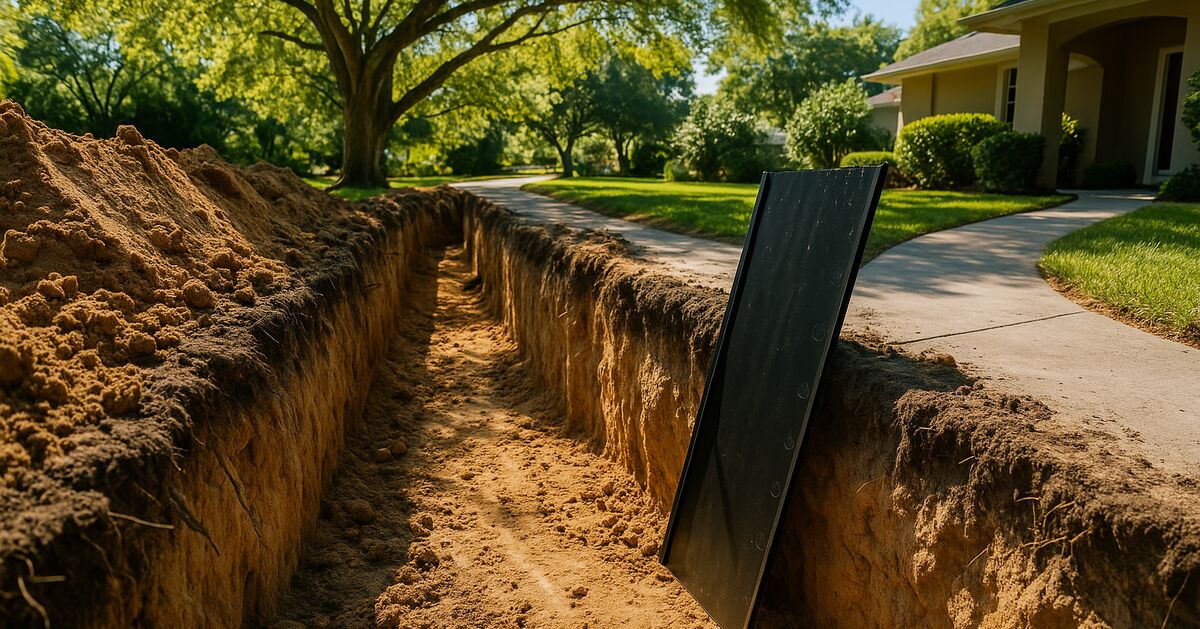
Root barriers sound like a clean, permanent solution: slip a panel into the ground between a tree and your driveway, pool deck, or sewer line, and the roots go somewhere else. Sometimes that's exactly right. But root barriers are also routinely sold to homeowners who don't need them, and installed incorrectly often enough that they cause a slow, expensive problem where there wasn't one before.
This post walks through what root barriers actually do, the situations where they earn their cost, the situations where they don't, and what to watch for when a contractor starts pitching one to you.
What a root barrier is, physically
A root barrier is a panel or roll of rigid or semi-rigid material, most often high-density polyethylene (HDPE) or a chemical-infused fabric, installed vertically in the soil to redirect growing roots away from a target structure.
There are two broad categories:
- Mechanical barriers - solid panels or fabric walls that physically block root growth. Roots reach the barrier, travel along it downward or laterally, and redirect away from the structure on the other side.
- Chemical barriers - panels or fabric impregnated with a compound (usually trifluralin, a root-growth inhibitor) that creates a zone roots won't penetrate. These are sometimes called biobarriers.
Both types depend on being installed at the right depth and close enough to the target to intercept roots before they get there. A barrier that's too shallow, too far from the structure, or that doesn't connect at both ends creates a gap roots will find, because roots don't "search" - they grow along the path of least resistance, and any opening is an opportunity.
The physics of root growth that sellers sometimes skip over
Tree roots don't behave like water pipes pushing toward a fixed destination. Lateral roots grow outward from the base in whatever direction the soil conditions favor: loose soil, moisture, oxygen, and available nutrients pull them. When a barrier is installed, roots don't turn around or stop growing. They follow the barrier face downward or to the side, looking for a way past.
This matters because:
- Depth is critical. For a barrier to work, it must go deeper than the root zone that's causing the problem. Shallow structural roots on sandy Gulf-coast soils, the kind common across Sarasota, Venice, North Port, and Englewood, often run near the surface, which is why barrier depth matters so much. A barrier installed at 12 inches may redirect roots under it.
- Width matters too. A barrier panel that doesn't span the full width of the planting zone simply deflects roots around its edges. Roots will find the flank.
- Proximity to the tree affects tree health. Installing a barrier too close to the trunk can sever feeder roots in a way that stresses or destabilizes the tree. The closer to the tree the trench is cut, the more root mass is disturbed. Per the ANSI A300 Tree Care Standards, root protection during any soil disturbance near a tree is a real concern, not a formality.
When a root barrier actually helps
There are situations where a properly installed barrier is genuinely the right answer.
Young trees planted near infrastructure. If a tree is newly installed or still a sapling, a barrier placed between it and a driveway or sidewalk can guide root development away from hardscape from the start. This is the scenario where barriers perform best, because the root system hasn't already invaded the target zone. Installing a barrier after roots have already reached a structure is a different problem entirely.
Defined, enclosed planting areas. Urban tree pits and sidewalk planters in areas like downtown Sarasota or near commercial blocks in Venice benefit from barriers because the enclosed geometry means there are only a few directions roots can travel, and a barrier can reliably redirect them without leaving flanks open.
Protecting underground utilities from small or moderate-sized trees. If a relatively modest ornamental or shade tree is planted near a lateral sewer or irrigation line and the tree is young, a barrier can reduce future conflict. This is not a guaranteed fix for large-canopy trees already established near pipes, and it's certainly not a substitute for proper tree selection at planting time.
Separation between an aggressive spreader and a neighboring structure. Some species, particularly ficus varieties that have escaped cultivation in South Florida, produce extremely aggressive surface roots. A deep, well-sealed barrier can buy time, though it rarely buys a permanent solution with ficus.
When root barriers are sold to people who don't need them
Here's where it's worth slowing down, because a root barrier that's unnecessary is not just wasted money. It can also cause real harm.
When the roots have already arrived. A root barrier does not remove existing roots. If roots have already grown under a driveway, lifted a pool deck, or infiltrated a pipe, installing a barrier on the far side of the tree does nothing to the roots already causing damage. Those need to be addressed directly. Sometimes that means root pruning (cutting and removing the offending roots), sometimes it means accepting that a tree that's too large for its space needs structural management or removal. Selling a barrier in this scenario is solving a future problem while ignoring the present one.
When the tree is already large and well-established. A mature live oak, a large slash pine, or a full-grown Canary Island date palm has a root system that already extends well past any barrier you'd install now. The barrier becomes a ring fence with the roots already on the wrong side. It doesn't redirect growth; it just sits in the ground.
When the tree is the wrong species for the location. If a homeowner planted a large-canopy species 6 feet from a pool cage in Nokomis or a driveway in North Port, the long-term answer is not a plastic panel. The species is wrong for the site. Either the tree will eventually need to come out, or the structure will need ongoing maintenance. A barrier pitched as a permanent fix in this scenario is not giving the homeowner an honest picture.
When the structure problem is actually a drainage or soil-settling issue. Cracked driveways and lifted pavers in Southwest Florida can sometimes be caused by sandy soil settling, moisture fluctuation, or poor original compaction rather than tree roots, so it's worth confirming the actual cause before treating it as a root problem. Roots frequently grow into existing cracks after the crack has already formed. Selling a root barrier to fix a crack that a tree didn't cause is selling the wrong solution.
When it's cheaper to just relocate the tree. On a young tree within the first few years of planting, sometimes the most honest answer is: the tree is in the wrong spot, and moving it now costs less than a barrier, less than future hardscape repair, and less than future removal. This is an uncomfortable conversation, but it's the right one.
How installation should actually go
If a barrier is the right call, the installation process matters. Here's what correct installation looks like:
- Trenching depth should match the root zone depth of the species involved. For many Florida species on sandy soils this is 18 to 36 inches. Mechanical barriers shorter than 18 inches are rarely adequate for established trees.
- Trench width should span the full protected zone, with panels connected at their seams so there are no gaps. Any gap becomes the path of least resistance.
- Distance from the tree needs to balance root interception against root protection. Getting too close to the trunk disturbs critical structural roots and can affect tree stability. A qualified arborist should assess this before any trenching begins.
- The tree's stability should be considered independently. Any time significant root cutting is involved, there's a question of whether the tree's anchorage is affected. Michael Calabro (ISA Certified Arborist, certificate FL-362432A) evaluates root architecture and stability as part of any assessment involving soil disturbance near a tree's critical root zone - because cutting roots isn't a purely cosmetic decision.
- Backfill and compaction matter. Disturbed soil that's loosely backfilled will settle and may shift the barrier out of position over time.
Root pruning: sometimes the better first step
In many situations, targeted root pruning is more useful than a barrier. Root pruning means cutting specific offending roots cleanly, then either leaving the barrier out entirely or installing one at the cut face to slow regrowth into that zone.
Per the ANSI A300 standards for root management, root pruning should be done with clean cuts rather than grinding or tearing, and the cut location relative to the trunk matters for the tree's health and structural integrity. Torn or crushed roots invite disease. Clean cuts heal.
Root pruning near a structure can resolve a current heaving or cracking problem. A barrier can then reduce how quickly that specific problem recurs. Together they're a more complete answer than a barrier alone.
You can read more about how root systems interact with structures and soil in our broader discussion of tree care services we offer, and if you're curious about what a professional site assessment actually covers, the frequently asked questions page addresses a lot of the common ones.
What species-specific knowledge changes
Not all roots behave the same way, and this matters for whether a barrier is worth installing.
- Live oaks produce wide-spreading lateral roots close to the surface. They're difficult to redirect with a single barrier because the root system fans out in many directions. Barriers can help near young oaks, but mature specimens near structures often need a different conversation.
- Slash pines tend to have a more vertical root structure, especially in the early years. Lateral roots do develop, but the geometry is somewhat different from an oak. If you're in a neighborhood in Laurel or Osprey where slash pines are common, read our post on why slash pines fail at the root zone, not the trunk for more on how their root systems behave under stress.
- Sabal palms have a very different root architecture from hardwoods: fibrous, regenerating roots rather than a few large laterals. Barriers are rarely relevant for sabal palms near structures.
- Ficus species are aggressive enough that barriers slow but rarely stop long-term root spread. Managing the tree itself (or removing it) is often the more honest recommendation.
What to ask before agreeing to a barrier
If a contractor proposes a root barrier for your property, these are the right questions:
- Are roots already on the far side of where you'd install it? If yes, the barrier won't address the existing problem.
- How deep will the barrier go, and how do you know that's deep enough for this species?
- Will you be cutting roots during installation, and how does that affect this tree's stability?
- What's the estimated lifespan of the barrier material, and what happens when it degrades?
- Is the current damage definitely from roots, or could it be settling, drainage, or soil movement?
A contractor who can answer those clearly and honestly is worth hearing out. One who skips past them to get to the price quote deserves more scrutiny.
Our team serves homeowners across Sarasota, Venice, Englewood, North Port, and the surrounding communities including Osprey, Nokomis, Laurel, Casey Key, Manasota Beach, Placida, and Port Charlotte. If you have a root situation you're trying to think through, the starting point is usually an honest site assessment, not a sale. Get in touch with us and we can look at what's actually happening before recommending anything.
The honest summary
Root barriers work well in a specific, limited set of circumstances: young trees, not-yet-invaded infrastructure, and enclosed planting zones where roots can be reliably redirected. They're worth the cost in those situations and can save significant hardscape repair expense down the road.
They don't work well when roots have already arrived, when trees are already mature, or when the underlying problem is something other than roots. And they can cause real harm when installed too close to the trunk, too shallow, or without understanding the species involved.
If you want to go deeper on how tree root systems interact with foundations and utilities specifically, see our related post on root systems and how they affect your foundation and pipes. And if you've noticed other structural changes in a tree on your property, our post on fungal conks, cavities, and cracks covers what those signs mean at the structural level.
The right answer for your yard depends on what's actually there. That starts with a look.
Got a tree that worries you?
Free, no-pressure on-site estimate across Sarasota & Charlotte Counties.