
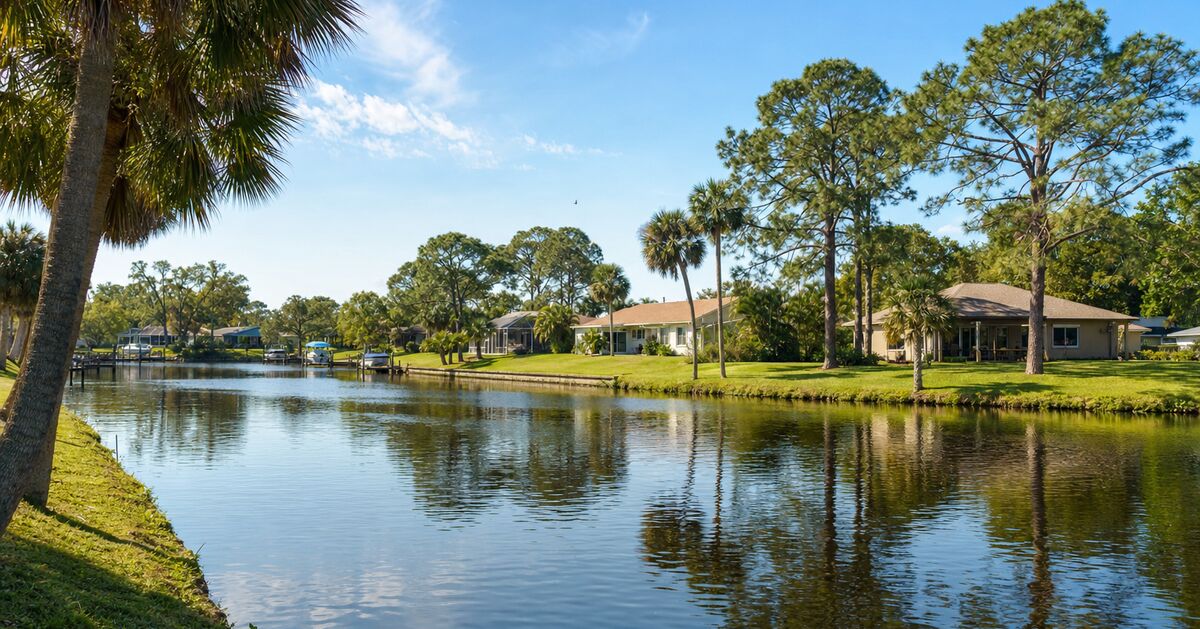
Rotonda West is one of the most distinctive planned communities on Florida's Gulf Coast, and its canal-lot properties are part of what makes it special. Those same canals, though, mean that every tree job here sits at the intersection of two separate rule sets: Charlotte County's land-development regulations and the Rotonda West Association's deed restrictions. Getting one right while ignoring the other is a shortcut to a stop-work order, a fine, or a replanting requirement that costs far more than the original job.
This post walks through what each authority actually controls, where the two sets of rules overlap, and what you need to have in hand before anyone picks up a chainsaw on your lot.
Why canal lots have extra layers of oversight
Rotonda West was developed in the early 1970s as a golf-and-canal community, with roughly 26 miles of freshwater canals lacing through the neighborhoods. Those canals drain into Coral Creek and eventually reach Lemon Bay and the Gulf. Because the canals are part of a larger watershed, any work near their banks draws attention from more than just the HOA. Charlotte County's stormwater and environmental review staff care about what happens to the soil, the root systems, and the vegetative buffer along those banks.
That means a tree removal or significant trimming on a canal-lot in Rotonda West can trigger review from:
- The Rotonda West Association (the community HOA), which enforces deed restrictions and architectural review rules
- Charlotte County Community Development / Code Compliance, which enforces the county's tree protection and land-clearing ordinances
- The South Florida Water Management District (SFWMD), which has jurisdiction over work within or immediately adjacent to the canal right-of-way
Understanding which body answers which question is the first step to getting the work done without surprises.
What Charlotte County controls
Charlotte County regulates trees through its Land Development Regulations (LDR), which include provisions on protected species, tree removal permits, and replanting requirements. The county does not use a single "tree ordinance" named statute; the rules are embedded in the LDR and enforced by Community Development staff.
Protected trees. The county designates certain species as protected regardless of size. Live oaks, slash pines, sabal palms, and several other species are commonly treated as protected under county land development regulations, so check with Charlotte County before removing them. If a tree meets the county's minimum size threshold (typically measured by diameter at breast height, or DBH), you need county sign-off.
Permit triggers. A permit is generally required when you remove a protected-species tree above the minimum DBH, or when land clearing exceeds a certain acreage threshold. For individual residential lots in an established neighborhood like Rotonda West, the most common permit trigger is the removal of a protected tree, not clearing acreage. Charlotte County's permit applications are submitted through the Community Development Department, and the county may require a mitigation plan showing what you will replant.
Replanting and mitigation. When a permit is granted for removal, the county can require inch-for-inch replacement, often calculated by DBH. That replacement tree must typically be a Florida-native or approved species and must meet a minimum caliper at the time of planting. Failure to replant as agreed may result in code enforcement action, so confirm the consequences with the county before proceeding.
Stormwater and buffer rules. Here is where canal lots get more complicated. The county's stormwater regulations and the SFWMD's rules both speak to vegetative buffers along waterways. Clearing or significantly disturbing the soil within a certain setback of the canal bank may require a separate environmental review or even an SFWMD right-of-way permit. This is true even if the tree itself is on your private lot but its root zone extends into the buffer area.
For properties in Englewood and other parts of southern Charlotte County, the rules follow the same county LDR framework, so this information applies broadly across that area as well.
What the Rotonda West HOA controls
The Rotonda West Association enforces the community's Declaration of Restrictions and its Architectural Review Committee (ARC) guidelines. These are private contractual rules that run with the land, meaning they apply to every lot regardless of what county rules say. Satisfying the county does not exempt you from the HOA, and vice versa.
ARC approval. Many exterior changes in Rotonda West require written approval from the ARC before work begins. Tree removal, significant trimming that changes the appearance of the landscape, and planting of new trees or large shrubs typically fall under ARC review. The ARC's review criteria are set by the Association's governing documents, which can be updated by the board, so the specific requirements in effect today may differ from what a neighbor remembers from five years ago.
Aesthetic and species standards. The HOA's rules often speak to what a lot must look like, not just what you cannot do. Some Rotonda West neighborhoods have expectations about maintaining a certain canopy height along the canal, keeping sight lines open between homes, or using species that fit the community's visual character. These are not safety rules; they are aesthetic standards, and the ARC has discretion in applying them.
Setback and encroachment rules. The HOA's deed restrictions set minimum landscape setbacks from property lines, the canal bank, and sometimes the street. A tree whose root ball or canopy extends across those setback lines can become a compliance issue under HOA rules even if the county has no objection.
What happens if you skip ARC approval. The Association may be able to require you to restore the property to its prior condition at your expense, depending on its governing documents. For a tree that has already been removed, that means a mandatory replanting, with the Association specifying the species, size, and location. The costs add up fast, especially if you have to bring in a large-caliper tree to satisfy a restoration requirement.
Where the two rule sets interact
The most confusing situations arise when the county and the HOA point in different directions, or when compliance with one seems to conflict with the other.
Example 1: The county grants a removal permit, but the HOA says no. This happens. A county permit gives you legal authority under county code, but it does not override your deed restrictions. You still need ARC approval. Many homeowners make the mistake of assuming that a government permit is the final word.
Example 2: The HOA approves removal, but the county requires a permit you have not pulled. The HOA's approval is a private contractual matter. It says nothing about whether you are in compliance with county code. If a Charlotte County code officer drives by and sees a protected tree being removed without a county permit, the fact that you have written HOA approval is not a defense.
Example 3: The canal buffer creates a no-go zone. If the tree you want to remove is within the SFWMD or county stormwater buffer along the canal, neither the HOA nor the county residential tree permit process may be sufficient. You may need a separate environmental permit. This is where engaging an ISA Certified Arborist early in the process pays for itself, because an experienced arborist can flag a buffer issue before you are already committed to a scope of work.
Michael Calabro (ISA Certified Arborist, certificate FL-362432A) regularly works with Charlotte County property owners to identify which permits are needed before work begins. The certificate means he has met ISA's knowledge and experience standards for arboriculture; ISA certifies individual practitioners, not companies.
What ANSI A300 says about work near water
When a tree job does proceed on a canal-lot property, the work itself should follow ANSI A300 Tree Care Standards. Those standards set the technical floor for pruning, removal, and soil management around trees. For pruning specifically, the A300 recognizes operations including crown cleaning (removing dead, dying, or crossing branches), crown raising (removing lower limbs to lift the canopy), crown reduction (reducing overall canopy size while maintaining natural form), and structural pruning (guiding a young tree's architecture). ANSI A300 standards generally discourage removing excessive live tissue, and an over-pruned tree near a canal bank may lose some of its soil-stabilizing function even if it survives.
The companion safety standard, ANSI Z133, is intended to govern how tree workers operate around hazards, which may include proximity to water. Canal work introduces specific hazards such as unstable banks, underwater obstructions, and limited egress, and the Z133 framework addresses how those hazards must be identified and controlled before work begins.
The practical checklist before you start
Here is the sequence that avoids the common traps on Rotonda West canal lots:
- Pull your deed and Declaration of Restrictions. Confirm what your HOA requires for the specific work you are planning. If the documents are unclear, contact the Rotonda West Association office directly.
- Identify the species and size of every tree you plan to touch. Florida's state tree, the sabal palm, is protected. So are live oaks and slash pines. If you are not certain of the species, have an arborist identify them before you plan anything.
- Measure the DBH of each tree. Use a tape measure at approximately 4.5 feet above grade. If the tree is on a slope, measure on the uphill side. This measurement determines whether the tree crosses the county's permit threshold.
- Determine your distance from the canal bank. Find your property survey and measure from the tree to the top of the canal bank. If you are within the buffer distance, factor in the possibility of an SFWMD review.
- Submit your ARC application first. HOA review can take several weeks. Submit your ARC application before you apply for a county permit, so both approvals can run roughly in parallel rather than sequentially.
- Apply for the county tree removal permit if required. Charlotte County's Community Development Department handles these. The permit application typically requires a site plan, a description of the tree(s) to be removed, and a proposed mitigation or replanting plan.
- Get the work scoped by an arborist, not just a tree crew. An arborist can document tree condition, recommend whether removal is actually necessary, and produce the written assessment that often accompanies a permit application. Sometimes a properly specified pruning operation under A300 standards resolves a problem without triggering a removal permit at all.
Our tree trimming, removal, and tree care services are available across Charlotte County, and our team is familiar with how the county's permit process works for canal-lot properties.
A note on trimming versus removal
One thing that surprises many Rotonda West homeowners is that significant trimming can also trigger review. At the county level, work that damages or kills a protected tree can be treated the same as unpermitted removal. At the HOA level, a heavy trim that changes the appearance of a tree may require ARC approval just as a removal would.
This is one reason why understanding the A300 terminology matters. A crown cleaning (removing dead wood) is very different from a crown reduction (reducing overall canopy volume). A crown raising (lifting the canopy off a roof or fence) is different from drastic thinning that removes most of the live interior growth. Describing the work accurately, using the right terms, helps the ARC and the county understand what you are proposing and reduces the chance of misinterpretation.
If you are dealing with a tree that leans over the canal or whose roots are approaching the seawall, you may also want to read our post on trees too close to a seawall: root damage risks, which covers how root systems interact with below-grade structures in ways that are not always visible from the surface.
Rotonda West in context: our broader service area
Rotonda West sits at the southern end of Charlotte County, close to the Charlotte-Sarasota county line. We serve the full area from Sarasota south through Venice, Nokomis, Osprey, North Port, Englewood, and into Charlotte County communities including Rotonda West, Port Charlotte, and Placida. Each jurisdiction has its own tree permit structure, so the specific checklist differs by location, but the underlying principle is the same: know your HOA's rules and the county's rules before you schedule any work.
You can see the full list of communities we serve on our locations page.
The bottom line
Canal-lot tree work in Rotonda West is not complicated if you work through the steps in order. The HOA and Charlotte County are parallel authorities, not competing ones. Each controls different things, and satisfying both is the only way to come out of the job without a fine, a restoration requirement, or a lien. Start with your deed restrictions, identify your tree species and sizes, check the buffer distance, and get the right permits before the first cut.
If you want a professional assessment that takes all of these layers into account, our contact page is the easiest place to start. We can walk through what you are dealing with and tell you exactly what approvals you need before we quote the work.
Got a tree that worries you?
Free, no-pressure on-site estimate across Sarasota & Charlotte Counties.