
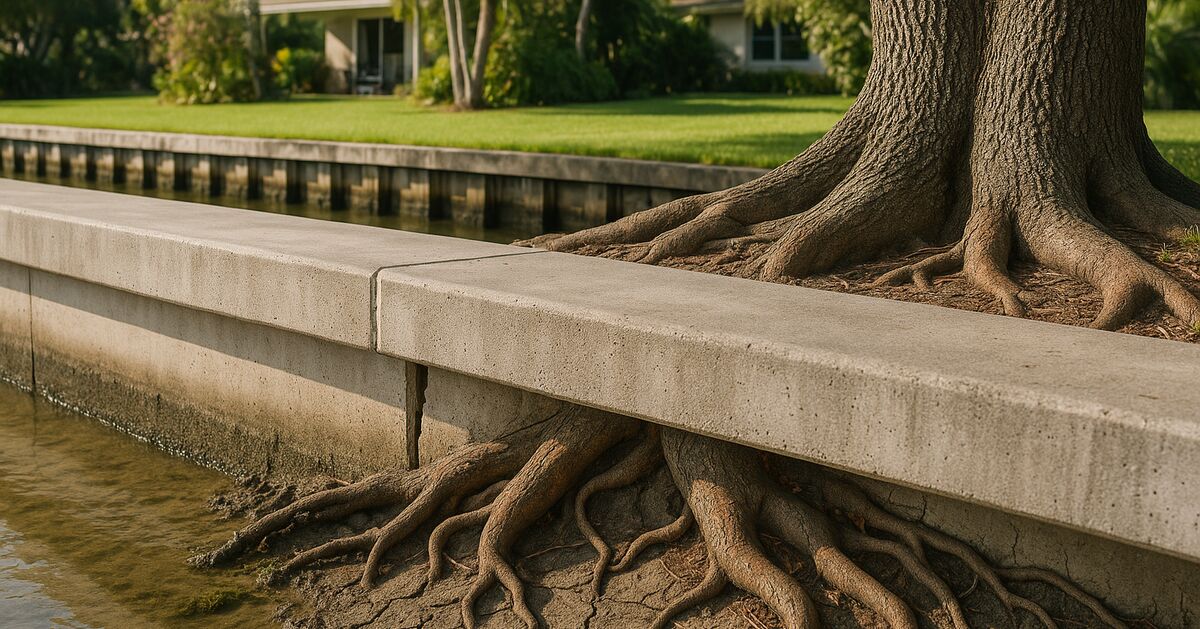
Seawall cracks rarely announce themselves until the repair bill is already steep. By the time you notice a bulge in the cap, a gap in the panels, or soil washing out behind the wall, the roots that caused it have been pushing for years. This post explains exactly how tree roots interact with seawall structures, which tree species create the highest risk along the waterfront communities we serve, and what your realistic options look like.
Why roots and seawalls are a bad combination
A seawall is essentially a retaining structure that holds back the weight of saturated soil on one side while resisting water pressure, wave energy, and tidal fluctuation on the other. Most residential seawalls along the Gulf Coast, including those in Sarasota, Venice, North Port, Englewood, and out on the barrier islands of Siesta Key and Casey Key, are constructed from concrete panels, vinyl sheet pile, or aluminum, all of which are designed to flex within a narrow tolerance.
Tree roots, by contrast, are not polite about boundaries. They grow where moisture and oxygen are available, and the soil directly behind a seawall is often the most attractive spot in the yard. It stays damp from tidal seepage. The backfill is often looser than native soil elsewhere on the property. Nutrients concentrate there. So roots move toward it, and once they arrive, the problems begin.
Root expansion exerts what engineers call radial pressure. As a root grows in diameter every season, it pushes outward against whatever surrounds it. A concrete panel that was poured to close tolerances gets incremental pressure applied to it year after year. Cracks form at the joints or along existing hairlines. Once a crack forms, water infiltrates, and in Florida's wet season that means repeated cycles of saturation, which accelerates further cracking and allows soil to migrate through the gap and into the waterway. The Army Corps of Engineers and state environmental agencies treat that soil migration as a water-quality concern, which is why seawall repair on navigable waterways typically requires permits.
There is a second mechanism that is less obvious: root channels become drainage pathways. When a large root eventually dies, whether from old age, root pruning, or disease, it leaves a tubular void in the soil directly behind the seawall. That void becomes a fast-moving conduit for water during heavy rain events, scouring soil away from behind the wall and creating a cavity that can cause sudden panel failure or cap settlement. Owners on canals in Placida, Port Charlotte, and along the Intracoastal near Osprey and Nokomis have experienced exactly this pattern.
Which trees cause the most damage near seawalls
Not every tree planted near the water creates equal risk. The key variables are root architecture, mature spread, and growth rate.
Ficus species (including strangler fig and weeping fig): These are among the most aggressive root producers in Florida. Their surface roots can travel extraordinary horizontal distances and their fine fibrous roots penetrate the smallest crack or joint. A ficus planted 15 feet from a seawall is not safe; its roots will find the wall.
Live oak (Quercus virginiana): Live oaks are genuinely beautiful trees and they belong in this region, but their lateral root system is wide and close to the surface. The roots can extend two to three times the canopy radius, which means a mature live oak with a 40-foot canopy spread may have roots reaching 60 to 80 feet in any direction. Our post on what live oak soil tells you about root spread goes into the structural logic of that spread in more detail. A live oak planted too close to the water's edge will eventually stress any seawall within that radius.
Melaleuca (Melaleuca quinquenervia): This invasive species is a prolific water-seeker. Where it has established near canals in Charlotte County and southern Sarasota County, it creates dense, aggressive root masses. Melaleuca is a state-listed invasive species in Florida, and its proximity to seawalls adds another reason to address it promptly.
Laurel oak (Quercus laurifolia): Often confused with live oak, the laurel oak is a shorter-lived tree that tends to develop significant heartwood decay as it ages. Decaying roots are soft and friable; they do not exert the same sustained radial pressure as healthy roots, but the voids they leave behind can be just as damaging to seawall integrity.
Royal poinciana and Brazilian pepper: Both are fast-growing, both develop extensive lateral root systems, and both are common in yards throughout our service area. Brazilian pepper is also widely regarded as an aggressive, fast-spreading species in Florida landscapes.
Trees that are generally lower-risk near seawalls include most palms, because palms produce fibrous root systems with low individual root diameter and no secondary root thickening. A sabal palm or a cluster of pigmy date palms near a seawall is a far safer choice than an oak or ficus of similar height. That said, even palms should not be planted directly against a seawall cap, because their root balls can still shift panels if they are allowed to grow into the expansion joints.
How close is too close?
There is no single universal setback number that applies to every tree and every seawall type. What arborists and seawall engineers generally agree on is that the critical distance depends on the species' expected mature root spread, the type of seawall construction, and the age and condition of the wall.
A reasonable working guideline for high-risk species like live oaks and ficus is a minimum setback equal to the expected mature canopy radius. If a live oak is going to reach 50 feet in canopy width at maturity, the trunk should ideally sit no closer than 25 feet from the seawall, and even that may not fully protect an aging concrete wall. Smaller, slower-growing trees like redbuds, native hollies, or most palms can be planted somewhat closer with less risk.
Our tree and land services overview describes how we approach site assessments, and an on-the-ground evaluation is the only way to get a number that is specific to your yard, your species, and your seawall condition.
Warning signs to look for right now
Walk your seawall and look for these specific indicators that roots may already be at work:
- Horizontal cracking or bowing in panels. Seawall panels are designed to resist horizontal pressure from behind. Cracking or movement in that direction often indicates soil pressure, which roots can contribute to or amplify.
- Lifted or displaced cap sections. The concrete cap that runs along the top of the wall is the first thing roots tend to displace. Even a small gap or lip in the cap is worth investigating.
- Soil loss behind the wall. If you notice depressions, soft spots, or sinkholes in the grass near the seawall, soil is migrating through cracks or root channels.
- Surface roots visible near the base of the wall. If roots are visible at the soil surface right next to the seawall, they are also present underneath it.
- Unusual tree lean toward the water. A tree that begins leaning toward the canal or bay may have lost anchor roots on the landward side, which can shift the root mass in the direction of the water and the wall.
If you see any of these signs, the right sequence is: get the tree assessed first, then get the seawall assessed. Trying to repair the seawall without addressing the root source means you will be repairing it again in a few years. Our frequently asked questions page covers some of the most common concerns homeowners raise when they discover this kind of problem.
What can actually be done
Once a tree has roots interfering with a seawall, the options exist on a spectrum from least to most disruptive.
Root pruning with a physical barrier: In some cases, a trench can be cut between the tree and the wall, severing the roots that have migrated toward it, and a physical root barrier installed to redirect future growth. This approach works best when the tree is still relatively young and the wall is still in good condition. Our related post on root barriers, how they work and when you need one explains the mechanics and limitations of this method in detail. The critical point is that root pruning must be done carefully and within limits. Removing too much of a root system destabilizes the tree and can also cause rapid crown decline. Work of this type should align with ANSI A300 Part 5 guidelines for root management, which define safe pruning depths and distances relative to trunk diameter.
Crown reduction to reduce overall demand: Reducing the canopy through a proper ANSI A300 crown reduction (not topping, which permanently damages tree structure) can slow root growth somewhat by reducing the photosynthetic load the root system has to support. This is rarely sufficient on its own, but it can be a useful part of a broader management plan when the tree has significant landscape or canopy value.
Tree removal: Where the tree is too close, too large, or has already caused significant damage, removal is the most reliable solution. This is not a casual recommendation, because mature trees have real ecological and property value. But a seawall replacement in a coastal Florida community can be a significant and costly undertaking, and the cost-benefit calculation sometimes makes removal the responsible choice. Our locations page shows the full range of communities we serve, and removal near waterways does require attention to site logistics since cranes or directional felling toward land rather than water are often necessary.
Replanting with an appropriate species: After removal, replanting with a lower-risk species at an appropriate setback keeps the waterfront looking cared for without recreating the same problem. Native sabal palms, buttonwood (Conocarpus erectus, which is actually a coastal mangrove associate), and certain native shrubs are worth considering with guidance from your local Florida-Friendly Landscaping program through the University of Florida IFAS Extension.
What to expect during an assessment
When Michael Calabro (ISA Certified Arborist, certificate FL-362432A) evaluates a tree near a seawall, the assessment is not just about the tree in isolation. It includes the species, estimated root spread based on trunk diameter and canopy geometry, visible surface root patterns, soil type, proximity to the wall, and any visible damage to the wall itself. The arborist can describe what the roots are likely doing underground without excavation, though in some cases air spading or careful hand excavation near the wall base adds useful information.
The assessment also considers what kind of pruning, if any, is appropriate under ANSI A300 and ANSI Z133 safety standards. Those standards govern how tree work is performed for both tree health and worker safety, and they matter particularly on waterfront sites where there is no room to drop material toward the water, and where proximity to a structure limits the angles available for aerial work.
The Gulf Coast context
Waterfront properties from Manasota Beach and Englewood up through Venice, Osprey, and Sarasota face a specific combination of factors that makes the tree-seawall relationship more pressing than in many other parts of the state. Soils along the coast tend to be sandy and free-draining, which encourages roots to spread wide in search of moisture. Tidal fluctuation keeps the zone immediately behind seawalls consistently damp. And the region's hurricane exposure means that trees near the water have to be healthy enough to withstand significant wind loads without uprooting, which creates a tension: a root system large enough to anchor a tree in a storm may also be large enough to stress the seawall.
That tension is worth thinking about before you plant anything new near the water, and worth evaluating if you have an existing tree that is getting close to the wall. Our related post on Casey Key and Siesta Key wind exposure covers how coastal wind loads affect tree risk, which is directly relevant to how you weigh keeping or removing a large waterfront tree.
The bottom line
Roots do not intend to damage seawalls. They go where conditions favor growth, and the soil behind a coastal seawall is often exactly those conditions. The result is a slow, often invisible process that can end in an expensive repair or a sudden structural failure. Catching it early, whether through routine property inspection or after a neighbor mentions a similar problem, gives you real options. Waiting until the cap lifts or a panel bows out reduces those options considerably.
If you have a tree within what feels like striking distance of your seawall and you are not sure what you are looking at, the practical next step is an on-site assessment. You can reach us through the contact page to set one up.
Got a tree that worries you?
Free, no-pressure on-site estimate across Sarasota & Charlotte Counties.