
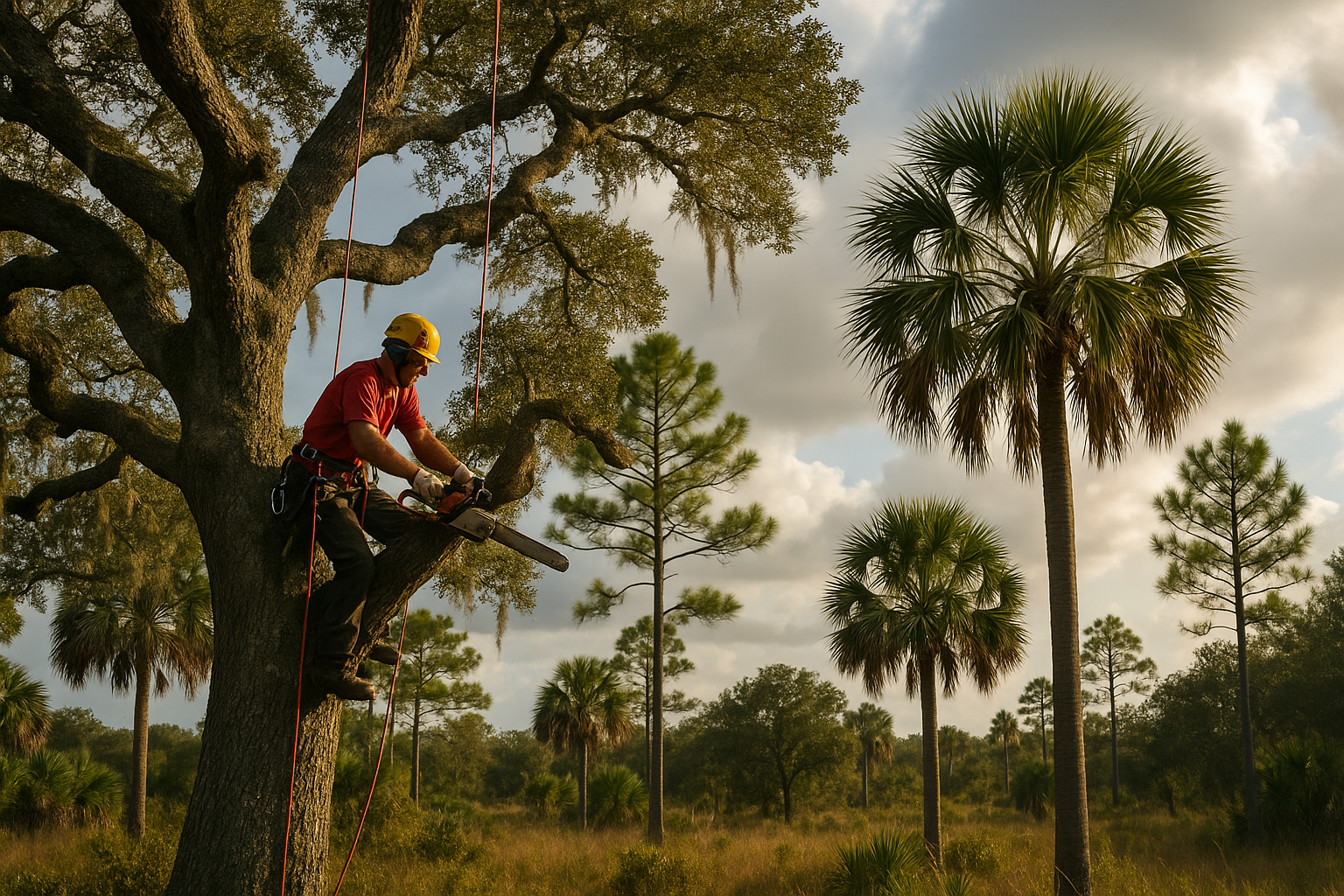
Florida's most common yard trees are not the problem - ignoring them is. Live oaks, slash pines, and sabal palms show up in nearly every neighborhood from North Port to Venice, and homeowners who understand how these trees actually grow tend to spend far less money on emergency calls and property repairs than those who don't. This guide covers the real care habits each species needs, the warning signs worth watching, and what to do when a tree crosses the line from beautiful to dangerous.
Why Local Species Knowledge Matters
Every tree species has its own growth pattern, vulnerability window, and set of care requirements. The advice on a generic gardening website is often written for climates nothing like ours. Southwest Florida's combination of sandy soil, high humidity, intense summer rain, a long dry season, and near-annual tropical storm threats means that a tree considered low-maintenance elsewhere can become a serious liability here if you treat it the wrong way.
Our tree removal and storm cleanup services are called out far too often after preventable situations: a slash pine that was pruned too aggressively and could not seal its wounds before a wet season, a live oak that lost a major limb because a co-dominant stem was never addressed when the tree was young, or a sabal palm that slowly starved because nobody knew it needed manganese. Understanding the basics before a problem starts is almost always cheaper and safer.
Live Oaks: The Heavy Lifters of the Florida Canopy
Quercus virginiana, the southern live oak, is probably the most magnificent tree you can have in a Florida yard. A mature live oak in Sarasota or Osprey can spread sixty to eighty feet wide, casting the kind of deep, dappled shade that drops a home's cooling costs noticeably. These trees are tough, long-lived, and genuinely beautiful. They are also frequently misunderstood.
How Live Oaks Actually Grow
Live oaks grow fast in youth and then slow down as they age. They hold their leaves year-round, but they do drop and replace them in late winter and early spring, which surprises new Florida residents who expect a different look from an "evergreen." That brief leaf drop in February or March is completely normal. If you see significant leaf drop outside that window, especially combined with yellowing or unusual timing, pay attention.
The biggest structural challenge with live oaks is something called co-dominant stems, where two or more main trunks grow upward at similar angles from one base, creating a V-shaped fork. Over time, bark becomes included between these stems, and the union can fail catastrophically under the kind of load a tropical storm produces. If you have a young live oak in your yard, getting a tree specialist to look at its structure early and make minor corrective pruning choices can prevent a major problem decades later.
Pruning Live Oaks the Right Way
Live oaks benefit from periodic canopy thinning to let wind pass through rather than push against solid branches. This is especially relevant in North Port, Rotonda West, and other areas where lots are large enough to allow a full canopy but where storms arrive with serious force. The goal of pruning is to maintain the tree's natural shape while reducing the sail effect that causes uprooting or limb failure.
A few things to avoid:
- Topping. Cutting the central leader or slashing back major limbs to stubs creates decay entry points and produces fast, weakly attached regrowth. Topped live oaks are more dangerous, not less.
- Over-thinning. Removing more than about 25 percent of the live crown at one time puts the tree under serious stress.
- Wound dressings. Black sealants applied to pruning cuts do not help and can actually trap moisture and delay the tree's natural sealing response. Skip them.
- Pruning in spring. Live oaks are susceptible to a disease called oak wilt, which is spread by beetles attracted to fresh wounds. In Florida this is less of a crisis than in Texas, but it is still wise to schedule major pruning outside the spring flush if you can.
After a storm, debris and broken limbs are a separate matter. See our post on emergency tree removal after a Florida storm for a step-by-step on what to prioritize when a live oak loses a major limb.
Fertilizing and Watering Live Oaks
Established live oaks rarely need supplemental watering. Once a tree has been in the ground for two or three years, its roots typically extend well beyond the drip line and can access whatever moisture the water table and rainfall provide. Young trees need consistent irrigation during the dry season (October through May), but it is easy to overdo it. Soggy soil around the base encourages root rot, particularly in the heavy clay pockets found in parts of inland Charlotte County.
Fertilizer is generally not necessary for a healthy, established live oak growing in natural soil. If a tree shows persistent yellowing, a soil test is far more useful than a general application of lawn fertilizer, which is typically too high in nitrogen for trees and can burn roots.
Slash Pines: The Misunderstood Native
Pinus elliottii, the slash pine, is a Florida native that once dominated vast stretches of the coastal plain. You still see large stands along the edges of conservation land in North Port, Port Charlotte, and Venice. In residential settings, slash pines grow quickly and provide welcome vertical structure, but they have a reputation for being brittle or dangerous that is only partly deserved.
What Makes Slash Pines Vulnerable
The real vulnerability of slash pines comes from two things: root disturbance and drought stress. A slash pine that is healthy and well-rooted handles wind surprisingly well. The ones that fail in storms are often those that have had their root zone paved over, graded, or impacted by construction, or those that quietly suffered through drought conditions that weakened their defenses against bark beetles.
Slash pines are also intolerant of fill soil placed over their roots. If you have had any grading work done near a slash pine, watch the tree carefully for the next two or three growing seasons. Yellowing needles, early needle drop, or pitch tubes (small, resin-coated bumps on the bark that indicate beetle activity) are signs the tree is struggling. Our page on signs a tree on your property has become dangerous covers these symptoms in more detail.
Pruning Slash Pines
Slash pines need very little pruning. The most important maintenance task is removing dead lower limbs, which are both a fire hazard in the dry season and an aesthetic issue. Live lower limbs on a slash pine should generally be left alone.
One common mistake homeowners make is trying to "raise" the canopy by removing too many living lower branches at once. This can trigger a stress response and, in some cases, make the tree more susceptible to the very beetles it would normally resist.
When a Slash Pine Needs to Come Down
A slash pine that has died, is actively infested with bark beetles, or has suffered major root damage is a genuine hazard. Dead pines can fall without much warning, and because their root systems are wide but relatively shallow, they tend to tip over as a unit rather than breaking at the trunk. If a slash pine in your yard is showing widespread needle death or has large areas of missing bark, do not wait on it. Check out our frequently asked questions for guidance on what the removal process looks like and what to ask a contractor before work begins.
Sabal Palms: Florida's State Tree Deserves Better Care
The sabal palm (Coryphi umbraculifera), also called the cabbage palm, is the Florida state tree and one of the most hurricane-resistant large plants you can grow here. A healthy sabal palm can flex dramatically in a storm and emerge just fine. The problem is that most sabal palms are not given the conditions to stay healthy, and a stressed sabal palm is a very different thing from a vigorous one.
The Skinning Mistake
Walk through almost any neighborhood in Sarasota, Nokomis, or Siesta Key and you will find sabal palms with their boots (the old leaf base attachments) stripped smooth or cut in a way that produces an unnatural, pineapple-like pattern. This is done for aesthetics, and it is not necessarily harmful if done carefully. But aggressive skinning that cuts into the living wood just below the boot can introduce disease and weaken the palm's structural integrity.
Palms also do not have bark the way broadleaf trees do. Any wound to the trunk of a sabal palm is permanent. The tree cannot seal or compartmentalize damage the way a live oak can. This makes physical damage during improper pruning a real and lasting concern.
Frond Pruning
The most common pruning mistake with sabal palms is removing too many fronds at once. A palm needs its green fronds for photosynthesis. Removing fronds that are still green and actively growing stresses the tree and can slow its growth significantly. The general rule: remove only fronds that have turned brown and hang below horizontal. Anything pointing sideways or upward is doing photosynthetic work and should stay.
The so-called "hurricane cut," where a palm is shaved down to just a tuft of fronds at the top, actually makes the palm weaker, not stronger, in a storm. It also triggers a nutrient drain that can take years for the tree to recover from.
Nutrient Deficiencies in Sabal Palms
Sandy soils throughout our service area, from Englewood to North Port, drain quickly and tend to be low in potassium, magnesium, and manganese. Sabal palms show nutrient deficiencies in specific ways. Potassium deficiency produces translucent yellow-orange spotting on older fronds. Magnesium deficiency creates a broad yellow band on the outer edges of older leaves. Manganese deficiency, sometimes called "frizzle top," causes new growth to emerge brown and crinkled, which can be fatal if not addressed quickly.
If your sabal palm is showing any of these symptoms, a palm-specific granular fertilizer with the right ratio of potassium, magnesium, and manganese is the right starting point. Standard lawn fertilizer will not fix a palm micronutrient problem.
When a Sabal Palm Needs Removal
Sabal palms that have lost their terminal bud (the single growing point at the top of the trunk) cannot recover. If a palm has no new growth emerging from the center for several months, or if the newest fronds are completely dead and brown, the tree is likely dead or dying. A dead sabal palm left standing becomes a hazard, especially in higher-wind areas like the beachside communities of Siesta Key and Casey Key.
Getting the Timing Right Before Storm Season
Florida's hurricane season runs from June through November, but most major storms arrive between August and October. If you have any concerns about a live oak's structure, a slash pine's root health, or a sabal palm's frond canopy, the window between February and late May is the ideal time to address them. Trees are actively growing, pruning wounds close faster, and contractors have more scheduling flexibility before the rush that comes after the first named storm of the season.
Our post on how to get your trees ready before hurricane season in Florida walks through a full pre-season checklist worth reviewing every spring.
Knowing When to Call a Pro
There is a lot a homeowner can do, including monitoring for warning signs, keeping the base of trees clear, watering young trees during dry season, and avoiding the worst pruning mistakes. But once a tree has a structural concern, a disease, or a canopy that exceeds what a ladder and hand saw can safely reach, the right call is to bring in someone who does this work every day.
We serve homeowners across Sarasota and Charlotte counties, including Sarasota, North Port, Venice, Englewood, Port Charlotte, Osprey, Nokomis, and the barrier islands. If you have a tree you are not sure about, the best investment is a professional assessment before something goes wrong, not after.
Reach out to us any time to schedule a look. We are happy to talk through what we see and give you an honest answer on what a tree actually needs, whether that is nothing, some pruning, or removal.
Got a tree that worries you?
Free, no-pressure on-site estimate across Sarasota & Charlotte Counties.