
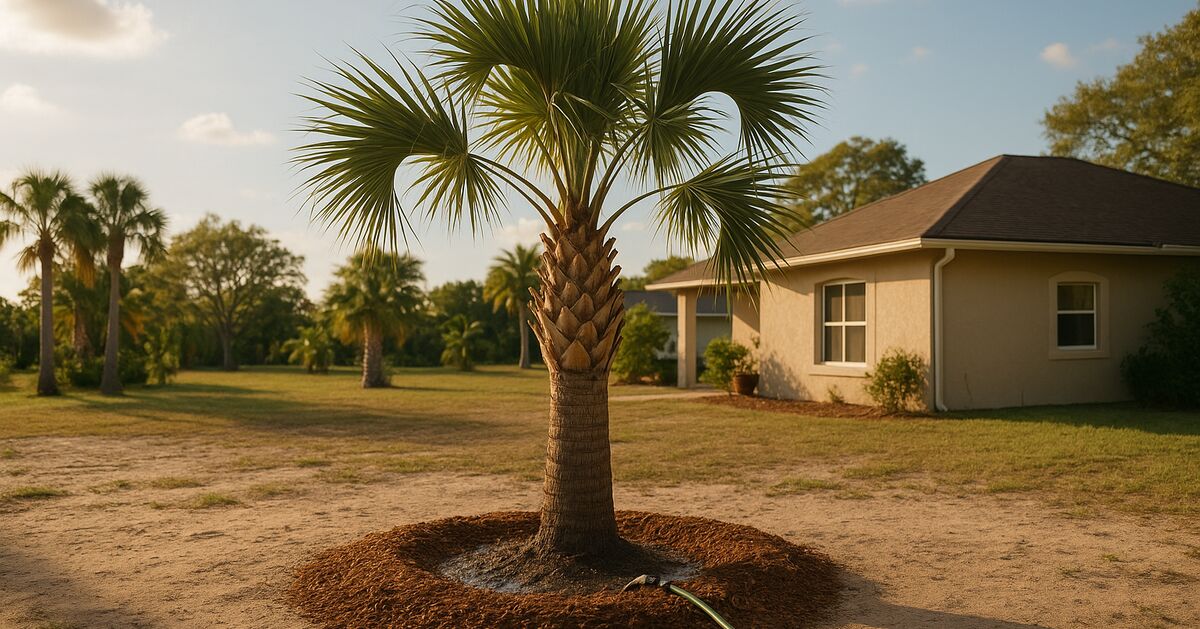
A freshly planted sabal palm can look perfectly fine for six months and then collapse, not because of disease or pests, but because of decisions made on planting day and in the weeks that followed. Understanding the biology behind those first two years is the difference between a palm that anchors your landscape for decades and one you end up paying to remove.
Why sabal palms are so vulnerable right after transplanting
The sabal palm (Sabal palmetto) is Florida's state tree, and for good reason. Once established, sabal palms are known for strong tolerance of drought, salt spray, sandy soil, and coastal storm conditions. The key phrase is "once established."
Unlike most trees, palms belong to the monocot plant family. They do not grow outward by adding rings of wood. Instead, a palm grows from a single meristematic growing point called the apical bud, sometimes called the boot or heart. Every leaf, every root, every bit of new tissue originates from that one spot. If that bud is damaged during transplanting or stressed past its tolerance in the months that follow, the palm cannot compensate the way an oak or a pine would. There is no secondary bud to take over. The tree dies.
This vulnerability is not a flaw you can work around by choosing a hardier cultivar. It is fundamental biology, and it shapes everything about how a sabal palm should be handled from the moment it is dug at the nursery to the day its new root system fully colonizes the surrounding soil, which takes roughly 18 to 24 months.
What actually happens underground at planting
When a sabal palm is dug for transplanting, even under ideal conditions, it loses the overwhelming majority of its root mass. Those fibrous roots do not regenerate from the cut ends the way a broadleaf tree's roots might. Instead, new roots emerge from the base of the trunk (called the root initiation zone) and grow outward into the surrounding soil. Until that new root system is functional, the palm is drawing on stored moisture and carbohydrates in its trunk to survive.
That trunk storage is finite. In the sandy, fast-draining soils common across North Port, Englewood, and Nokomis, stored reserves can deplete faster than expected, especially during a warm, dry stretch in the first spring after planting. This is why a palm planted in October can look fine through winter and then suddenly decline in April. The reserves ran out right as heat demand spiked.
The practical takeaway: everything you do in those first 24 months is aimed at reducing demand on the trunk's reserves while the new root system catches up. Reduce stress, reduce moisture loss, and give the roots every possible advantage in the soil.
Proper planting depth: getting it right the first time
Planting depth is one area where a mistake is almost impossible to correct after the fact. Plant too deep, and you bury the root initiation zone in anaerobic, waterlogged soil (a real risk in the seasonally wet areas of Port Charlotte and Laurel). Bury it under more than an inch or two of soil and you can suffocate the zone where new roots need to emerge.
Plant too shallow, and the palm becomes unstable in sandy soil. With summer thunderstorms and Gulf-Coast tropical systems moving through between June and November, an under-anchored palm can shift or topple before its roots have had a chance to grip.
The correct depth places the root initiation zone (the flared base of the trunk where it meets the original root ball) at or very slightly above the finished soil grade. You want water to drain away from the base, not pool against it. A slight crown of soil and mulch around the perimeter of the root ball, not against the trunk, helps manage this.
The role of proper backfill and soil preparation
A common error in planting discussions is the idea that you should amend the backfill soil heavily with compost or enriched mixes. For palms in our region, this can actually work against you. Heavily amended backfill creates a soil texture boundary: roots reach the edge of the amended zone and have difficulty transitioning into the native sandy soil beyond. The roots stay within the enriched pocket, limiting the ultimate root spread and leaving the palm more vulnerable to toppling.
In the sandy Gulf-Coast soils of Sarasota County and Charlotte County, the better approach is to use the native soil as backfill, broken up well to eliminate large air pockets, with the hole backfilled and watered in gradually in lifts to settle the soil uniformly around the root ball. The goal is intimate contact between the root ball and the surrounding soil, with no air voids that would let roots dry out before they can grow outward.
This is one of the topics we cover in more detail on the choosing and siting a new tree for sandy Gulf-Coast soil post, which applies equally to palms and broadleaf trees.
Watering in year one: the single biggest survival factor
If there is one variable that separates palms that thrive from palms that fail, it is irrigation management in the first year. Florida homeowners sometimes assume that because sabal palms are "Florida natives," they do not need supplemental water once they are in the ground. That is true of established palms. It is not true of newly transplanted ones.
Per the University of Florida IFAS guidance on transplanting palms, newly installed palms should be irrigated at the root ball and its immediate surroundings, not just at the drip line, because the new root system has not yet grown beyond the original ball. Watering frequency depends on season and rainfall, but during a dry stretch in the first summer, every-other-day irrigation directly at the root zone is not unusual.
The biggest irrigation mistakes:
- Overwatering at the trunk base. Constant moisture at the root initiation zone invites fungal pathogens. Water around the perimeter of the root ball, not against the trunk.
- Stopping irrigation too soon. A palm that looks green and healthy at month four still has a tiny, immature root system. The visual health of the canopy lags behind root development by weeks or months.
- Relying entirely on in-ground irrigation heads that miss the root ball. Many residential irrigation systems are calibrated for established landscaping. A new palm's root ball may be sitting in a dry spot between two heads. Confirm coverage manually.
- No irrigation at all in dry season. Osprey and Nokomis can see extended dry stretches from November through May. A palm planted in fall needs hand-watering through its first dry season even if it looks fine.
Mulching: why it matters and how to do it correctly
A 3-to-4-inch layer of wood chip mulch over the root zone does two important things during establishment: it moderates soil temperature (sandy Florida soil can heat to levels that stress root growth on summer afternoons) and it dramatically slows moisture loss between watering events.
Keep mulch pulled back 6 inches from the trunk. Mulch piled against the trunk stays wet, and constant moisture against the root initiation zone is one of the conditions that favors fungal rot. The mulch ring should be wide, covering an area at least as broad as the original root ball, ideally wider. Think of it as a moisture and temperature buffer for the root zone, not a decoration around the base.
Do not prune heavily right after planting
A newly transplanted palm is already working hard to balance water loss from its fronds against the limited water uptake from its compromised root system. Every green leaf is a net contributor to photosynthesis and, critically, a source of the carbohydrates the palm is storing in its trunk. Removing healthy green fronds at planting removes that resource.
The practice of tying fronds upright around the emerging spear or removing all but a few fronds at transplanting was once common. Current guidance from University of Florida IFAS and from arboricultural research does not support heavy frond removal at transplanting for sabal palms. Removing dead or clearly dying brown fronds is appropriate. Removing green fronds to "reduce stress" is counterproductive.
For a detailed look at which cuts are correct and which cause lasting harm to palms, the pruning a palm properly: what to cut, what to leave, and how often post walks through the reasoning in full.
Trunk wrapping and bracing: short-term support, not long-term solutions
On large, heavy sabal palms transplanted by crane (common for the mature palms you see installed along beachfront properties on Casey Key or Manasota Beach), temporary trunk support or bracing is sometimes used to prevent movement while new roots anchor the tree. When bracing is used, it must be done correctly. Wires or straps in direct contact with the trunk can cause lasting damage.
Temporary support should generally be removed as soon as the palm shows signs of new root anchorage, typically within a matter of months rather than left indefinitely. Leaving bracing in place longer than necessary actually impedes the trunk's natural development of taper and tensile strength, the properties that allow a palm to flex rather than break in hurricane-force wind. If you have a palm with old, forgotten bracing on it, that is worth addressing.
Recognizing trouble in years one and two
A sabal palm in establishment trouble shows specific warning signs. The most serious is the failure of the emerging spear leaf (the newest, upright leaf emerging from the center of the crown) to unfurl normally. If the spear leaf pulls out easily, or if the base of it is discolored or has an off smell, that is a sign of bud rot, often caused by Phytophthora or Thielaviopsis fungi. This is a genuine emergency. Caught early, some cases can be treated. Left unaddressed, bud rot is fatal.
Other warning signs include:
- New growth that is pale, stunted, or narrow compared to established leaves
- A general bronzing or yellowing of the canopy that persists after manganese or potassium fertilization
- Soft or discolored tissue at the base of the trunk
- Failure to produce any new leaves after 3 to 4 months in the ground
If you are seeing any of these signs on a recently planted palm, an assessment by an ISA Certified Arborist is the right first step, not a round of generic fertilizer. Michael Calabro (ISA Certificate FL-362432A) can evaluate a struggling palm and tell you whether the problem is correctable or whether the palm is past the point of intervention. You can read more about what that kind of assessment involves at our tree and palm care services page.
Fertilization: timing and formulation matter
Sabal palms installed in the nutrient-poor sandy soils of Siesta Key, Venice, or Englewood benefit from palm-specific slow-release fertilizer, but timing matters. The University of Florida IFAS recommends waiting two to three months after transplanting before fertilizing, allowing the root initiation zone to stabilize before introducing salts that can burn emerging roots.
When you do fertilize, use a palm-specific granular fertilizer with an 8-2-12 or similar ratio that includes magnesium and micronutrients (particularly manganese and boron, deficiencies of which show up quickly in Florida's sandy, leached soils). Avoid high-nitrogen turf fertilizers, which push leafy growth the palm's limited root system cannot sustain during establishment.
The Florida Friendly Landscaping program, managed through the University of Florida IFAS Extension, provides county-specific guidance on palm fertilization that is worth following, particularly because fertilizer timing and rates interact with the wet season in ways that generic bag instructions do not account for.
What "established" actually means
After 18 to 24 months, a healthy sabal palm in the Sarasota or Charlotte County area will have developed enough new root mass to largely sustain itself through normal rainfall patterns. You can observe establishment happening: new fronds will emerge on a fairly regular schedule during warm weather, the spear leaves will be full-sized and normal in color, and the trunk will begin to show new vertical growth above the transplant line.
At this point, irrigation demand drops sharply, and the palm begins to look after itself the way the mature sabals you see lining Gulf-Coast roadsides and park entrances do. Those trees are not fragile. They have simply passed through the establishment window.
If you are planning a new installation anywhere in our service area, from Sarasota to North Port or Englewood, or if you have a palm in its first two years that is showing signs of stress, the right move is a conversation with someone who can look at the actual tree, the actual soil, and the actual site conditions.
Our frequently asked questions page covers many of the common concerns around new palm care, and our team is always glad to walk through a site visit before a problem becomes irreversible. Reach out through our contact page any time.
The two-year window is not a marketing concept. It is biology. Respect it, and a sabal palm will reward you for the next half-century.
Got a tree that worries you?
Free, no-pressure on-site estimate across Sarasota & Charlotte Counties.