
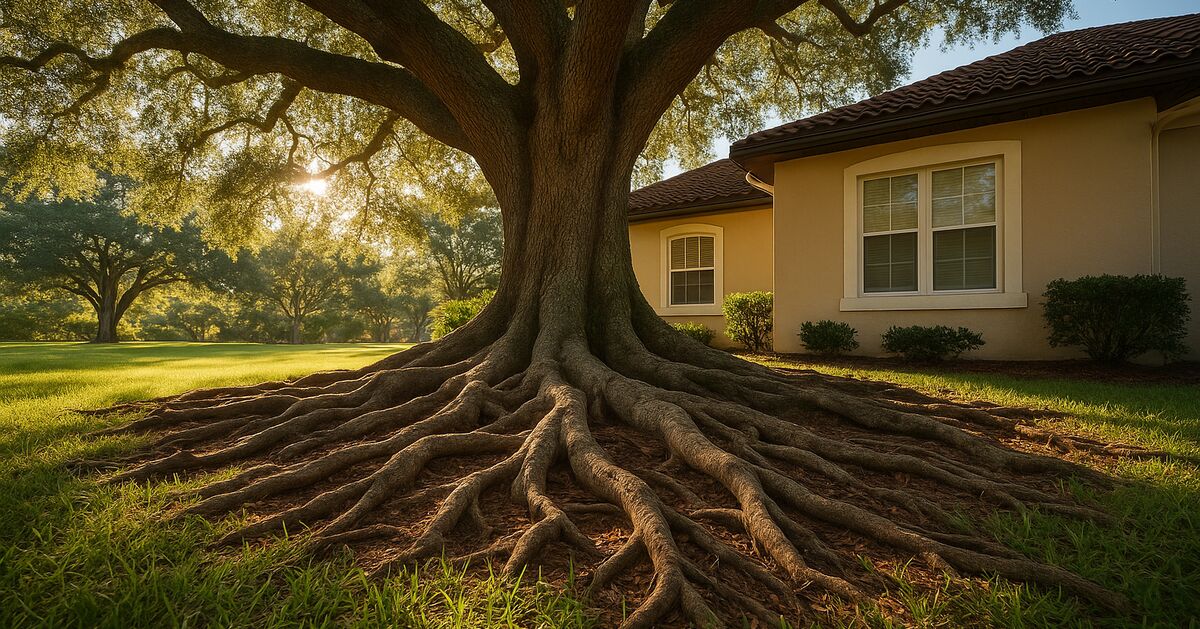
A beautiful live oak shading your back porch is one of the great joys of owning a home on Florida's Gulf Coast. But that same tree, if it's rooted eight feet from your foundation, can cost you far more than shade.
"How close is too close?" is one of the most common questions homeowners ask us before scheduling an appointment. The honest answer depends on the species, the size, the soil, and what exactly the tree is growing near. This guide walks through all of it so you can make a smart decision rather than a panicked one after the next big storm.
Why proximity matters more in Southwest Florida than most places
In many parts of the country, a tree that's too close is mostly a nuisance. Here, it can become a structural emergency overnight. Our soils along the coast, particularly the sandy, shallow profiles common from Sarasota and Siesta Key down through Venice and Englewood, don't anchor roots the way dense clay soils do. A mature slash pine or laurel oak can develop a wide but surprisingly shallow root system, which means the whole tree can lever out of the ground in a strong wind rather than simply losing branches.
Add in the fact that we sit squarely in Florida's hurricane corridor, and "too close" becomes a question with real financial and safety consequences. If you've already read Why Sandy Gulf-Coast Soil Makes Oaks and Pines More Likely to Fall, you know how much the ground itself works against root stability here.
Trees near your home's foundation
The general rule of thumb used by most tree specialists is that a tree's canopy spread at maturity gives you a rough guide to how far its roots will travel. Roots typically extend one to three times the canopy radius, not just straight down.
For practical purposes:
- Small ornamental trees (crape myrtles, hollies, most palms under 30 feet) - plant or leave them at least 10 feet from the foundation.
- Medium trees (young live oaks, red maples, sweet gums) - 20 feet is the working minimum; 25 to 30 is far safer.
- Large canopy trees (mature live oaks, laurel oaks, slash pines) - 30 to 50 feet is the recommended clearance from any structure.
When a large tree is already inside those distances, you have three realistic options: strategic trimming to reduce the load, root barrier installation, or removal. Structural trimming done right can extend the life of a tree near a structure by years, but only if the tree is otherwise healthy and the canopy can be reduced without gutting it.
Roots growing under a slab foundation are a slower but equally serious problem. You may not notice the damage until you see cracks in the driveway, buckled flooring, or doors that no longer sit square in their frames. In heavy clay pockets mixed into our sandy soils (more common inland toward North Port and Rotonda West), expansive roots can crack a slab in a single dry season as the tree competes for moisture.
Trees near your fence
Fences are lower stakes than foundations, but the costs still add up. A fence is usually the first thing to go when a tree fails or drops a large limb. The more pressing concern is what's on the other side of the fence. If your neighbor's fence butts up against your tree, you may share liability for any damage depending on how and why the tree fell.
For wood or vinyl privacy fences, keep any tree with a mature trunk diameter over 6 inches at least 5 to 8 feet from the fence line. That seems like a lot when the tree is a sapling, but it matters when the tree is 40 years old and the root flare is buckling the posts from below.
Roots growing under a fence can actually destabilize the fence itself by lifting posts. If you're in a neighborhood in Sarasota or Venice where HOA fence standards are strict, this kind of slow damage can turn into an expensive repair you didn't see coming.
Trees and overhead utility lines
This one has a hard answer: if a tree's canopy touches or reaches toward overhead power lines, it needs attention now, not next spring.
Florida Power & Light has right-of-way trimming programs, but utility company trimming is notoriously aggressive and rarely looks good. They will cut whatever they need to cut to protect their lines, without any regard for the tree's structure or appearance. If you want the work done in a way that preserves the tree's health and shape, schedule it yourself before they do it for you.
The general clearance guideline from utility tree specialists is a minimum of 10 feet between any branch and a conductor line. That's a minimum under calm conditions. In a 60 mph gust (entirely routine in a tropical storm), a branch can flex 5 to 10 feet, which means a tree that looks clear on a calm Tuesday can slap a line during a storm.
Fast-growing species are the worst offenders near lines. Chinaberry trees, Brazilian peppers, and even younger slash pines in the Osprey and Nokomis areas along the coast can put on 3 to 4 feet of height per year. If you planted one under a line ten years ago, it may already be a problem.
For trees that have grown into lines, removal is often the most practical answer. Repeated heavy pruning to keep a tree below a line stresses the tree, creates decay entry points, and just postpones the same decision every three to five years.
Trees near driveways, walkways, and drains
Pavement damage from surface roots is common with live oaks, ficus, and some palms throughout the area. The root systems of large live oaks in particular can buckle a concrete driveway in as little as 10 to 15 years if the tree was planted within 8 to 10 feet of the edge.
Beyond the tripping hazard and repair costs, roots that grow into French drains or stormwater management systems can cause flooding issues in low-lying areas. This is especially relevant in communities built on reclaimed wetlands in parts of North Port and Port Charlotte, where drainage management is already a consideration.
For trees already damaging pavement, root pruning combined with a root barrier can sometimes resolve the issue without removing the tree. An experienced tree specialist should assess the situation before any root pruning is done, because cutting too close to the trunk can destabilize the tree or introduce decay.
How to assess the trees you already have
Walk your property and look at each tree through the lens of what's nearby, not just how the tree looks on its own. Ask yourself:
- Is the trunk base within 20 feet of my home's exterior wall?
- Are any large branches (over 4 inches in diameter) hanging directly over the roof, a vehicle, or a neighbor's structure?
- Does the canopy touch or brush any power or cable lines?
- Are surface roots already cracking or lifting pavement, fence posts, or any structure?
- Has the tree ever leaned noticeably after a storm and been left as-is?
If you answer yes to any of these, the tree deserves a closer look. That doesn't automatically mean removal. Sometimes a structural trim, a cable brace, or simple dead-wooding is enough to bring a tree back inside acceptable risk levels. Our frequently asked questions page covers a lot of the decision points around trimming versus removal if you want to think it through before calling anyone.
What "too close" looks like after a storm
The clearest illustration of proximity risk is what we see after a named storm rolls through the region. The calls we get from homeowners in Sarasota, Venice, North Port, and Englewood after a major event follow a predictable pattern. Rarely is the tree that causes damage one that was visibly dead or diseased. More often, it's a tree that looked fine but was growing too close to the house and had a root system that couldn't hold under saturated soil and sustained wind.
If a tree has already fallen or partially failed near a structure, take a look at our post on what to do first after emergency storm damage before anyone sets foot in that area. Safety sequencing matters.
The cost of waiting
Removing a tree proactively, when it's standing and your yard is clear, is almost always less expensive than removing one after it has fallen on something. The factors that drive tree removal costs in Sarasota and Charlotte County include accessibility, crane requirements, and debris volume. All three of those cost drivers get worse, not better, when a tree has fallen on a structure or across a fence.
Insurance coverage adds another layer of complexity. A tree that falls because it was diseased or clearly neglected may be treated differently by your insurer than one that failed in a certified storm event. It's worth reviewing your policy and understanding that distinction before you need it.
When to call a professional
You don't need to hire a tree specialist every time you look at a tree. But you do need one when:
- A large tree (anything over 30 feet) is within striking distance of a structure and you're not sure of the risk level.
- You've noticed recent changes: new lean, cracks at the base, sudden leaf drop, or mushroom growth at the roots.
- A neighbor or HOA has raised concerns about a tree on your property.
- You're buying or selling a home and the inspection flagged trees as a concern.
Our team works throughout Sarasota, Siesta Key, Venice, Englewood, North Port, Port Charlotte, and the rest of Sarasota and Charlotte County. We're happy to take a look and give you a straight answer on whether a tree poses a real risk or whether you can leave it alone with peace of mind.
The bottom line
Trees are worth keeping when you can keep them safely. The goal isn't to clear your yard, it's to understand which trees are genuinely within safe range of your home and which ones are borrowing time. A quick assessment now, before the next storm season ramps up, is almost always the right call.
If you'd like a professional set of eyes on the trees near your house, fence, or utility lines, reach out to us and we'll schedule a visit. No pressure, no overselling, just an honest look at what you're working with.
Got a tree that worries you?
Free, no-pressure on-site estimate across Sarasota & Charlotte Counties.