
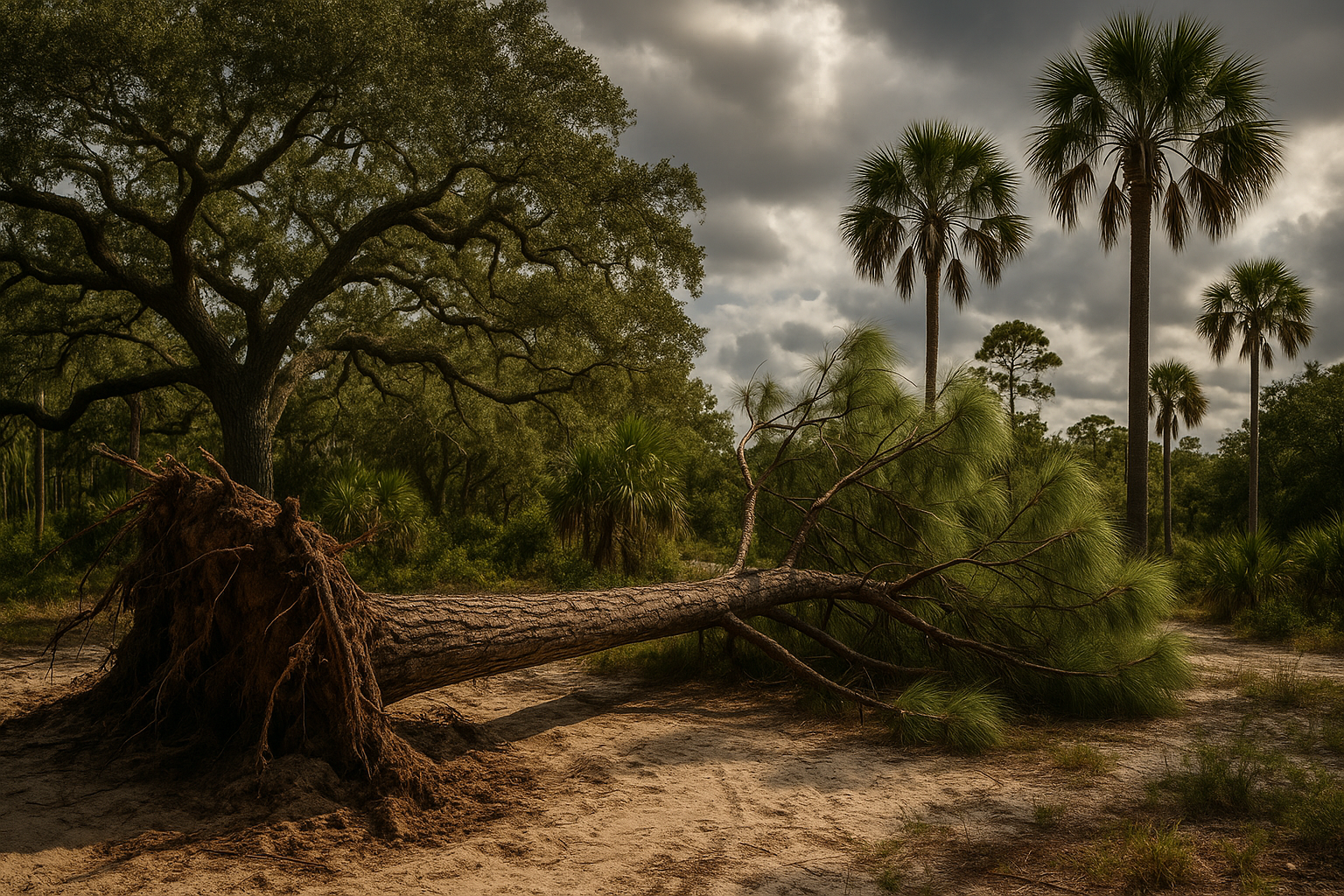
Sandy soil looks harmless enough from the surface. You dig a hole in your North Port backyard, and the dirt practically falls away from the shovel like loose sugar. But that same light, porous quality that makes Gulf-Coast soil so easy to work with is also one of the biggest reasons that mature oaks and pines tip over in storms here more often than they do almost anywhere else in the country.
Understanding why this happens is not just an interesting science lesson. It is genuinely useful information that can help you decide which trees on your property need attention before the next tropical system rolls in off the Gulf.
What "Sandy Soil" Actually Means for a Tree's Root System
Most of Florida's Gulf Coast, from Siesta Key and Casey Key south through Venice and Englewood and inland through North Port, Rotonda West, and Port Charlotte, sits on a layer of fine quartz sand that ranges from a few inches to several feet deep before hitting hardpan or limestone below. That sand is the result of millennia of coastal deposition and, in some areas, ancient seabed uplift.
Here is the problem for trees: sand particles are relatively large compared with clay or silt particles. Large particles do not pack tightly, which means there are big air gaps between them. Water drains through those gaps quickly, and the sand itself offers very little mechanical grip.
A tree anchors itself through two root systems working together. The first is the structural root system, a network of thick, woody roots that radiate out from the base and are meant to act like guy-wires, holding the trunk upright against wind load. The second is the fine feeder root system, which explores the soil for water and nutrients.
In sandy soil, both systems face challenges. Structural roots cannot get the same bite they would in heavier soil. When a 70-mph gust hits the canopy of a large live oak, the mechanical leverage transferred to those roots is enormous, and roots that are anchored in loose sand simply cannot resist it the way roots anchored in dense clay can. The root plate, that disc of roots and soil directly under and around the base of the tree, is also lighter and smaller because the soil provides less resistance during root growth. A shallow, poorly anchored root plate is the single biggest mechanical reason trees fall over.
Why Oaks and Pines Are Particularly Vulnerable
Most of the trees homeowners care most about across this stretch of coast are live oaks (Quercus virginiana) and various pines, primarily slash pine (Pinus elliottii) and longleaf pine (Pinus palustris). Both have characteristics that interact badly with sandy soil.
Live oaks have dense, heavy canopies. A mature live oak can hold a staggering amount of wind-catching surface area. The same broad, sweeping canopy that provides shade for your patio acts as a sail in a strong storm. In heavier soil, the extensive root system that oaks naturally develop can counterbalance that sail effect. In sand, the roots spread wide but often stay surprisingly shallow because deeper layers of dry sand or hardpan offer little reward. The result is a wide, beautiful tree sitting on a root plate that is not nearly as deep as you would hope.
Pines have a different problem. Their taproots tend to drive downward early in life, which sounds like an advantage. But in Florida's sandy coastal soils, that taproot frequently hits hardpan or a water table within the first few feet. Once the taproot cannot go deeper, the tree compensates by spreading lateral roots outward, but those lateral roots in sandy soil are again relatively shallow and lack grip. Pines also hold their needles year-round, which means they never reduce their wind profile the way a deciduous tree does in winter.
Both species also commonly suffer from root rot in Florida's wet climate, and here is where sandy soil adds a second layer of risk: it can mask decay. Because water drains away quickly, the soil at the base of a tree may look and feel fine while the roots just a foot down are sitting in standing water near a hardpan layer after heavy rain, slowly decaying. You would never know by looking at the surface.
For a detailed checklist of what to look for above ground, the post on signs a tree on your property has become dangerous walks through the visible warning signs that often accompany compromised roots.
The Role of Wet-Dry Cycles on the Gulf Coast
One of the more insidious aspects of Gulf-Coast soil is the extreme swing between wet and dry conditions. Sarasota, North Port, and the surrounding areas typically see 50 to 60 inches of rain a year, with the vast majority falling between June and September. During the dry season, sandy soils can become almost powdery at the surface. During the wet season, water can pool on top of hardpan layers that sit just below the sand.
Each wet-dry cycle shifts the soil around the roots slightly. Over years and decades, this cycling can cause the soil immediately around the structural roots to become progressively looser rather than more compacted. Think of it like repeatedly wetting and drying a sandcastle wall. Each cycle loosens it a little more. By the time a tree is 30 or 40 years old, the root-to-soil interface may be significantly weaker than it was when the tree was young, even if the tree looks perfectly healthy from the outside.
This is one reason why trees that have stood for decades can still come down in a storm that, by historical standards, would not seem particularly severe. The damage accumulates invisibly over time.
Coastal Salt and Its Effect on Root Health
For homeowners near the water, whether on Siesta Key, Casey Key, or along the waterfront in Englewood and Nokomis, there is an additional factor: salt. Salt spray and occasional saltwater intrusion during storm surge events stress root systems and can kill fine feeder roots. A tree with a depleted feeder root system is less able to take up the water and nutrients it needs to maintain healthy structural roots and a dense, vigorous canopy. A weakened tree is a falling tree waiting for the right storm.
Salt damage at the root level rarely shows dramatic above-ground symptoms right away. You might notice some needle browning on pines or leaf scorch on oaks after a significant storm surge, but the deeper structural damage to the root system plays out over the following growing seasons. By the time you can clearly see the tree is declining, the structural compromise may already be significant.
What Happens When a Tree Actually Falls
If you have ever seen a large pine or oak uproot after a storm here on the Gulf Coast rather than simply snap mid-trunk, you have witnessed exactly what shallow sandy-soil anchoring looks like. The root plate comes up as a flat, surprisingly thin disc, often carrying only a few inches of soil before the roots transition to bare sand. Contrast that with video of storm-damaged trees in the Midwest or Mid-Atlantic, where uprooted trees carry enormous balls of dense, dark soil. The difference is stark and explains a great deal.
That root plate, when it comes up, can destroy anything nearby: sidewalks, driveways, irrigation systems, foundations, fences. The canopy then falls in whatever direction the root plate was leaning, which is not always predictable. This is why understanding the lean and loading of a tree near structures matters so much before a storm arrives. Our post on how to get your trees ready before hurricane season in Florida covers the preparation steps worth taking every spring.
If the worst has already happened and you are dealing with a downed tree, the post on emergency tree removal after a Florida storm explains what to do first to stay safe and protect your property.
What You Can Do About It
Knowing that your soil creates elevated risk does not mean you have to remove every mature tree on your property. It means you should be strategic and informed. Here are the practical steps worth taking.
- Get a professional assessment of any large oak or pine near your home. An experienced tree specialist can probe the base of the tree, look for fungal growth at the root collar, check for lean, and evaluate the canopy load relative to the root structure. This is especially important for trees within striking distance of your roof or a neighbor's structure.
- Do not ignore surface-level symptoms. Mushrooms or conks growing at the base of a tree are not a minor cosmetic issue. They are almost always a sign of internal root decay. Likewise, a subtle lean that has developed or increased in recent years is a red flag in sandy soil.
- Consider crown reduction for large trees close to the house. Reducing the canopy size on a structurally sound but heavily loaded tree reduces the sail effect without removing the tree entirely. This is a common and worthwhile option in communities like Venice and Port Charlotte, where large pines and oaks are common on residential lots.
- Be cautious about fill soil and grade changes near tree bases. Covering the root zone with fill to level a yard, or cutting into the root zone to install a driveway or fence, can critically damage structural roots in soil that offers them little extra support to begin with.
You can explore the full range of tree care and removal services we offer across the region, or visit our service area page to confirm we cover your neighborhood.
When Removal Is the Right Answer
Sometimes the honest answer is that a tree needs to come down. A large live oak with significant root decay, a pronounced lean toward the house, and a history of leaning further after each storm is not a tree that is going to get better. In sandy Gulf-Coast soil, that tree is a risk that compounds each year.
If you are unsure about the cost of having a tree assessed or removed, the post on how much tree removal costs in Sarasota and Charlotte County gives a realistic breakdown of the factors that affect pricing in this area.
Removal is not the enemy of a healthy landscape. It is often what protects the rest of your landscape, and your home, from a single catastrophic event. After removal, if you are wondering what happens next, our post on what happens to the wood and debris after tree removal walks through the process.
Our team works throughout the Gulf Coast corridor, from Sarasota and Osprey to Siesta Key and Venice. We understand this soil, these trees, and the specific risks this region throws at homeowners every hurricane season. If you have a tree you are not sure about, the best time to have someone look at it is before a storm is on the forecast, not after.
Reach out through our contact page to schedule a tree assessment. We are straightforward about what we see, and we will never push removal when it is not warranted.
Got a tree that worries you?
Free, no-pressure on-site estimate across Sarasota & Charlotte Counties.