
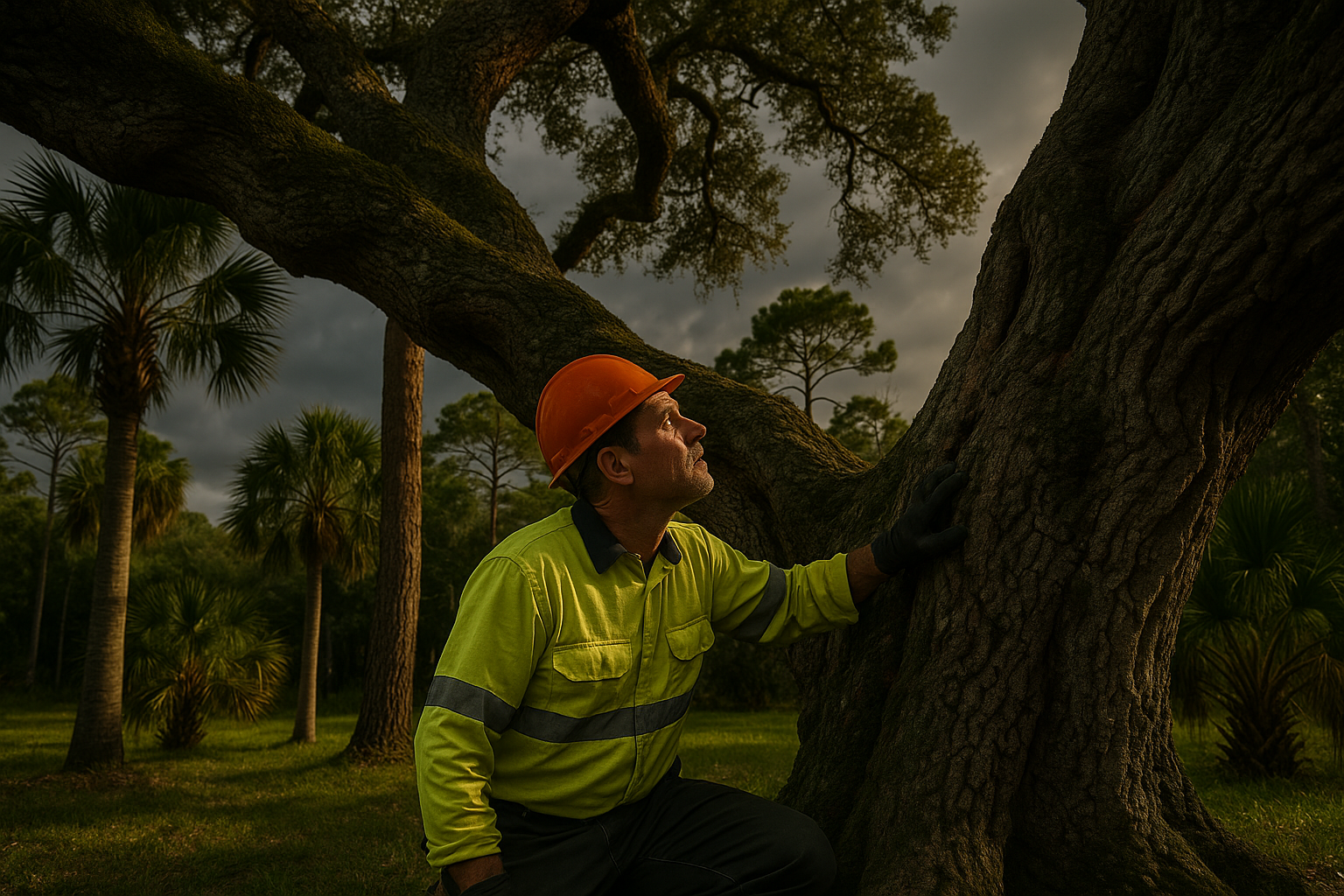
A tree doesn't have to be dead to kill someone. That's the part most homeowners miss. The oak in your backyard can look full, green, and perfectly healthy from the driveway and still be weeks away from dropping a major limb on your roof or your neighbor's fence. Knowing what to look for changes everything.
In Florida's climate, trees face a unique combination of stresses: salt air along the coast near Siesta Key and Casey Key, heavy clay soils inland toward North Port and Englewood, relentless summer heat, and hurricane-force winds that arrive with almost no warning. Those conditions accelerate the kind of hidden decay and structural weakness that leads to failures. The good news is that most hazard trees give you clues well before they come down. You just need to know where to look.
What Makes a Tree a "Hazard Tree" Exactly?
A hazard tree is any tree with a structural defect, disease, or positioning that makes it likely to fail and likely to hit something of value when it does. Both parts of that definition matter. A massive dead oak in the middle of an open field is a low-risk tree even though it's in bad shape. A smaller live oak with a hollow trunk leaning over your screened lanai is a high-risk hazard tree even though it still has leaves on it.
When tree specialists evaluate risk, they look at three things in combination: the likelihood of failure, the likelihood that the failure reaches a target (a house, a car, a person), and the consequences of that strike. Homeowners in Venice, North Port, and Sarasota who understand this framework can walk their own property with much sharper eyes.
Start at the Base: Root Zone and Soil Clues
The most dangerous tree failures often start underground, which is why the base of the tree is where your inspection should begin.
Soil heaving or lifting. If the soil on one side of the tree is pushing up, or if you can see roots pulling out of the ground, the tree is actively uprooting. This is a serious and immediate warning sign. Do not wait on this one.
Mushrooms and fungal growth at the base. Certain shelf fungi (conks) growing directly on the trunk or at soil level are reliable indicators of internal wood rot. The fungus is the fruiting body of decay that's already eating the tree from the inside out. Armillaria (honey fungus) clusters near the root flare are similarly alarming.
Soft or spongy wood at the base. Press a screwdriver or a pocketknife blade into the wood at the base of the trunk. Sound wood resists. If the blade sinks in easily, you've found decay. Areas that crumble, feel hollow when tapped, or show discoloration should not be ignored.
Recent construction or grade changes. In newer subdivisions in North Port and Rotonda West, it's common for grading work to bury root flares or sever major roots during construction. Trees can look fine for three to five years after that kind of damage before they fail structurally. If a road, driveway, or structure was built within the drip line of an older tree in the last decade, that tree deserves extra scrutiny.
Move Up the Trunk: Bark, Cracks, and Cavities
Once you've checked the base, work your way up the trunk looking for these signs.
Cracks or seams running vertically or spiraling up the trunk. These can indicate internal tension or splitting. A crack that runs through the bark and into the wood, especially one that looks fresh or shows exposed wood, is a structural red flag.
Missing bark patches or cankers. Cankers are sunken, dead areas on the bark caused by fungal or bacterial infections. A single small canker isn't an emergency, but multiple cankers or a canker that wraps more than a third of the trunk's circumference can compromise the tree's structural integrity enough to cause failure.
Hollow sections or cavities. A cavity doesn't automatically condemn a tree, but size and position matter enormously. A hollow that removes more than about a third of the trunk's wall thickness in a load-bearing area is a serious concern. You can get a rough sense of how hollow a trunk is by tapping it with a rubber mallet. A solid thud means wood. A hollow knock means something to investigate further.
Multiple trunks with a tight "V" crotch. This is one of the most commonly overlooked hazards in Florida yards. When two or more major stems grow together at a sharp angle, bark becomes included between them as they grow. That bark inclusion prevents the stems from forming a strong wood bond. Over time, especially after wind loading, the stems can split apart suddenly. If you have a large multi-stem tree and you can see bark pinched in the joint between the stems, that junction is weaker than it looks. Signs a tree on your property has become dangerous covers this and other warning signs in detail.
Look at the Crown: Branches and Canopy Health
Step back far enough that you can see the whole crown and look for these patterns.
Dead wood in the canopy. Dead branches are called "widow-makers" in the tree industry for good reason. Unlike a whole tree falling, dead branches can drop without warning on calm days. Wind isn't required. Heat stress, the weight of rain, or even a bird landing can dislodge a branch that's been dead long enough to dry out and lose its connection to the surrounding wood. Any dead branch larger than two inches in diameter within striking distance of people or structures should come down.
A thinning or one-sided canopy. If one side of the canopy is noticeably sparser than the other, or if the entire crown seems thinner than it was a couple of seasons ago, the tree is stressed. This can be from root damage, disease, drought, or pest activity. Dieback in the crown that progresses year over year is the tree telling you something is wrong below.
Epicormic sprouting. These are clusters of small shoots growing directly from the trunk or large limbs rather than from normal branch tips. They look almost like the tree is trying to push out new growth from unusual places. That's exactly what's happening. The tree is under stress and attempting to compensate for lost crown function. It's a sign worth investigating.
Hangers. A "hanger" is a broken branch that's still partially attached and caught in the canopy above. These are invisible from the ground unless you look carefully. During your inspection, tilt your head back and scan the interior of the crown for branches that are resting at odd angles or suspended on others. A hanger can fall days, weeks, or months after it broke.
The Lean: When Is It a Problem?
Most trees aren't perfectly vertical, and a gentle natural lean that developed as the tree grew isn't usually a hazard. The worrying lean is one that appeared recently or seems to be progressing.
If a tree that used to stand straight is now noticeably off-vertical, check the soil on the tension side (the side opposite the lean direction). Soil heaving there, combined with a lean that's getting worse, means the root system is failing. That tree can come down fast and with very little additional provocation. In hurricane-prone areas like Englewood, Port Charlotte, and coastal Siesta Key, a compromised root system combined with even a tropical storm is a recipe for total failure.
For guidance on timing your tree evaluations to the storm season, how to get your trees ready before hurricane season in Florida is a practical starting point before June arrives.
Species-Specific Notes for Florida Yards
Not all trees fail the same way, and knowing your species helps you know what to watch for.
- Laurel oak and water oak. These are the most common hazard trees we see across Sarasota and Charlotte counties. Both are fast-growing, which is part of their appeal, but they're also prone to internal decay that isn't visible on the outside. A laurel oak that looks healthy at 50 years old may be significantly hollow.
- Queen palms. The trunk may look solid but the heart of the palm at the crown is its only growing point. Once that point is damaged by Ganoderma butt rot (a fungal disease that produces a shelf conk low on the trunk), the palm will fall. There is no saving a palm with active Ganoderma.
- Brazilian pepper and Chinese tallow. These invasive species are common in disturbed areas and have brittle wood that fails early in wind events. If you have them near structures, they deserve attention before any named storm.
- Live oak. The Florida live oak is one of the most wind-resistant trees around and is rarely a hazard when healthy. Watch for included bark in multi-stem forms and for Ganoderma at the base, which does affect live oaks as well.
After a Storm: Reassess Everything
A tree that survived last season's storm may have taken root damage or trunk cracking you can't see from the outside. Post-storm is an important time to re-walk your property and look for new lean, new soil movement, and fresh cracks. If a tree came close to a structure or had major limbs torn away, it should be evaluated before the next storm season arrives.
If you had a tree come down or a close call recently, emergency tree removal after a Florida storm - what to do first walks through the immediate steps you should take to stay safe and get help quickly.
When to Call a Professional
Some of what's described here you can honestly assess yourself on a weekend morning with a good look and a screwdriver. But there's a point where a walk-around inspection has real limits. If you find multiple warning signs on the same tree, if the tree is very large, if it's close to your home, or if you're simply not sure what you're looking at, that's when a professional set of eyes adds real value.
An experienced tree specialist can probe for internal decay, assess root zones, and give you an honest opinion on whether a tree needs removal, pruning, or just monitoring. Our frequently asked questions page covers what to expect during a tree assessment if you've never had one done before.
The cost of having a hazard tree assessed and removed is almost always far less than a homeowner's insurance deductible after a tree falls through a roof. How much does tree removal cost in Sarasota and Charlotte County gives you a realistic picture of what the work actually runs so you can plan ahead without surprises.
Building a Habit: Walking Your Property Seasonally
The homeowners who rarely deal with tree emergencies aren't lucky. They walk their property three or four times a year with a purpose: before hurricane season in late spring, after the first major storm of summer, in the fall after the heat stress of summer, and again in late winter. Each pass takes twenty minutes. Each pass might catch something that the previous one missed because trees change, and their conditions change with the seasons.
Start with what you can see from the ground. Check the base. Check the trunk. Check the crown. Note anything that looks different from the last time you looked. Take a photo with your phone and date it so you can compare over time. That habit, more than any single inspection, is what keeps a yard safe year after year.
If you're ready to have a professional walk your property, reach out to us directly and we can schedule a look. We work across Sarasota, Venice, North Port, Port Charlotte, and all surrounding communities. You can also browse our full list of service areas to confirm we cover your neighborhood. Our crew brings the same honest, practical approach to every property we visit, whether that leads to a removal or just good peace of mind.
A hazard tree rarely fails the moment you spot the first warning sign. That's actually encouraging. It means you have time to act, if you act before the storm does it for you.
Got a tree that worries you?
Free, no-pressure on-site estimate across Sarasota & Charlotte Counties.