
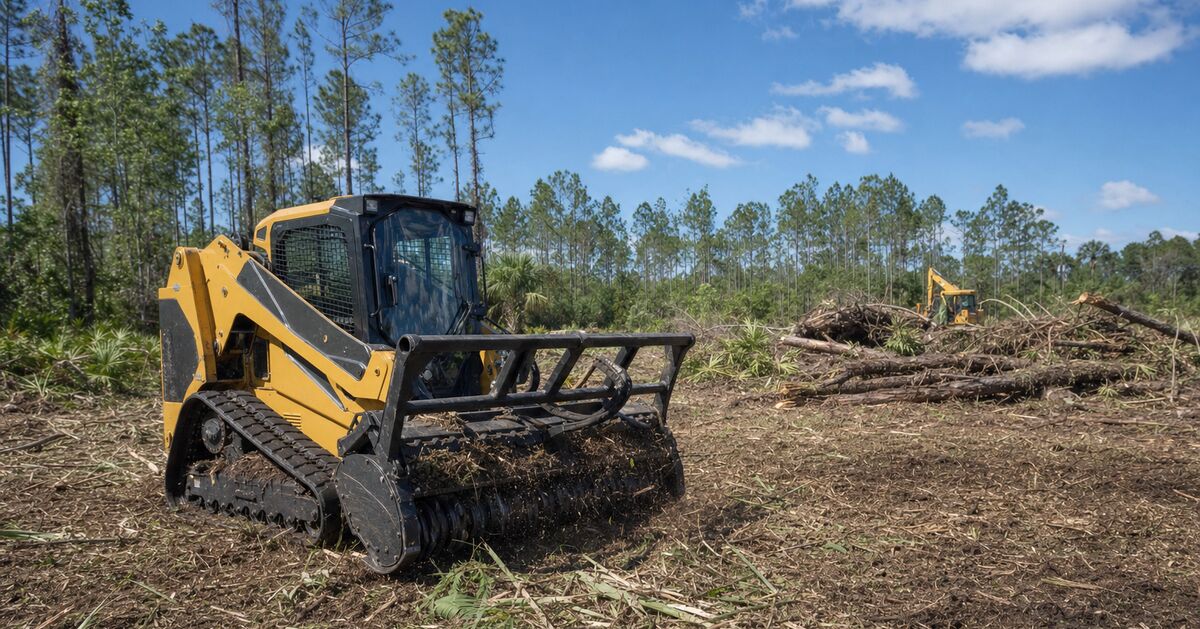
Florida scrub doesn't go quietly. If you've priced a lot clearing job in Port Charlotte, Englewood, or Placida lately, you've probably noticed that two quotes for the "same" parcel can differ by thousands of dollars - and the reason often comes down to what each contractor actually includes. Understanding the breakdown before you sign anything can save you a genuinely uncomfortable surprise when the crew shows up.
What "lot clearing" means - and what it doesn't
The phrase "lot clearing" describes a goal, not a fixed scope of work. The goal is a parcel that is free of vegetation so construction, grading, or landscaping can proceed. How you get there, and who is responsible for each step, varies by contractor, parcel size, vegetation type, and local code requirements.
Charlotte County's combination of pine flatwoods, saw palmetto thickets, cabbage palms, and scattered live oaks means a typical rural or semi-rural parcel contains at least four or five distinct categories of work. Each of those categories has a different labor requirement, a different equipment need, and a different disposal cost. That's why responsible contractors list them separately rather than burying everything in one number.
If you're comparing estimates for work in our Charlotte County service areas, always ask each contractor to break out the same line items so you're comparing apples to apples.
Tasks that commonly come standard in a clearing quote
These are the tasks that most experienced clearing contractors include in a base quote, because they're inherent to the work and can't practically be separated from it.
Felling and cutting standing trees. Dropping trees, bucking the trunks into manageable sections, and stacking them on site is the core of clearing. If you're not getting this, you're not getting clearing.
Small-diameter brush and understory removal. Saw palmetto, Brazilian pepper, wax myrtle, and similar understory plants are usually treated as part of the base scope. They come down with a skid steer, forestry mulcher, or hand crews depending on density and site conditions.
Rough grading of the disturbed area. Most clearing contracts include at least one pass with a machine to level obvious ruts and mounds left by equipment. This is not finish grading - it's the rough pass that leaves the parcel walkable and ready for a surveyor or builder.
Hauling debris off site (or grinding it on site). A clearing quote that doesn't address what happens to all that wood and brush is an incomplete quote. Standard practice is either to haul material to a disposal facility or to run a tub grinder and spread or haul the resulting mulch. Confirm which method is included and whether disposal tipping fees are factored in.
That last point matters more than it sounds. Tipping fees at Charlotte County solid waste facilities are a real cost, and a contractor who bids low by omitting them will either pass the cost to you later or leave the debris on site. The Charlotte County Utilities & Solid Waste department publishes its current fee schedule online and it's worth a two-minute check before you finalize any clearing contract.
Tasks that are almost always separate line items
Here's where the real variation lives. The following tasks are common enough that you should ask about every single one of them before signing.
Stump grinding. This is the single most frequently misunderstood item in a clearing quote. Felling a tree and grinding the stump are two separate operations requiring different equipment. Many clearing contractors drop trees to grade (meaning they cut the trunk at or just above ground level) and either leave the stump or treat grinding as a separate bid item. If your plans call for a foundation, driveway, or slab anywhere near a former tree location, you need every stump ground to a depth that gets below the structural root zone - typically 8 to 12 inches below grade. Ask specifically: "Does your quote include stump grinding on every tree, to what depth, and is root flare material included?"
You can read more about why stumps behave so differently from each other in our post on why some stumps regrow and others never sprout. That biology directly affects how deep grinding needs to go and whether chemical treatment is ever appropriate.
Root removal or root ball extraction. Grinding a stump leaves the lateral roots in place. For most landscape and lawn situations that's fine - roots decay over time. For construction, roads, or driveways, buried roots can create voids as they decay, leading to settling. Full root ball extraction is a separate, heavier operation that involves an excavator and significantly more soil disturbance. It is typically not included in a standard clearing quote and should be discussed explicitly if your project involves hardscaping over former tree locations.
Large-tree removal with specialized equipment. A parcel that has 30-inch-diameter live oaks or large slash pines mixed in with the brushy understory is a different job than one that's mostly small-diameter material. Large trees may require a crane, a larger chipper, or more complex rigging - all of which carry additional cost. Our post on crane removal situations in Sarasota walks through the logic that determines when that equipment becomes necessary, and the same logic applies on Charlotte County parcels.
Protected species assessment and permitting. Charlotte County, like all Florida counties, has tree protection ordinances that govern the removal of certain species and size classes of trees. Gopher tortoises and their burrows, common in scrubby flatwoods areas like North Port and parts of Englewood, may require a wildlife relocation permit before ground disturbance; check with Charlotte County and state wildlife authorities. Neither the permit process nor any required wildlife surveys are typically included in a clearing quote. The permitting cost and timeline are real - build them into your project schedule.
Finish grading. As noted above, clearing contracts include a rough pass. If your project requires final grade elevations certified for a building permit, or precise swales for drainage, that is a civil or grading contractor scope and priced separately.
Soil haul-in or fill. Clearing a dense stand of trees leaves a site lower than expected once the root mass settles and the topsoil is disturbed. If your site design calls for a finished pad elevation above existing grade, that fill material and its placement are add-ons.
Wet-lot accommodations. Parcels in low-lying areas of Port Charlotte, near Placida, or in the flatwoods sections of Englewood frequently have standing water or saturated soil for significant portions of the year. Clearing a wet lot requires different equipment choices, may require matting or temporary access roads to prevent equipment from getting stuck, and can involve dewatering. That work carries real additional cost - our post on clearing a wet lot and how standing water changes the job covers the specifics in detail.
The arborist piece: when it matters on a clearing job
Lot clearing is often framed as a purely mechanical operation - machines go in, trees come out. But if your parcel contains trees that will be retained (a common scenario when a client wants to preserve specimen oaks or palms near the building envelope), or if the parcel is in a jurisdiction that requires a tree survey as part of permitting, an arborist assessment is a necessary step before machinery starts.
Michael Calabro, ISA Certified Arborist FL-362432A, performs pre-clearing assessments that document which trees are worth preserving, identify structural defects in trees adjacent to the clearing zone (a falling neighbor tree during clearing operations is a real hazard), and help clients make defensible decisions before anything is cut.
That kind of assessment is grounded in ANSI A300 Part 9 (tree risk assessment) and ANSI Z133 safety requirements, which cover how work near retained trees should be conducted so that equipment damage to root systems, bark, and structural roots is minimized. These aren't abstract rules - root damage during clearing can contribute to retained trees failing in the years following construction. See our tree and land care services page for more on how assessments fit into a clearing project.
Charlotte County specifics to keep in mind
Charlotte County's vegetation is dominated by pine flatwoods and scrub communities, with cabbage palms scattered throughout. A few things specific to this area affect clearing scope and cost:
- Cabbage palms (Sabal palmetto) are Florida's state tree and have some protections under Florida Statute 581.185, though the specifics of when a permit is required depend on the land use and jurisdiction. Confirm with Charlotte County Community Development before assuming palms on a vacant parcel can be removed without review.
- Brazilian pepper is a Category I invasive per the Florida Exotic Pest Plant Council and cannot be legally transported or replanted. Its disposal must be handled correctly - chipped on site or taken to a facility that accepts invasive material. Confirm your contractor knows this.
- Slash pines in flatwoods settings often have shallower root systems than their size suggests, particularly in soils that have seasonal high water tables. This affects how they fall and what the stump grinding depth requirement is.
- Gopher tortoise surveys may be required by FWC prior to clearing depending on lot size and habitat type. This is a separate professional service, typically performed by a permitted wildlife biologist, and is not part of a tree clearing quote.
If your parcel is in Englewood, Placida, or the more rural sections of Port Charlotte, these biological considerations are especially relevant and worth a conversation with Charlotte County's planning department before you start soliciting clearing bids. Our locations page covers all of the communities we serve and can help you understand the local context for each area.
How to compare clearing quotes fairly
Armed with the breakdown above, here's a practical checklist for evaluating competing clearing quotes:
- Does the quote specify what happens to stumps (grade cut vs. grinding, and to what depth)?
- Does it include debris disposal, and are tipping fees factored in or treated as a pass-through?
- Is rough grading included? What is the assumed final condition of the site?
- Are large-diameter trees (say, over 18 inches DBH) priced differently from small-diameter material?
- Is wet-lot or access matting addressed, or is the quote written assuming a dry, firm site?
- Who is responsible for the permitting research, and is any permit fee included?
- If you're retaining any trees, is there a tree protection specification?
A contractor who can answer every one of those questions clearly, in writing, is a contractor who has done this before and understands the scope. Vague answers to any of these questions are a signal to ask again or move on.
For more context on what to expect from professional tree and clearing work throughout our service area, visit the Eagle Eye Tree and Land Services home page or reach out directly to talk through what your specific parcel involves. Every lot is a little different - that's the nature of clearing work in southwest Florida - and an honest scope conversation before the quote protects everyone.
Got a tree that worries you?
Free, no-pressure on-site estimate across Sarasota & Charlotte Counties.