
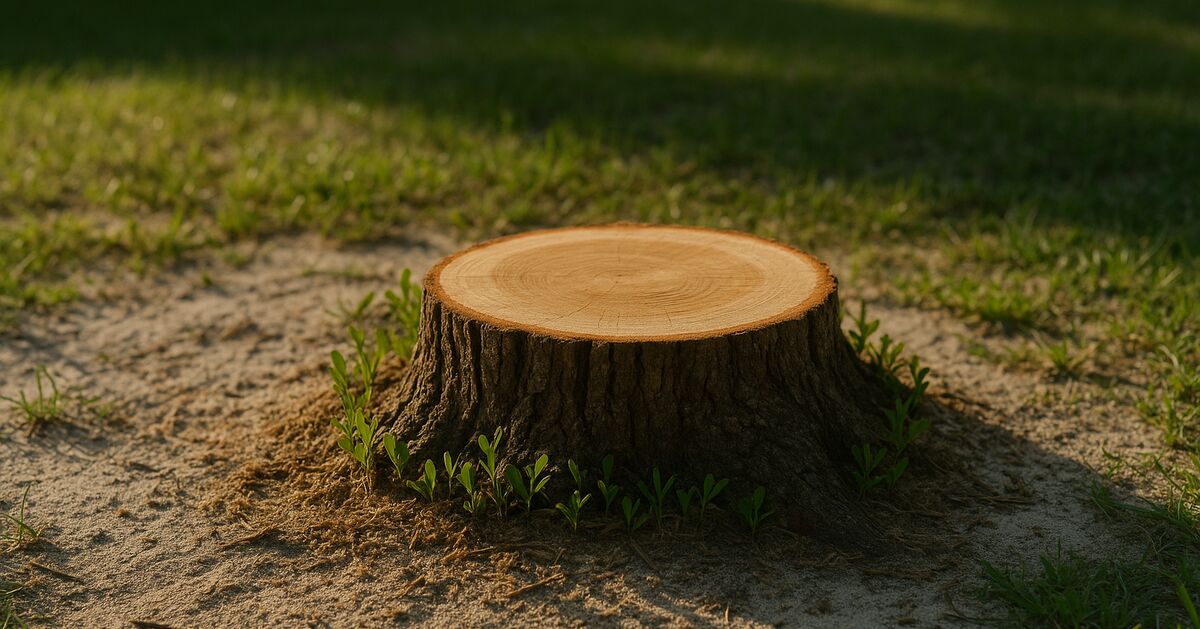
Spend a season driving around Venice or North Port and you'll notice it: a freshly cut stump in one yard is already pushing up a green ring of shoots, while the stump next door looks exactly as dead as the day it was cut. Same neighborhood, same sandy soil, same summer rain. What's the difference? The short answer is species biology. The longer answer involves stored energy, hormone chemistry, and a few things about Southwest Florida's growing conditions that make the regrowth question here different from most of the country.
The biology behind resprouting
Every woody plant stores carbohydrates in its root system. Those reserves are the tree's emergency fuel supply. When the top of the tree is removed, the roots still have a full tank. In many broadleaf species, that stored energy triggers a survival response called epicormic sprouting. Dormant buds tucked just beneath the bark (or embedded in the root tissue itself) suddenly get a hormonal signal that the canopy is gone, and they break dormancy fast.
The hormone at the center of this is auxin. While a tree stands, auxin produced in the growing tips flows downward and suppresses the buds lower on the stem and in the root collar. Remove the source of auxin by cutting the tree, and those suppressed buds are released. In species with high bud density and large carbohydrate reserves, resprouts can appear within days of cutting in warm weather. In our climate, where soil temperatures rarely drop low enough to slow root metabolism, that response can be almost startling in its speed.
Species that resprout aggressively in this region
A few trees account for the bulk of regrowth complaints from homeowners across Sarasota, Osprey, and Englewood.
Laurel oak (Quercus laurifolia) and live oak (Quercus virginiana) are the classic examples. Both produce vigorous stump sprouts and, more critically, root sprouts that can emerge several feet from the original stump. Live oaks in particular have deeply interconnected root systems, and cutting one stem does not kill the root network. Our post on what live oak soil tells you about root spread goes into detail on just how wide that network can extend, which helps explain why sprouts seem to appear in random spots across the yard.
Brazilian pepper (Schinus terebinthifolia) is aggressive beyond what most homeowners expect. It is classified as a Category I invasive species by the Florida Invasive Species Council. Cut it and it will resprout from the stump, from severed roots, and sometimes from root fragments left in the soil. Grinding the stump alone is often not enough. Chemical treatment of the cambium layer immediately after cutting is the approach that gives the best results.
Chinaberry (Melia azedarach) behaves similarly. It grows fast, resprouts fast, and the seeds in the soil will germinate to fill any gap left by the parent tree. In neighborhoods around North Port and Port Charlotte that still have large chinaberry specimens, removing one tree without a follow-up plan often means fighting regrowth for multiple seasons.
Earleaf acacia (Acacia auriculiformis) is another invasive that resprouted strongly after the wave of removals that followed major hurricane seasons. It responds to stump damage the way Brazilian pepper does: quickly and from multiple points simultaneously.
Slash pine (Pinus elliottii) is an interesting middle case. It will not typically send up basal sprouts the way oaks do, but it can produce coppice growth from latent buds at the base if the cut is close to the ground. However, pines are far less likely to be problem resprouts than hardwoods.
Species that rarely or never resprout
Palms are in a category of their own. Palms are monocots, not true trees, and their tissue structure is completely different from broadleaf species. A palm has a single growing point, called the apical meristem, at the very top of the trunk. There are no lateral buds, no root collar buds, no dormant bud bank. When you remove that growing tip, or when you cut the trunk, the palm is finished. It cannot resprout. This is why a cut sabal palm stump will decay in place without ever putting up a green shoot, and why our post on why a trimmed queen palm can still collapse emphasizes how differently palms fail compared to broadleaf trees. Their structure makes them more fragile at the trunk, not more resilient.
Most conifers, including slash pine in maturity, lack the bud-bank density of hardwoods. Once cut, the stump often decays rather than regrows.
Older, declining broadleaf trees also resprout less reliably. A live oak that was already stressed by root damage, soil compaction, or disease before it was cut may have depleted carbohydrate reserves. The survival response still triggers, but there may not be enough stored energy to sustain more than a flush or two of weak growth.
Why our climate makes regrowth faster and more persistent
Most of the United States has a true dormant season. Soil temperatures drop, root metabolism slows, and any resprouts that emerge in fall are killed by frost before they can establish. Southwest Florida doesn't have that reset. Soil temperatures in Sarasota and Venice stay warm enough year-round to support root activity. A stump cut in December here will still push sprouts in January. That means there is no cold-season window to "starve out" a stump by simply waiting.
Combine that with the region's heavy annual rainfall and the high organic content of many landscaped yards, and conditions favor fast, persistent resprouting from any species capable of it.
What actually stops regrowth - and what doesn't
Stump grinding is the most common approach, and for many species it is effective. The grinder removes the stump to several inches below grade, destroying the crown where most of the sprout buds are concentrated. For palms, any simple cutting and grinding is permanent. For non-invasive oaks and maples, grinding typically prevents further stump sprouting, though root sprouts may still emerge for a season from the surviving root system a foot or two from the grinding zone.
For invasive species like Brazilian pepper, and likely similar aggressive resprouters like chinaberry, grinding alone is often not enough. The root system beyond the grind radius can still sustain sprouts. The most effective approach combines grinding with a cut-stump herbicide application, applied by someone who understands Florida Department of Agriculture and Consumer Services regulations on herbicide use near waterways, especially relevant for properties in Nokomis, Laurel, and Casey Key where drainage canals and tidal areas are close.
Covering the stump with soil or mulch does not stop resprouting in vigorous species. It may slow decay, but it will not deplete the root reserves fast enough to prevent growth. Shoots will find daylight.
Simply waiting and cutting resprouts as they appear will eventually exhaust a stump's carbohydrate reserves, but this can take two to four years for a large oak, and longer for invasive species. Each flush of resprouts should be removed as early as possible, before the new shoots have time to photosynthesize and replenish the root bank. If you let the sprouts run for a full season, you are essentially giving the root system a refill.
How root damage before removal affects regrowth potential
A point that comes up regularly during arborist assessments is that the condition of the root system at the time of removal matters a great deal. A tree that suffered significant root loss from irrigation trenching near mature trees or from construction activity will have depleted carbohydrate reserves before the cutting ever happens. That tree's stump may resprout only weakly or not at all, because the energy reserves were already compromised.
Conversely, a healthy, well-established live oak in a large yard with undisturbed soil may have a root system that extends well beyond the drip line and holds substantial reserves. That stump can sustain vigorous resprouts for years if not managed correctly.
What ANSI A300 says about stump treatment
The ANSI A300 Tree Care Standards address vegetation management and stump treatment as part of integrated tree management practices. The standards emphasize that decisions about post-removal treatment should be based on species characteristics and site conditions. Grinding depth, the need for chemical follow-up, and the management of root suckers should all be part of the scope-of-work conversation before removal begins, not an afterthought.
When Michael Calabro (ISA Certified Arborist, certificate FL-362432A) assesses a tree for removal, one of the standard questions in that evaluation is what the owner wants the outcome to be at the stump level. "We just need it gone" and "we need it gone and we don't want anything coming back" are two different scopes of work, and the plan should reflect that from the start.
Practical guidance for homeowners
If you are planning a removal and regrowth is a concern, here are the questions worth asking before work begins:
- What species is it? If the answer is a known resprouter (laurel oak, live oak, Brazilian pepper, chinaberry, earleaf acacia), plan for stump treatment beyond basic grinding.
- Is it an invasive species? Florida-invasive species warrant a more aggressive approach. The Florida Invasive Species Council's Category I list is a useful reference.
- How healthy was the root system? A stressed, damaged tree resprouts less. A healthy tree in good soil resprouts more.
- What is going in that space? If you are planting grass, laying pavers, or installing a pool cage, you need a different level of eradication than if you are planting a replacement tree that will shade out any competition.
- Is there a water feature or canal nearby? Herbicide applications near water require careful product selection and application timing. Our tree and land services team can walk through site-specific constraints before recommending an approach.
When to call an arborist versus just a crew
For a standard removal of a non-invasive, non-oak species where regrowth is unlikely (a dead pine, a palm, a small ornamental), a qualified tree crew with proper equipment handles the work well. When the tree in question is a large live oak, a known invasive, or when the removal is part of a broader replanting or landscaping plan, having Michael Calabro conduct an arborist assessment first gives you a clearer picture of what to expect. The full list of tree care services we offer covers both the removal and the post-removal planning conversation.
Homeowners in Englewood, Manasota Beach, and Placida dealing with large oak regrowth from previous removals are also welcome to reach out through our contact page. In some cases, what looks like a stump problem is actually a root suckering problem from a surviving connected root system, and that changes the approach entirely.
A note on replanting after removal
Choosing the right replacement tree matters partly because it affects how the site behaves after the old root system finally breaks down. Our locations page has contact information for all the communities we serve, and we are glad to advise on species selection as part of any removal consultation. The tree installation guidance for Sarasota County accepted species is a good starting reference for what grows well and stays manageable in this part of Florida.
The stump question is rarely just about the stump. It is about the whole root system, the species biology, and what you want the space to become. Getting that conversation right before the crew arrives saves a lot of follow-up work.
Got a tree that worries you?
Free, no-pressure on-site estimate across Sarasota & Charlotte Counties.