
Tree installation in Sarasota County: accepted species
October 14, 2026
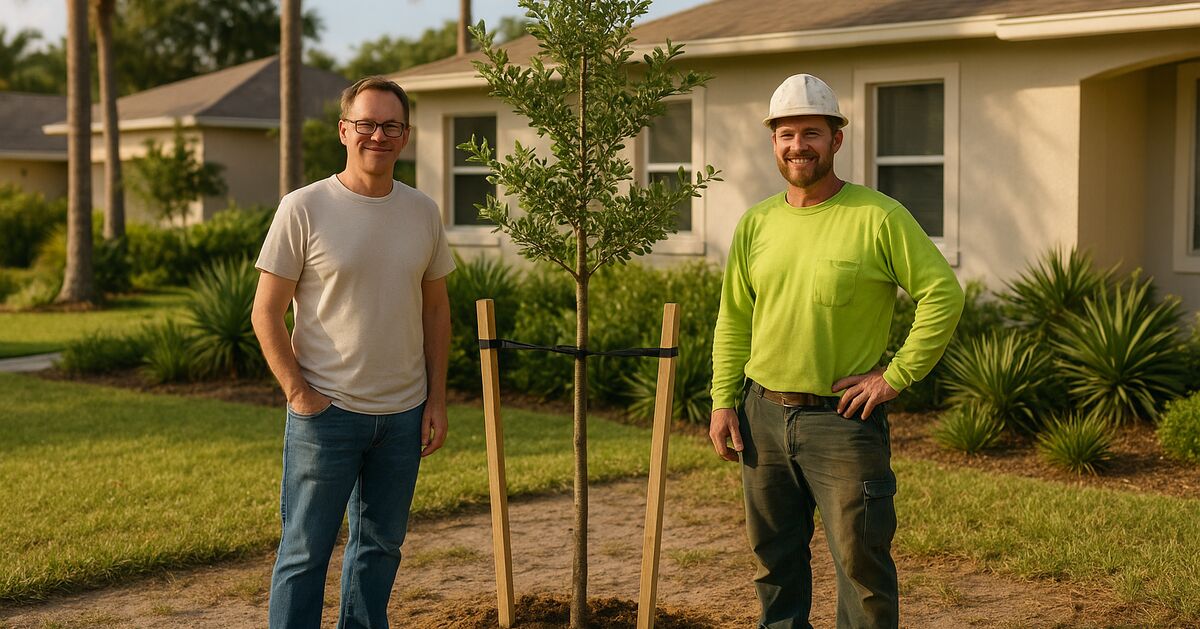
Picking the wrong tree for a replacement planting can cost you a fine, force a re-do, and leave you out the price of a tree you can't keep. Sarasota County's replacement tree requirements are not complicated once you understand the logic behind them, but they are specific, and "I didn't know" rarely earns much sympathy at the code enforcement office. Here is a plain-spoken walkthrough of what the county will and won't accept, and why those rules exist.
Why replacement trees are regulated in the first place
Florida counties regulate which trees can replace removed ones because tree canopy is a public resource, not just a private amenity. A mature live oak shades the street, holds stormwater in place, cools surrounding pavement, and supports wildlife. When that tree comes down, a tiny ornamental that will never grow past twelve feet does not replace what was lost. Sarasota County's Land Development Regulations (LDR) and its adopted landscape code exist to make sure replacement plantings actually restore canopy over time, not just fill a checkbox.
The same reasoning explains why certain non-native species are disqualified even when they are sold freely at nurseries. A tree that escapes into native habitat and outcompetes Florida vegetation creates harm that outlasts whatever aesthetic value it offered on the property where it was planted. The Florida Exotic Pest Plant Council (FEPPC) maintains the Category I and Category II invasive plant lists that Florida counties, including Sarasota, use as the baseline for what cannot be planted as a replacement.
If you are navigating this after a removal, the tree care and removal services page explains the full arc of work, from removal through stump grinding to replanting.
The foundation: Sarasota County's approved plant list
Sarasota County maintains a preferred plant list that leans heavily on Florida native species. For replacement trees specifically, the county's code requires that replacement trees meet minimum size requirements at the time of planting and that they are not on any state or county invasive species list.
The county's own landscape manual identifies several broad categories that are generally accepted:
Native canopy trees (most commonly accepted):
- Live oak (Quercus virginiana) - the gold standard for canopy replacement in the county. If a live oak was removed, a live oak replacement is often the cleanest path to compliance.
- Sabal palm (Sabal palmetto) - Florida's state tree, accepted in most replacement scenarios, though palms are handled differently from canopy trees in the code because their growth form does not produce the same canopy spread.
- Slash pine (Pinus elliottii) - accepted and appropriate for upland sandhill settings common in North Port and parts of Englewood.
- Southern magnolia (Magnolia grandiflora) - accepted where canopy tree replacement is required and space permits.
- Bald cypress (Taxodium distichum) - often required or preferred in wet areas and near retention ponds.
- Sweetgum (Liquidambar styraciflua) - accepted, though its root structure makes site selection important.
- Dahoon holly (Ilex cassine) and American holly (Ilex opaca) - accepted as smaller native canopy options.
- Red maple (Acer rubrum) - a Florida native that tolerates our wet seasons and is widely accepted.
Non-native trees that are conditionally accepted: A small set of non-native trees appear on the county's approved list because they are not invasive and have a long track record of performing well in the local climate without escaping into natural areas. Crape myrtle (Lagerstroemia spp.) is the most common example: not a Florida native, but well-behaved, widely used in Sarasota streetscapes, and accepted in most residential replacement scenarios. Note that crape myrtle is a small-to-medium tree and will not satisfy a replacement requirement that specifies a large canopy tree.
For the coastal barrier islands, wind-load and salt tolerance matter just as much as the species list. Our post on Casey Key and Siesta Key wind exposure covers why species selection on those properties carries extra consequences.
What the county will not accept
The list of disqualified species is where a lot of homeowners get caught out. These trees are often sold at big-box garden centers and look perfectly attractive, which is why people buy them without realizing they cannot be used as replacements.
Category I invasive species (never accepted as replacements):
- Brazilian pepper (Schinus terebinthifolia) - one of the most aggressive invaders in South Florida. If you have it on your property now, it does not count toward your required tree canopy.
- Melaleuca (Melaleuca quinquenervia) - aggressively invasive in wetlands and flatwoods throughout Sarasota and Charlotte counties. Not accepted under any circumstances as a replacement.
- Australian pine (Casuarina spp.) - commonly confused with a true pine because of its needle-like foliage, but it is not. It is a serious invasive and prohibited statewide for new planting.
- Earleaf acacia (Acacia auriculiformis) - a Category I invasive that spreads readily and is not permitted.
- Carrotwood (Cupaniopsis anacardioides) - invasive in coastal areas and expressly prohibited.
- Bishopwood (Bischofia javanica) - another Category I plant that will not satisfy any replacement requirement.
Category II invasives (generally not accepted): Category II plants show invasive characteristics but have not yet caused widespread documented harm at the Category I level. Sarasota County typically excludes them from replacement plantings as well, though the list evolves as the FEPPC updates its findings. Camphor tree (Cinnamomum camphora) is a well-known example that shows up in this category.
Trees that are legal but too small: This is a separate issue from invasiveness. Even a perfectly appropriate species will not satisfy a replacement requirement if it does not meet the minimum caliper (trunk diameter) or height specified in your permit or county code citation. Minimum caliper requirements vary by permit, so confirm the exact figure and measurement height specified in your Sarasota County permit conditions before purchasing a tree.
Palms are measured differently. A sabal palm used as a replacement typically needs to show a minimum clear trunk height (the bare trunk above the old boot scars), and that number is spelled out in the relevant permit condition.
How the replacement ratio works
When a tree is removed under a Sarasota County permit, the permit specifies how many replacement trees are required and what size they must be. The ratio is not always one-for-one. A large canopy tree removal may require two or three replacement trees, or a single large-caliper specimen. The calculation is based on the diameter of the removed tree, and the county code is specific about the formula.
This is important because buying a single two-inch-caliper tree to replace a twenty-four-inch live oak will not satisfy your permit conditions, even if the species is perfectly correct. Understanding the ratio before you go to the nursery saves you a second trip and a potential citation.
If the removal involved a tree near the water, you may also be dealing with overlapping county and state regulations. Our post on trees too close to a seawall explains how proximity to waterfront structures changes the picture.
Planting location rules: the other half of the equation
Even a correctly sized, county-approved species can be rejected if it is planted in the wrong spot. The county's code specifies minimum setbacks from structures, utilities, paved surfaces, and property lines. Planting a large-canopy tree directly under a power line, for example, will not be accepted, because the tree will either fail structurally when it is repeatedly cut back or it will require removal in the future, defeating the purpose of the replacement.
Setbacks from underground utilities are equally important. Aggressive root systems planted too close to pipes or irrigation lines create future problems. The ANSI A300 standards for tree planting (Part 6) address site assessment, soil preparation, and placement as prerequisites for successful establishment, and those guidelines are a useful reference for anyone planning a replacement installation.
Michael Calabro, our ISA Certified Arborist (certificate FL-362432A), often points out that the site conditions matter as much as the species tag on the tree. A bald cypress planted in well-drained sandy soil in a Nokomis backyard will struggle and may not achieve the growth milestones that code compliance requires. Matching the species to the actual site conditions is not optional. The locations page can connect you with local knowledge for your specific community.
Municipalities within the county may have additional rules
Sarasota County's rules apply in unincorporated areas. If your property is within the City of Sarasota, City of Venice, City of North Port, or City of Englewood, those municipalities have their own tree ordinances that may be stricter, more specific, or slightly different in their approved species lists and replacement ratios.
Venice, for example, has a strong local preference for native species and has at times maintained its own supplemental plant list. North Port, which covers a large area of former Scrub and flatwoods habitat, may have conditions tied to specific soil types and habitat designations that influence what the city will accept. If you are in one of those cities, our local pages for Venice tree services and North Port tree services are good starting points, and calling the municipality's planning or code department directly before purchasing a tree is always the right move.
For homeowners in Osprey, Nokomis, Laurel, Englewood, and the barrier islands including Siesta Key, most properties fall under county jurisdiction, though some parcels near municipal boundaries can surprise people. Checking your parcel's jurisdiction through the county property appraiser's website before you apply for any permit saves confusion. See also our Osprey tree services and Nokomis tree services pages for area-specific context.
What to bring to the nursery
Once you know your permit conditions and required species, heading to the nursery with the right checklist makes the visit faster and avoids a return trip.
- The permit number and the species requirement listed on your permit conditions sheet
- The required caliper measurement (confirm whether the county wants caliper at 6 inches above grade or at DBH)
- For palms: the required minimum clear trunk height
- The planting location dimensions so you can confirm the mature spread of your chosen tree fits the space
- A note of any overhead or underground utilities in the planting area
A Florida-certified nursery professional can help you select a compliant specimen, but the burden of confirming compliance rests with the property owner and, if you have hired one, your tree service.
After the tree goes in: the establishment window
Sarasota County may require a follow-up inspection to confirm a replacement tree was installed. Some permits include an establishment period requirement, so check your specific permit conditions for the exact timeframe the tree must survive. If the tree dies during that window, you may be required to replace it again.
This is why species-to-site matching matters so much. A tree that is technically on the approved list but is planted in the wrong soil, in too much shade, or in a spot that stays saturated for weeks after rain will not thrive. A dead replacement tree is not a compliant replacement tree.
Irrigation support during establishment is typically necessary in Sarasota County's sandy soils. If you are planning irrigation work around the new planting, be careful about how close any trenching comes to the new root zone. Our post on irrigation trenching near mature trees addresses root system impacts that apply to young trees as well.
Getting it right the first time
The county's replacement rules exist to protect a shared resource, and they are not arbitrary. Planting the right tree in the right place at the right size, then giving it a genuine chance to establish, is good for your property and good for the neighborhood. When in doubt, reach out to us directly before you purchase or plant anything. A short conversation with someone who knows the local code and the local soil can save you real money and real headaches.
For a full picture of the services we provide throughout Sarasota County and the surrounding communities, visit our services page.
Got a tree that worries you?
Free, no-pressure on-site estimate across Sarasota & Charlotte Counties.