
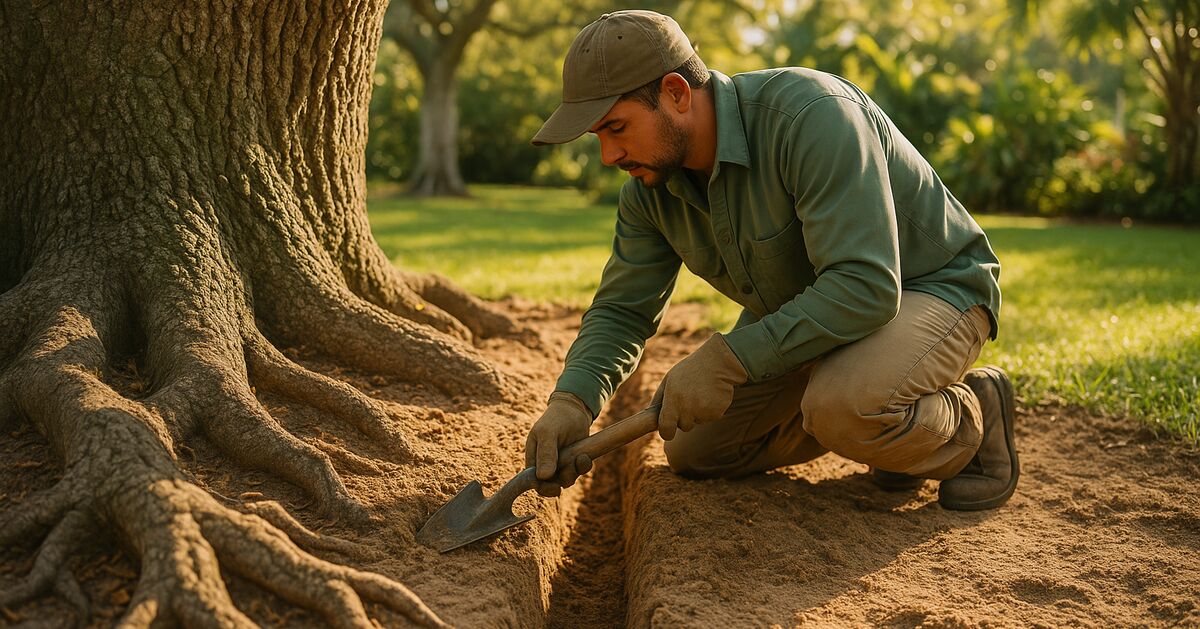
Florida homeowners upgrade irrigation systems all the time, and the project looks straightforward on paper: dig a trench, lay the pipe, backfill. But when that trench runs anywhere near a mature live oak, slash pine, or row of palms, the underground reality is far more complicated than the surface suggests.
Root cuts from irrigation trenching are one of the more common causes of delayed tree decline across Sarasota, Venice, North Port, and the surrounding communities we serve. The tree rarely shows distress the day the trench is dug. Problems surface months or even a year or two later, by which point the damage is done and the connection to a landscape project is easy to miss.
This post explains the mechanics of root injury, which cuts a healthy tree can survive, which ones put it on a slow decline, and how to plan irrigation work so you protect the trees that took decades to grow.
Why irrigation trenching is a root problem, not just a digging problem
Tree roots do not stay under the tree's canopy the way many homeowners picture them. Research cited by the University of Florida IFAS Extension shows that structural and fine roots of many species extend two to three times the radius of the canopy, and in sandy Gulf-coast soils they spread even farther because they are chasing moisture and nutrients across a wide area.
Our post on what live oak soil tells you about root spread goes into detail on exactly that phenomenon. The short version: a live oak with a 40-foot canopy spread can have functional roots 60 to 80 feet from the trunk. A standard irrigation trench crossing the yard at what looks like a "safe" distance from that tree may still be cutting through a dense zone of active roots.
Those roots serve two jobs. Large structural roots (sometimes called anchor roots) physically stabilize the tree. Smaller transport roots, including the fine feeder roots closest to the surface, absorb water and dissolved nutrients. A trench that severs several large roots close to the trunk attacks stability. A trench that cuts through a broad swath of feeder roots attacks the tree's ability to feed itself. Both types of damage matter, but they play out differently over time.
The anatomy of a root cut: what actually happens underground
When a trenching machine or shovel cuts a root, the root does not simply stop functioning at the cut. The tree responds by compartmentalizing the wound, walling off the damaged tissue to prevent decay from traveling inward. This process, described in the work of Dr. Alex Shigo and built into the ANSI A300 tree care standards that guide professional arboricultural work, requires energy and diverts resources from growth and defense.
A clean cut through a root creates a smaller wound than a torn or shredded root. Mechanical trenchers with sharp blades do less cumulative damage than a dull blade or a mini-excavator bucket that rips roots apart. This matters when you are choosing equipment and timing for a project.
After the cut, several things happen simultaneously:
- The section of root beyond the cut dies back to the nearest lateral branch, if one exists.
- Decay fungi can enter through the wound, especially in warm, humid Florida conditions.
- The tree's crown may show stress months later as it runs short of the water and nutrients those roots were supplying.
- Structural root loss can shift the tree's support, increasing the risk of lean or failure in a wind event.
The severity of all of this depends on how many roots were cut, how large they were, how close to the trunk the cuts happened, the species involved, and the overall health of the tree at the time.
Which root cuts a tree can usually recover from
Not every root cut is a death sentence. Trees are remarkably resilient when the damage is limited and the tree is otherwise healthy. Here are the conditions that favor recovery:
Small-diameter roots, far from the trunk. Roots smaller than about 2 inches in diameter at the point of the cut, located well outside the critical root zone, represent a manageable loss for a healthy tree. The tree can generate new feeder roots from lateral branches on surviving roots, and the structural loss is minimal.
Cuts beyond the critical root zone. The critical root zone (CRZ) is defined under ANSI A300 as roughly 1 foot of radius for every inch of trunk diameter, measured at breast height. For a 20-inch-diameter live oak, that is a 20-foot radius around the trunk. Work that stays outside the CRZ carries much lower risk, though it is never zero risk given how far roots actually travel.
Trenching that crosses, not runs parallel to, root lines. A single trench crossing perpendicular to the direction of root growth severs individual roots at one point. A long trench running parallel to the trunk and inside the dripline can sever dozens of roots along its entire length, which is far more damaging.
Healthy trees with no pre-existing stress. A tree already dealing with drought, compaction, or disease has fewer resources to compartmentalize wounds and generate new roots. A tree in good structural health and well-established in the soil has a real chance of bouncing back from minor root loss.
Which root cuts are likely to cause serious decline or failure
Some cuts tip the balance in the wrong direction, and the consequences can be severe.
Severing structural roots inside the critical root zone. Large-diameter structural roots within the CRZ are anchors. Cut enough of them and the tree becomes a wind-load risk, even if the canopy looks fine. Our post on why slash pines fail at the root zone, not the trunk describes this dynamic in detail: the failure point is underground, and you often cannot see it until the tree goes down.
Cutting more than 25-30% of the root system. Arboricultural literature and ISA guidance commonly describe the loss of roughly one-quarter to one-third of a tree's functional root system as a range where decline becomes more likely, though no single cited source here confirms this specific figure. In practice, this threshold is easy to exceed when a trench runs a long distance inside the drip line.
Exposing roots to repeated soil disturbance. Irrigation work sometimes involves multiple trenches for lateral lines, valve boxes, and conduit. Cumulative cuts from several passes of a trenching machine can exceed the threshold that a single cut would not.
Species with limited recovery capacity. Palms are not true trees in the botanical sense, and their root system works differently. Palms produce roots from the root initiation zone at the base of the trunk. Sever those roots close to the trunk and the palm cannot regenerate them from the cut root. Each severed root is simply gone. This makes palms particularly vulnerable to close-in trenching. We have written about palm vulnerability in our post on why a trimmed queen palm can still collapse, which addresses above-ground stress, but the same principle of irreversible damage applies underground.
Trenching through compacted or waterlogged soil near the trunk. When soil conditions are already poor, cut roots are slower to wall off decay and slower to generate new growth. Sarasota and Charlotte County properties with clay hardpan layers or with fill soil placed over original grade are common settings for this kind of compounded damage.
What to do before a trench is ever dug
The best protection for your trees is a conversation that happens before the project starts, not after the damage is done.
Mark the critical root zones before the irrigation contractor arrives. Use flags or spray paint to show the CRZ of every significant tree. Ask the contractor to route lines around those zones wherever possible.
Request hand digging or air spading near tree roots. Mechanical trenchers are efficient but blunt. Within the drip line of a mature tree, hand digging allows a worker to expose and redirect the trench around large roots rather than through them. Air spading (using compressed air to excavate soil without cutting roots) is the least damaging option close to the trunk. It costs more, but it is often the difference between a tree that survives and one that slowly declines.
Ask whether directional boring is an option. For lines that must cross a root zone, horizontal directional boring tunnels the pipe beneath the root zone without a surface trench. It is a real option for longer runs under significant trees, and a skilled irrigation contractor should be able to price it.
Have an ISA Certified Arborist assess high-value trees before work begins. Michael Calabro (ISA Certificate FL-362432A) can evaluate the root architecture, assess the structural importance of specific roots, and provide a written recommendation for trench routing that the irrigation crew can follow. That kind of pre-construction assessment is exactly the work described in our full list of tree and land services.
After the trench is dug: what signs to watch for
Even well-planned trenching causes some root disturbance. In the weeks and months that follow, watch for these indicators that a tree is struggling:
- Wilting or smaller-than-normal new leaves. The crown is telling you it cannot move enough water.
- Early leaf drop. A tree shedding leaves out of season is often reducing crown size to match its diminished root capacity.
- Crown dieback starting at branch tips. Tip dieback that progresses inward over one or two growing seasons is a classic sign of root loss stress.
- Fungal conks or soft wood at the base. Decay entering through cut roots can travel toward the trunk. Our post on fungal conks, cavities, and cracks explained walks through what to look for.
- New lean or soil movement at the base. If structural roots were compromised, the tree may begin to shift, particularly after a rain event that softens the soil.
If you see any of these signs, have the tree assessed promptly. A tree that is declining from root loss sometimes responds to targeted support measures, including crown reduction to balance the reduced root capacity. Crown reduction, done to ANSI A300 standards, removes end weight from limbs and lowers the overall water demand on a stressed root system. It is not a cure, but it can slow the decline and reduce the risk of failure while the tree attempts to regenerate roots.
Local context: why this matters more on the Gulf coast
The sandy, fast-draining soils common across Sarasota, Venice, Osprey, Nokomis, and Englewood mean that tree roots often compete for water and can spread aggressively to find it. That is good for tree establishment, but it also means roots show up in unexpected places and at shallow depths close to the surface, where irrigation trenches typically run.
The warm, humid climate also means that decay fungi are active year-round. A cut root in coastal Florida encounters fungal spores quickly, which is why the quality of the cut, the timing relative to the tree's growth cycle, and post-trench tree care all matter more here than in drier or cooler climates.
Properties near tidal areas in Osprey, Casey Key, and Nokomis add another layer of complexity, since saltwater intrusion events can already stress root systems. A tree carrying that background stress has a lower tolerance for additional root loss.
The straightforward bottom line
Irrigation work near mature trees is manageable, but it requires planning. Trenches that stay outside the critical root zone, cross rather than parallel major roots, use clean cuts, and avoid palms' root initiation zones carry a reasonable chance of leaving the tree intact. Trenches that run inside the CRZ, sever large structural roots, or cumulatively remove a significant fraction of the root system can set a tree on a multi-year decline that ends in removal.
If you have mature trees on a property in Sarasota, Venice, North Port, or anywhere across our full service area, and an irrigation project is coming up, reach out before the trenching machine arrives. A short pre-construction consultation is far less expensive than losing a 40-year-old oak or a mature palm row.
You can also browse our frequently asked questions for more detail on what to expect from a tree assessment, or get in touch directly to schedule a visit.
Got a tree that worries you?
Free, no-pressure on-site estimate across Sarasota & Charlotte Counties.