
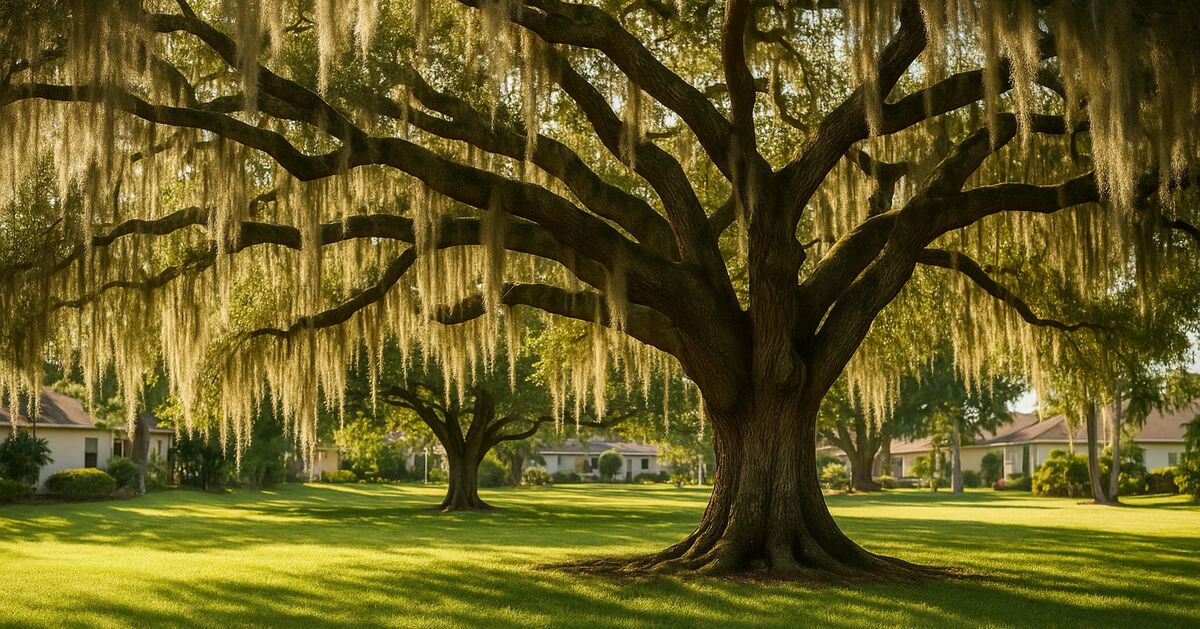
Spanish moss hanging from a live oak on a North Port street is one of those sights that makes Southwest Florida feel like itself. But stand under that same tree after a wet summer and you might notice something else: branches weighed down with gray curtains, barely any sunlight getting through, a few limbs looking thin and tired. That's the moment most homeowners start wondering whether all that beautiful "moss" is quietly killing their tree.
The short answer is: probably not killing it, but possibly stressing it, and in the wrong conditions, contributing to decline. The longer answer depends on which epiphyte you're dealing with, how much of it is there, and what the tree underneath it is already going through.
Here is what you actually need to know.
What Spanish moss, ball moss, and air plants actually are
All three belong to the same botanical family: Bromeliaceae, the bromeliad family. They are not mosses, not parasites, and not fungi. They are epiphytes, meaning they use trees and other structures purely as a place to perch. They pull their water and nutrients from rain, humidity, and airborne dust. They do not insert roots into the tree's vascular system, and they do not steal water or sugars the way a parasitic plant like mistletoe does.
Spanish moss (Tillandsia usneoides) is the long, draping, gray-green curtain you see hanging from live oaks, bald cypresses, and even utility lines across Sarasota and Charlotte counties. It grows from tiny, scale-covered filaments that absorb moisture directly from the air. It thrives in high humidity, which is why our coastal areas from Siesta Key and Casey Key all the way inland to Rotonda West and North Port provide near-perfect conditions for it.
Ball moss (Tillandsia recurvata) looks completely different: small, round gray-green rosettes, usually about the size of a golf ball, clustered on branches. It favors the smaller, interior branches of a tree where air circulation is lower and light is already limited. On a stressed tree, you can find hundreds of these clustered so thickly the branch looks furred.
Wild air plants (Tillandsia fasciculata and related species) are the most visually striking: larger, spiky bromeliads that look like miniature pineapple tops growing directly out of bark. Several native Tillandsia species grow throughout Southwest Florida, and some are actually protected under Florida law. The giant wild pine (Tillandsia utriculata) and the banded air plant (Tillandsia flexuosa) are listed as commercially exploited species, meaning removing them from public lands or selling them is restricted.
What they are actually doing to your trees
Here is where homeowners get into trouble with assumptions going in both directions. Some people assume any epiphyte is harmless; others panic and want everything stripped immediately. The reality is more nuanced.
The legitimate concerns:
Weight. Spanish moss absorbs a tremendous amount of water during our rainy season, which runs from roughly June through September. A branch that carries modest-looking moss in April can carry several times that weight by August. On a live oak with wide, horizontal limbs, that added weight increases leverage stress on branch unions. On a tree that already has some decay at a crotch or a compromised root system, this additional load matters. This is especially relevant in Venice, Sarasota, and Englewood neighborhoods where older live oaks have wide canopies draped with years of accumulated Spanish moss growth.
Light competition. Trees photosynthesize through their leaves. A very dense layer of Spanish moss can act like a partial shade cloth, reducing light to interior foliage. In most healthy trees, this is a minor concern. In a tree already struggling, reduced photosynthesis slows the tree's ability to defend itself against pests and disease.
Ball moss and interior branch health. Ball moss is more problematic than Spanish moss because of where it prefers to live. It colonizes the low-light interior and smaller branches of a tree, the same branches that are already marginally productive. Its root-like holdfasts grip the bark and, over time, can create small wounds in the outer bark layer. This does not kill a healthy tree, but it can accelerate the decline of a branch that is already weakening. On crape myrtles, water oaks, and stressed pines throughout Port Charlotte and Osprey, dense ball moss is often a symptom you'll notice on a tree that has other problems.
Moisture retention and bark. Both Spanish moss and ball moss hold moisture against bark. In most conditions this is benign. In cases where the bark is already cracked, has old pruning wounds, or has existing fungal infection, that trapped moisture can create conditions that favor rot.
What they are NOT doing:
They are not feeding on the tree's internal tissues. They are not causing root damage. They do not introduce pathogens into the tree themselves. And critically, heavy epiphyte growth is almost always a symptom as much as it is a cause. A vigorous, well-maintained tree with good canopy density sheds moss more readily, receives more wind movement, and is less susceptible to problematic buildup. When you see a tree absolutely overwhelmed by ball moss, the first question should not be "how do we get rid of the moss?" but rather "why is this tree already struggling?"
When to actually remove them
The decision to remove epiphytes should be based on practical factors, not just aesthetics.
Remove or reduce Spanish moss when:
- A branch with heavy moss loading already shows signs of structural weakness, tight or included bark at the union, previous storm damage, or visible decay. You are not saving the tree from the moss; you are reducing load on a branch that deserves your attention. Read more in our post about a tree leaning toward your house: what to do now for more context on assessing structural risks.
- The tree is in visible decline (yellowing leaves, thinning canopy, dieback) and you want to reduce every possible stress factor while addressing the underlying cause.
- A large mass of moss has built up on branches over a pool cage, lanai, or structure and the added weight during storms is a genuine concern.
- A big storm is coming. Moss-laden branches catch wind like sails. Before hurricane season, reducing dense moss loading on large limbs is a sensible step. Our tree removal and storm cleanup services include pre-storm trimming for exactly this reason.
Remove or reduce ball moss when:
- It is dense on interior branches that already appear weakened or nearly dead.
- You are doing a corrective pruning job anyway and can remove it incidentally.
- It is proliferating on a young tree that has not yet established a strong canopy.
Leave air plants (wild Tillandsias) alone when:
- They are native species and the tree is healthy. These plants are part of the local ecosystem and provide habitat for small wildlife.
- Removal requires disturbing large sections of bark or canopy.
- You are on a property near inland conservation areas or other areas where native plant communities are intact; removal may actually be counterproductive ecologically.
- You are not certain of the species. Some Florida Tillandsias are protected and should not be removed without understanding what you have.
DIY removal: what works, what damages trees
Homeowners sometimes try to strip Spanish moss by pulling or raking it off branches. For light, accessible growth, this can work fine. Use your hands or a soft rake and pull gently downward. Avoid scraping bark.
For ball moss, copper sulfate sprays are a common recommendation and they do work, but with important caveats. Copper sulfate is toxic to aquatic organisms. In coastal areas of Siesta Key, Casey Key, and properties along bay and canal tributaries, runoff from copper sprays is a genuine environmental concern. If you use any chemical treatment near drainage areas, stormwater ponds, or canals, check current county guidelines or consult a tree care professional.
Power washing bark to remove epiphytes is almost always a bad idea. High-pressure water strips the outer protective bark layer, opens wounds, and causes more harm than the epiphytes themselves would have.
High-reach removal on large oaks, tall pines, or any tree near structures should always be done by a professional. Working at height in a tree canopy without proper rigging is genuinely dangerous, and amateur climbing or ladder work causes more tree injuries, broken branches, and stripped bark than it solves. If you are in North Port, Sarasota, or anywhere across Sarasota and Charlotte counties, getting a professional assessment before attempting any significant removal is worthwhile. You can contact us here for a no-pressure look at what you are dealing with.
The connection to overall tree health
Here is a perspective that often gets missed: dense epiphyte growth, especially heavy ball moss infestations, is frequently a warning sign about the tree's condition, not the primary cause of it. Trees that are under chronic stress from soil compaction, drought, root disturbance during construction, disease, or poor pruning history become more vulnerable to heavy epiphyte colonization.
If your tree is covered in ball moss, it is worth asking a tree specialist whether the tree itself has underlying issues worth addressing. Our post on how to spot a hazard tree before it fails covers the warning signs in practical terms. And if you are weighing whether a struggling tree is worth saving versus removing, our frequently asked questions page addresses a lot of those judgment calls.
The trees that tend to handle epiphyte loads best in our area are healthy live oaks with full canopy crowns and good root zones. The trees that struggle most are isolated water oaks, over-pruned laurel oaks, and older slash pines whose root systems have been compromised by irrigation, pavement, or repeated drought. Understanding your specific tree's species and condition matters before making any decision.
What to expect from a professional assessment
A qualified tree specialist will look at several things at once: the species and age of the tree, the distribution and density of the epiphytes, the structural condition of the major limbs, signs of fungal infection or insect damage underneath, and proximity to your home or other structures.
In some cases, the right answer is targeted moss removal combined with light structural pruning. In others, the moss is not worth worrying about and the tree needs attention for completely different reasons. In a few situations, a tree that looks bad primarily because of moss turns out to be structurally sound and just needs a cleanup. And occasionally, a tree where moss is just one of several concerns does warrant full removal.
You can learn more about what a professional assessment looks like and how to evaluate the people doing it at our guide to choosing a legitimate tree removal company in Sarasota and Charlotte County. Not every tree company will give you a nuanced answer; a good one will tell you honestly when removal is not necessary.
A local reality check
Spanish moss, ball moss, and air plants are part of the Southwest Florida landscape in a way they simply are not in most of the country. They evolved here alongside our live oaks, sabal palms, and cypresses. Some degree of epiphyte growth on mature trees is completely normal and not a cause for alarm.
What matters is proportion, condition, and context. A live oak in a Sarasota yard with a moderate drape of Spanish moss and a clean, full canopy is doing fine. That same tree with heavy moss on structurally questionable limbs, ball moss colonizing half its interior branches, and a canopy that has thinned noticeably over the past two seasons deserves a closer look.
If you are across our service area from North Port to Englewood and you are genuinely unsure whether your tree needs attention, the safest move is to have someone qualified look at it. Most professionals can tell you in a single visit whether you have something worth acting on or whether you can let nature do its thing. Our team covers the full area including Sarasota, Venice, and Port Charlotte, and we are happy to take a look without any pressure to sell you on a removal you do not need.
When in doubt, leave the air plants alone, monitor the Spanish moss, and pay close attention to what the tree itself is telling you.
Got a tree that worries you?
Free, no-pressure on-site estimate across Sarasota & Charlotte Counties.