
Most tree removal jobs look fast from the outside. You watch a crew work for a couple of hours, the tree is gone, and everyone packs up. But the clock actually starts well before the chainsaw does, and for some jobs it keeps running for a day or two after the crew leaves. Knowing what the timeline really looks like helps you plan your week, coordinate with a neighbor whose fence is nearby, or simply stop wondering why it seems to take longer than expected.
The estimate visit: usually same day to 48 hours
Before any work can happen, someone needs to look at the tree. A phone description or a photo is helpful context, but it cannot replace a pair of eyes on the ground. An experienced crew lead needs to see how tall the tree is, how close it sits to your house, power lines, fences, driveways, or neighboring structures, and whether the trunk or root plate shows signs of decay that could change how the tree will be handled.
In most parts of Sarasota and Charlotte County, including Sarasota, North Port, and Venice, a reputable company can usually get someone out for a look within a day or two during normal seasons. After a major storm event the wait can stretch longer simply because demand spikes across the whole region at once. Our service areas page shows every community we cover, which can help you confirm you are in our territory before you call.
Permits: the step that surprises most homeowners
Some trees require a permit before removal, and pulling that permit adds time to the schedule. Sarasota County and Charlotte County both have tree ordinances that protect certain species and size classes, particularly live oaks above a given trunk diameter. If your tree falls under a protected category, the permit process can add anywhere from a few business days to a couple of weeks depending on the municipality and how backed up the review queue is.
The good news is that many residential removals, especially for trees that are clearly dead, diseased, or posing an immediate safety hazard, can move through the process more quickly. A company that knows the local rules can tell you right away whether a permit is likely required and roughly how long it will take. Never let anyone convince you to skip the permit step to save a few days. Fines and mandatory replanting requirements are real, and they land on the property owner, not the contractor.
Scheduling the work: a few days to a few weeks
Once the estimate is done and any permit issues are sorted, you get on the schedule. How long that wait is depends on the season and the complexity of the job.
During the slower winter and early spring months, a straightforward removal in Englewood or Port Charlotte might be scheduled within three to five business days. During the busy stretch after a named storm rolls through, or in the weeks leading up to and following hurricane season, the backlog can run two to four weeks for non-emergency jobs. Emergency situations, such as a tree actively resting on a roof or blocking a road, move to the front of the line, but even then a crew needs to be available and safely equipped.
A few things that extend scheduling time:
- Crane jobs. Large trees in tight spaces sometimes require a crane, and crane availability is its own scheduling puzzle.
- Utility coordination. If a tree is tangled with power lines, the crew may need Florida Power and Light or TECO to come out first or stand by during the work.
- Access restrictions. Narrow lots in Siesta Key or older neighborhoods in Nokomis sometimes require equipment to be staged carefully, which takes more planning.
- Large or multiple trees. A job involving four or five big trees will naturally take longer to slot in than a single small one.
The day of removal: one to eight hours on site
Here is where most people focus, and it is honestly the most variable part of the timeline. A single small or medium tree in an open yard with no obstacles can be down, chipped, and cleaned up in one to two hours. A large live oak canopied over a driveway and leaning toward a screen enclosure in a Sarasota neighborhood can take a full day, sometimes two.
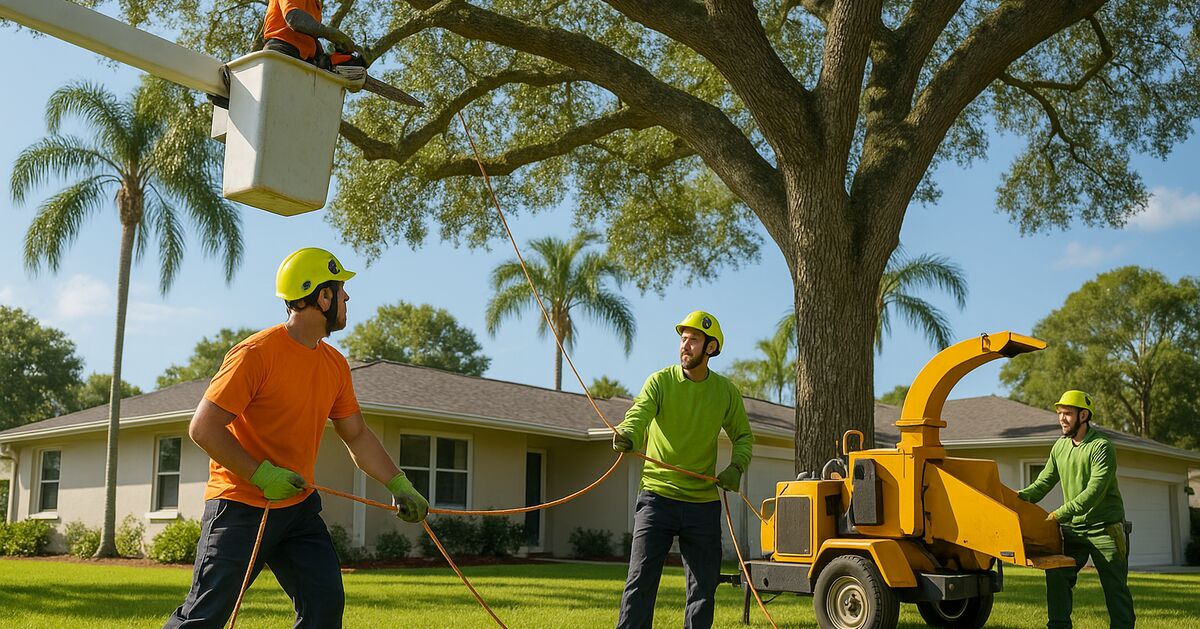
The crew works in a set sequence. They assess the drop zones one more time, set up any rigging needed to control where limbs fall, and start cutting from the top down. Larger limbs are lowered carefully rather than dropped. Once the canopy is cleared, the trunk is taken in sections. The chipper runs alongside to process brush continuously, which keeps the site from becoming buried in debris.
A few specific factors that affect how many hours the crew actually spends on your property:
- Tree height and trunk diameter. A 70-foot slash pine takes considerably longer than a 30-foot crape myrtle.
- Proximity to structures. Every cut near a fence, roof, or AC unit requires slower, more deliberate rigging.
- Wood condition. Severely rotted wood can be unpredictable to cut and requires extra caution, which adds time.
- Stump handling. If stump grinding is included in the job, add another 20 minutes to an hour depending on stump size. If you are on the fence about whether to grind at all, our post on stump grinding vs. stump removal lays out the tradeoffs clearly.
After the crew leaves: cleanup and final debris
Most crews do a thorough pass with rakes and blowers before they pack up, but what exactly is hauled away depends on what you agreed to in the estimate. Typically the crew chips all brush on site and hauls it away. Larger sections of trunk may be left for you as firewood, hauled to a disposal site, or chipped depending on the agreement. If you have never thought about what happens to all that wood and mulch, our breakdown of what happens to the wood and debris after tree removal walks through the common outcomes.
For most residential jobs, the yard is back to normal the same day. The stump hole or low stump (if grinding was done) will be there, filled with wood grindings, but the bulk of the material is gone.
Storm cleanup: when the timeline is compressed
If a storm has already knocked a tree down or snapped major limbs onto your property, the sequence above gets compressed and reordered. Safety comes first, not scheduling. In those situations, the most important thing is to document damage with photos, stay away from anything touching or near a power line, and call for an emergency assessment.
We have written a detailed guide on what to do first after emergency storm tree removal that covers the specific steps for homeowners in our area. Storm response crews can often be on site within hours for a true emergency, though again, after a widespread event like a direct hurricane hit on the coast, demand can temporarily outpace available crews.
What slows the whole timeline down: the honest list
If you want to avoid delays on your end, here are the most common reasons jobs take longer than homeowners expect:
- Waiting too long to schedule. If a tree looks questionable going into hurricane season, call in April or May, not August. Demand spikes hard from June through October.
- Unclear property lines. If the tree sits near a fence line or property boundary, having that conversation with your neighbor before the crew arrives saves a lot of standing around.
- HOA approvals. Some communities in the region require written approval from the association before work begins. That step is entirely outside our control.
- Surprise underground utilities. Roots near buried lines can complicate stump grinding and may require a Sunshine 811 call before work proceeds.
- Weather. We work in the rain for most tasks, but lightning or high winds will stop a crew mid-job for safety reasons. This is not common, but it does occasionally push a job into a second day.
A realistic total timeline by job type
To make it concrete, here is a rough picture of what to expect from first call to finished yard under normal conditions:
Small tree, no permit required, open yard: Estimate to finish in four to seven days total. Work day of two hours or less.
Medium tree near a structure, no permit required: Estimate to finish in one to two weeks. Work day of three to five hours.
Large protected tree requiring a permit: Estimate to finish in two to four weeks depending on permit review. Work day of four to eight hours, sometimes split across two days.
Post-storm emergency: Crew on site within hours to one to two days. Duration depends on damage extent.
These windows assume normal seasonal demand. Check our FAQ for more specifics about what to expect in different scenarios, and if you are ready to get a tree on the schedule, the easiest step is to reach out to us directly for a free estimate.
The bottom line
Tree removal does not happen overnight, and for good reason. The estimate, the permit check, the scheduling, the work itself, and the cleanup are all genuine steps that each take real time. When you understand the full sequence, the timeline stops feeling like foot-dragging and starts making sense. If a tree on your property is showing warning signs, the smartest move is to start the process early rather than wait until urgency forces a rushed decision. For anyone across Sarasota, Siesta Key, Venice, North Port, Osprey, Port Charlotte, or anywhere else in Sarasota or Charlotte County, we are glad to come take a look and give you a straight answer on timing and cost.
Got a tree that worries you?
Free, no-pressure on-site estimate across Sarasota & Charlotte Counties.