
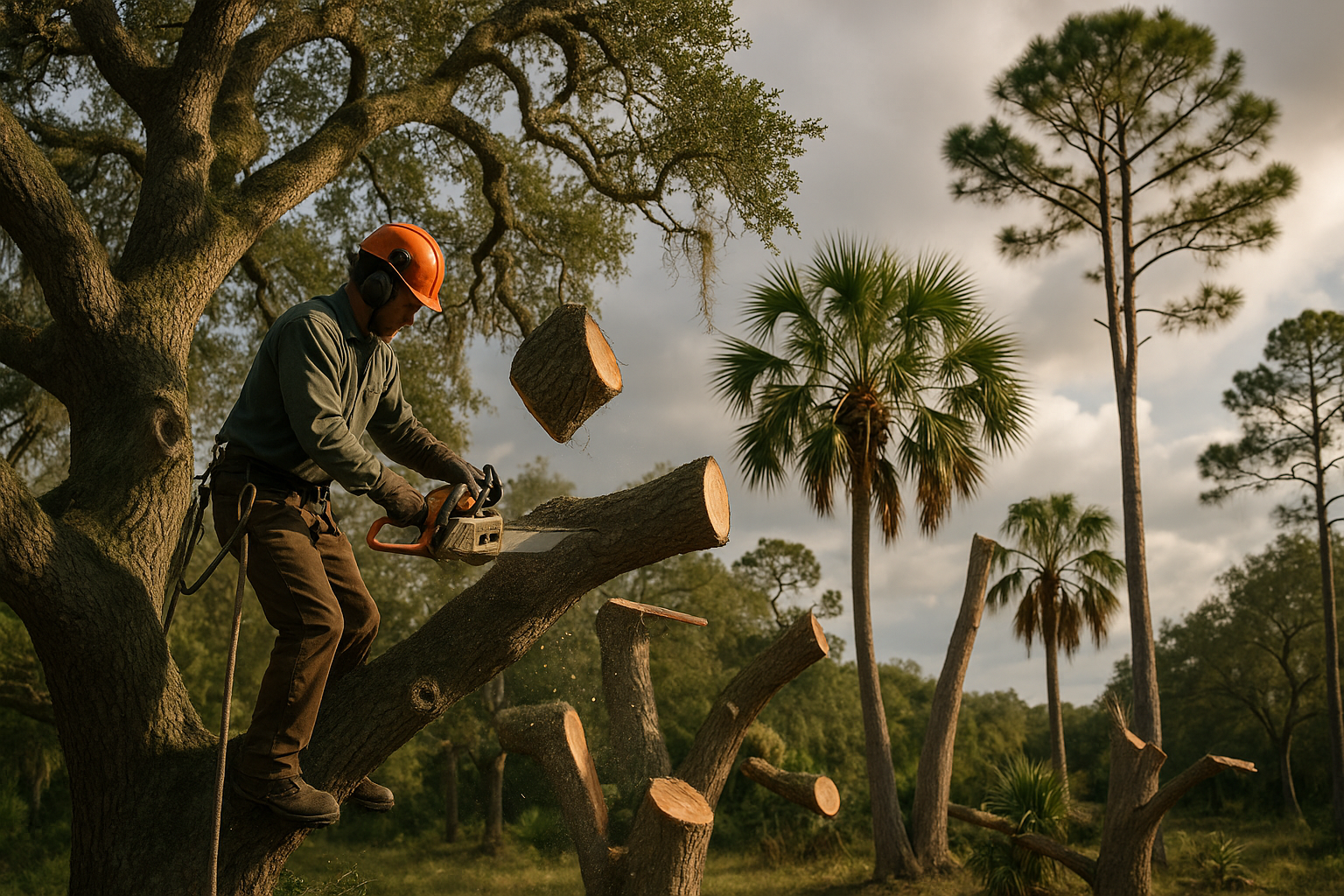
Cutting down a tree is not always the right answer, and neither is leaving a dangerous one standing. Knowing which situation you are actually dealing with can save you hundreds of dollars, preserve a tree that adds real value to your property, or protect your home from a hazard that looks deceptively healthy from the curb.
This post walks you through the honest decision-making process that experienced tree specialists use when they look at a problem tree. There is no agenda here to sell you a removal you do not need, or to talk you out of one you do.
Why the Distinction Actually Matters
A mature shade tree in Sarasota or North Port is not just pretty. It lowers your cooling bill, reduces stormwater runoff, anchors soil, and adds measurable resale value to your property. Removing one unnecessarily is a permanent decision with long-term costs. On the other hand, leaving a structurally compromised tree standing next to your home, your kids' play area, or a neighbor's fence is a real liability, especially heading into hurricane season on Florida's Gulf Coast.
The goal of a proper evaluation is to preserve what can be safely preserved and remove what genuinely cannot. Experienced tree specialists do not default to removal because it is easier or more profitable. They look at the whole picture.
The First Question: How Much of the Tree Is Actually Affected?
The single most useful starting point is to estimate what percentage of the tree is compromised versus what percentage is structurally sound and healthy.
A rough but practical rule used by many tree-care professionals is the 50% guideline. If more than half the tree's structure (canopy, trunk, or root system) is damaged, diseased, or dead, removal is usually the better long-term choice. If the damage or disease affects less than half, a well-executed structural trim can often restore the tree's health and safety.
This is not a hard law, but it is a sensible starting framework.
Here is what to look for in each part of the tree:
In the canopy:
- Dead or hanging branches (called "widow makers") that cannot simply be pruned away without gutting the crown
- More than 50% of the live foliage missing or dead
- A lopsided canopy caused by root or trunk damage on one side
In the trunk:
- Hollow sections longer than one-third of the trunk height
- Deep cracks that run with the grain (called "shakes") rather than across it
- Fungal conks or shelf mushrooms growing directly on the bark, which often signal advanced internal rot
- Significant lean that has developed recently rather than gradually over years
In the root zone:
- Soil heaving or lifting on one side of the base
- Severed or damaged roots from recent construction, trenching, or paving
- Root rot visible at the base as soft, discolored wood
If you are seeing problems in multiple categories at once, that significantly changes the math. A tree with a moderately bad canopy and a hollow trunk and lifted roots is a very different situation from a tree with just a broken top branch.
When a Structural Trim Is the Right Call
A structural trim, done correctly by someone who understands tree physiology, does more than make a tree look tidy. It removes weight from vulnerable limbs, improves the tree's wind profile so it sheds storm energy rather than catching it, and redirects the tree's growth energy into stronger wood.
Here are the situations where a skilled trim is genuinely the right answer:
One or two large dead branches. Dead wood does not always mean a dying tree. A single large limb that has died due to shading, disease, or lightning strike can be removed while leaving the rest of the tree intact and healthy. This is one of the most common and straightforward cases.
An overgrown or lopsided canopy. Florida trees grow fast. A live oak or laurel oak in Siesta Key or Osprey can develop an unbalanced crown that puts too much weight on one side. Selective crown thinning and rebalancing can restore the tree's structural integrity without removing it.
Branches threatening a structure. If a limb is growing toward your roofline, rubbing against your house, or hanging over a pool cage, that branch is the problem, not the tree. Removing or redirecting those specific limbs is almost always sufficient.
Young trees with co-dominant stems. Two leaders (main trunks) growing at a tight V-angle is a common defect in young trees. Left alone, the included bark at the junction becomes a weakness that can fail in a storm. Removing the secondary leader while the tree is young is a minor trim that prevents a major problem decades later.
Post-storm limb breakage on an otherwise healthy tree. After a storm rolls through Englewood or Nokomis, it is common to see trees with broken or stripped limbs. If the damage is in the crown and the trunk and root system are sound, a cleanup trim to remove the broken wood and restore shape is usually all that is needed. For more guidance on what to do right after a storm, our post on emergency tree removal after a Florida storm covers the immediate steps well.
When Removal Is the Only Responsible Choice
Some trees cannot be saved, and trying to trim your way out of a genuine structural failure is both ineffective and dangerous. Here are the situations that call for removal:
Advanced trunk decay. When the interior of a tree is significantly hollow or rotten, no amount of pruning addresses the core problem. The tree can still leaf out and look alive while the trunk is too compromised to hold its own weight in a strong wind. Fungal fruiting bodies (mushrooms or conks) growing on the trunk are a serious warning sign of this condition.
Significant and sudden lean. A tree that has always leaned gradually as it grew toward light is usually stable. A tree that has developed a new lean, especially after heavy rain when soils are saturated, is telling you that its root system is failing. This is a removal situation.
Root system failure or major root loss. In areas like Casey Key and Venice, construction activity, utility work, and even severe flooding can cut or kill the major structural roots of a tree. A tree that has lost a significant portion of its root plate on one side can fall without warning. If you can see heaving soil or feel that the tree rocks at the base when you push it, that is a serious red flag.
Disease or pest infestation throughout the tree. Some diseases, like laurel wilt (which moves through redbay ambrosia beetles and affects a wide range of trees in our region), kill trees rapidly and cannot be reversed. When a disease has progressed through the whole tree, removal is the answer. In some cases, prompt removal even helps prevent spread to neighboring trees.
Dead trees, full stop. A completely dead tree has no living tissue to compartmentalize wounds or respond to trimming. It is simply a standing hazard. The timeline to failure shortens dramatically once a tree dies, and in Florida's climate, wood deteriorates fast. Our post on signs a tree has become dangerous goes into detail on how to read those warning signs before a tree reaches that point.
Poor placement with no good trim solution. Sometimes a tree was planted too close to a foundation, a septic system, or a structure, and its roots or canopy will inevitably cause damage as it grows. If trimming to a safe size would remove so much of the tree that it could not sustain itself, removal is more honest than repeated heavy pruning that stresses the tree year after year.
The Florida Factor: Storm Load Changes Everything
Here on the Gulf Coast, we evaluate trees with hurricane season in mind every single year. A tree that might be "fine for now" in a low-wind environment is not necessarily fine here. Structural defects that would take decades to cause a problem in a calmer climate can be exploited in a matter of minutes during a tropical storm.
This does not mean every imperfect tree in Port Charlotte or Rotonda West needs to come down. It does mean that a tree's ability to handle high-wind loading is a legitimate part of the risk assessment. Getting your trees ready before hurricane season is something every homeowner in our area should be doing annually, and proper structural pruning is a big part of that preparation.
A well-trimmed tree with a thinned canopy and sound structure actually performs better in a storm than an unpruned one. Wind passes through a thinned crown rather than pushing against it like a sail. That is a strong argument for regular structural trimming, not as an alternative to removal when removal is warranted, but as an ongoing investment in tree health that can reduce removal decisions over time.
What the Evaluation Process Looks Like
When a qualified tree specialist looks at your tree, they are not just eyeballing it from the ground. A proper evaluation involves:
- Walking a full circle around the tree to check lean and canopy symmetry
- Looking at the base and root flare for signs of decay, fungus, or soil movement
- Checking the trunk for cracks, cavities, included bark in branch unions, and dead wood
- Assessing the surrounding environment (proximity to structures, utility lines, overhead clearance, soil conditions)
- Considering the tree species and its known failure patterns in our local climate
Some species common in Sarasota and Charlotte County, like laurel oaks, are known to develop internal decay while still looking leafy and green. Others, like live oaks with their wide spreading structure, are remarkably wind-resistant when properly maintained. Species knowledge matters.
What Happens After: Removal or Trim?
If the decision is a structural trim, you should expect the crew to remove only what is necessary, make clean cuts that the tree can seal over properly, and leave the tree with a balanced, natural shape. Topping (cutting the main trunk or major limbs back to stubs) is not a legitimate structural trim. It is damaging to the tree, looks terrible, and creates future hazards as weakly attached regrowth races back up. If someone quotes you a "topping" as a solution, walk away.
If the decision is removal, you will want to understand what happens to the wood and debris afterward. Our blog post on what happens to wood and debris after tree removal covers your options in detail, from chipping to hauling to repurposing.
After removal, you will also face a stump. Grinding and full removal are two different approaches with different costs and use cases. Stump grinding versus stump removal explains the tradeoffs so you can make the right call for your yard.
Getting a Second Opinion Is Smart
If you are not sure which way your situation goes, get a second opinion from a qualified tree specialist before committing to either a full removal or a major trim. This is not a knock on any single contractor. It is just good practice for a decision that is either permanent (removal) or that affects your tree's long-term health (trimming).
Our team serves homeowners across Sarasota, Siesta Key, Osprey, Nokomis, Laurel, Venice, Englewood, Casey Key, Manasota Beach, North Port, Placida, Port Charlotte, and Rotonda West. We are happy to come out, look at your tree honestly, and tell you what we actually see, not just what leads to the bigger job.
You can learn more about our tree removal and trimming services, browse our service locations, or get in touch directly to schedule an evaluation. If you have questions before you call, our FAQ page answers many of the most common ones homeowners ask us.
The right call for your tree is the one based on what the tree actually needs. That is the only standard worth using.
Got a tree that worries you?
Free, no-pressure on-site estimate across Sarasota & Charlotte Counties.