
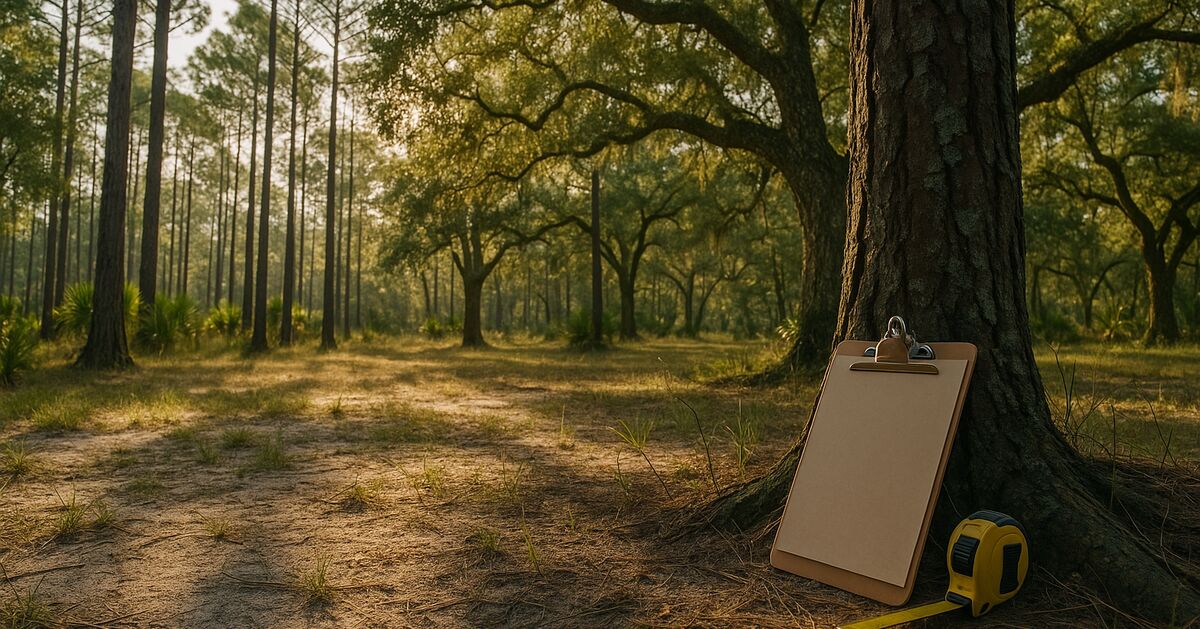
A wooded lot in North Port or Englewood can look like the perfect find, shaded, private, and full of mature canopy that would take decades to grow. What you cannot see from the road, or even from a walk-through, is whether those trees are structurally sound, whether they carry diseases common to Southwest Florida, or whether they sit close enough to your future building envelope to become a serious liability.
Getting a professional tree assessment before you close is one of the most practical things a buyer can do, and yet it is rarely included in a standard home inspection. This post walks through what that assessment covers, why it matters in this particular part of Florida, and how to use what you learn before you sign.
Why wooded lots in North Port and Englewood deserve extra attention
Charlotte and Sarasota counties contain large stretches of old Florida scrub, slash-pine flatwoods, and mixed oak hammock. North Port, which still has significant undeveloped parcels, and Englewood, where estate-size lots back up against tidal wetlands, both have wooded inventory that comes with its own set of risks.
A few factors make this region different from buying a wooded lot further inland:
- Sandy, poorly drained soil. The Gulf-coast soils running from North Port through Englewood and down toward Placida and Port Charlotte are often a mix of fine sand and muck with a shallow water table. Trees in this soil produce wide, shallow root systems rather than deep taproots. Those shallow roots are efficient in calm conditions but offer less anchoring in high wind.
- Frequent tropical weather. Southwest Florida sits in a well-established hurricane and tropical-storm corridor. Wind-loading on a mature canopy is enormous, and a tree that looks healthy can still fail if its root plate is compromised.
- Species-specific disease pressure. Slash pine, live oak, laurel oak, and sabal palm each carry specific failure modes common in this part of the state. Some of those failure modes are invisible from the outside.
- Setback and clearing decisions. Florida's tree canopy ordinances vary by county and municipality. Understanding what is on the lot before you close helps you know which trees you are free to remove, which ones may require a permit, and which ones the county may require you to preserve as part of a building or site plan approval.
What a pre-closing tree assessment actually covers
A pre-closing assessment is not the same as a quick walk-around with a clipboard. Done properly, it is a systematic visual survey of every significant tree on the lot, documented in writing, and interpreted by someone who can explain what the findings mean for your plans.
Michael Calabro, ISA Certified Arborist FL-362432A, conducts assessments for buyers across our service area, including North Port and Englewood. Here is what a thorough assessment includes:
Species identification and a basic inventory
Every tree of significance gets cataloged by species, approximate height and canopy spread, and general location on the lot. This inventory becomes the foundation for everything else. It tells you what you have, and species identity tells you what risks to look for.
Structural defect inspection
An arborist working to the ANSI A300 Tree Risk Assessment standard inspects each tree for:
- Co-dominant stems with included bark. When two or more stems of equal size grow from the same point, they can push bark into the union instead of forming solid wood. That joint is far weaker than a single-stem branch attachment and is a known failure point in high wind. Live oaks and laurel oaks in this region commonly develop this structure.
- Cracks, cavities, and cankers. A crack in the trunk or a hollow cavity signals compromised wood. The size, depth, and orientation of a crack matters, and an experienced arborist can estimate how much structural integrity remains. Our post on fungal conks, cavities, and cracks goes into detail on how these are evaluated.
- Root zone problems. Because Gulf-coast trees are so shallow-rooted, root plate inspection is critical. Soil disturbance, standing water, and buried debris can all compromise the root zone without showing any symptoms in the crown for months or years. Slash pines in particular tend to fail at the root collar rather than the trunk, a pattern explained in depth in our post on why slash pines fail at the root zone.
- Lean and crown asymmetry. A tree leaning significantly toward a future structure or property line gets flagged and documented. Lean alone does not mean a tree is hazardous, but lean combined with soil heaving, exposed roots on the upwind side, or crown imbalance raises the risk rating.
Signs of disease and pest activity
Several diseases common in Southwest Florida are either invisible or easy to overlook without knowing what you are looking for.
Laurel wilt is a fungal disease spread by the redbay ambrosia beetle. It moves through the vascular system and kills laurel oak, swamp bay, and related species quickly. An arborist can spot early wilting and discoloration in the crown that a buyer or general inspector would likely miss.
Ganoderma butt rot affects palms, particularly sabal palm. The diagnostic conk (a shelf-like fruiting body at the base of the trunk) can be subtle on a large lot with dense understory. A palm with ganoderma has no treatment. Removal is the only option, and knowing this before closing changes your budget.
Fusiform rust galls are common on slash pines. The galls themselves are not always fatal, but a tree with a large gall near the base of the trunk, or multiple galls in the crown, can have its structural integrity affected.
Proximity mapping to the planned building envelope
If you have a survey or a conceptual site plan, an arborist can map which trees fall within the proposed building footprint, within the setback zone, or close enough to the structure to become a target risk. This is where the assessment becomes most useful for a buyer. You learn:
- Which trees will need to be removed regardless of condition, simply because they occupy the building footprint.
- Which trees close to the planned structure are structurally sound and worth keeping.
- Which trees close to the planned structure have defects that make removal the prudent choice before construction begins.
Documentation for negotiation or permit applications
A written assessment with photographs and a site sketch is a useful document. It can support negotiation with the seller if significant hazard trees are found. It can also support a tree permit application with Charlotte County or Sarasota County, because some jurisdictions require an arborist's documentation as part of that process.
Common findings on vacant lots in this region
A few patterns come up again and again on wooded lots in North Port, Englewood, and nearby areas like Laurel and Osprey.
Overgrown slash pine stands. When pines grow in a dense cluster without management, they compete for light and become tall and slender with small, high crowns. These trees have a poor height-to-crown ratio and are more susceptible to wind throw. Thinning the stand is often necessary, which means removal costs are part of your pre-construction budget.
Laurel oak over-maturity. Laurel oaks generally grow faster but tend to have a shorter structural lifespan than live oaks, based on general arboricultural observation. A mature laurel oak on a vacant lot may already be past its structural prime. Signs include a thinning crown, bark anomalies, and dieback in the upper canopy.
Unmaintained palm clusters. Sabal palms and Washington palms on vacant lots often carry years of dead frond accumulation ("boots") and may have crowns so tight from lack of pruning that they trap debris and moisture. This does not automatically make them hazardous, but it does mean maintenance cost is coming. Our post on pruning a palm properly explains what sound palm care actually looks like.
Soil disturbance from prior activity. Lots that were partially cleared years ago and then left often have buried root material, compacted soil, or grade changes that stressed remaining trees in ways that may not be visible yet.
How to use the findings before you close
An assessment is only useful if you act on what it finds. Here is how buyers typically use the report:
Budget for removal and maintenance. If the assessment identifies five slash pines that need to come down before construction, get a removal estimate now and factor it into your offer or your construction budget. A surprise removal job after closing, especially if a tree is large or in a tight space, can be a significant unexpected cost.
Ask the seller for credits or remediation. If an obvious hazard tree exists close to the lot line or over an existing fence or structure, findings in a written assessment give you a concrete basis for negotiation. This is the same logic behind asking for a roof inspection or a septic report.
Plan your clearing permit correctly. Charlotte County and Sarasota County both regulate tree removal on new construction sites. Knowing which species are on the lot, and in what condition, helps your contractor or arborist prepare the correct permit documentation. A surprise protected tree in the building footprint discovered after permits are submitted can cause costly delays.
Set a maintenance plan. Trees you plan to keep around the future home deserve a proactive care plan. That might mean structural pruning on young oaks to correct co-dominant stems before they become a problem, or crown cleaning on mature trees to remove deadwood before construction begins. For an overview of what sound tree care looks like, visit our tree care services page.
What the assessment does not include
A pre-closing tree assessment is a visual survey. It does not include laboratory analysis of soil or tissue, internal decay probing with a resistograph, or any invasive testing unless those are specifically requested and quoted separately. If an arborist flags a tree as suspected for internal decay, additional testing using a probe or other diagnostic tool can follow. Our post on how to read a wood decay report explains what that next step looks like.
The assessment also does not replace a legal survey or a wetland delineation. If your lot has wetland or upland boundaries that affect where you can build, those are separate professional disciplines.
Timing: when to schedule the assessment
Schedule it during your inspection period, the window your contract sets aside for due diligence. Many Florida contracts give buyers a specified number of days to inspect and either proceed or withdraw, so check your contract's specific terms. A tree assessment typically takes one to three hours on site for a standard lot, plus a day or two for the written report. That timeline fits easily within a standard inspection window if you schedule it early.
If you are buying in North Port or Englewood, or elsewhere in our service area including Nokomis, Siesta Key, Venice, and the communities along the coast, we are available to schedule assessments for buyers, real estate attorneys, and builders. Visit our contact page to reach us or to ask questions about what an assessment for your specific parcel would involve.
A final note on what trees add to a lot
None of this is an argument against buying a wooded lot. Mature trees are genuinely valuable. They reduce cooling costs, buffer wind, absorb stormwater, and give a property character that new construction cannot replicate. The goal of a pre-closing assessment is not to scare you out of buying, it is to make sure you understand what you are buying and that there are no surprises waiting in the canopy.
Going into the purchase with clear eyes, a written inventory, and a plan for the trees that need attention puts you in a far better position than discovering problems after the concrete is poured. Visit our frequently asked questions page for more on what to expect from the assessment process, or browse the blog for more articles on tree care specific to Southwest Florida.
Got a tree that worries you?
Free, no-pressure on-site estimate across Sarasota & Charlotte Counties.