
When to Remove a Storm-Damaged Tree vs. When It Can Be Saved
July 4, 2026 · Eagle Eye Tree & Land Services
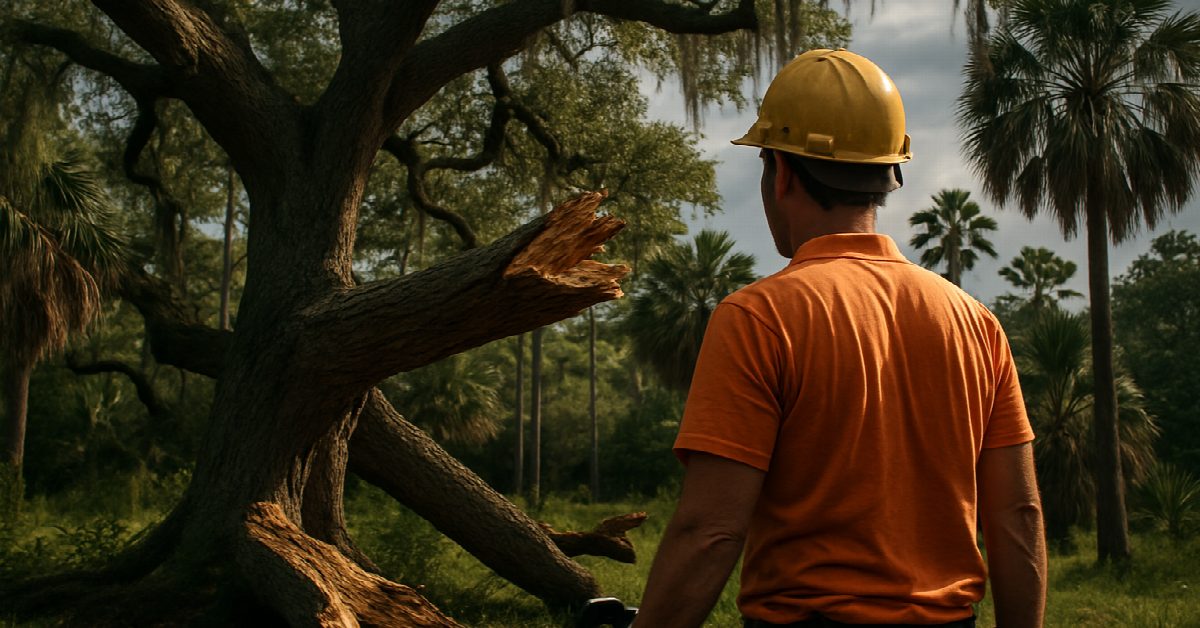
A storm rolls through overnight, and by morning your yard looks like a different place. Branches are down, bark is stripped, and one of your big oaks is leaning a few degrees it wasn't leaning yesterday. Now you're standing in the yard with coffee in hand, trying to figure out whether that tree is going to be okay or whether it's a disaster waiting to happen.
This is one of the most common calls we get after a storm here in Sarasota and Charlotte counties, and it's genuinely not always easy to answer. The good news is that trees are resilient. The bad news is that a storm-damaged tree can look surprisingly okay from the outside while being structurally compromised in ways that matter a lot. This guide walks you through the real decision-making process, so you can approach that tree with information instead of guesswork.
Why Florida storms are especially hard on trees
Florida's weather is not gentle. Hurricane season runs from June through November, and even a mid-grade tropical storm or a fast-moving afternoon thunderstorm can drop sustained winds of 60 to 80 mph over a neighborhood. Couple that with the sandy, shallow soils common across Sarasota, Venice, and the barrier islands like Siesta Key and Casey Key, and you have conditions where even healthy, well-established trees can fail at the root zone without much warning.
The soil saturation that comes with heavy rainfall is often the real culprit. When the ground is waterlogged, root systems lose their grip. A tree that would have held fine in dry conditions can lean or topple in the same wind speed after three days of rain. That's worth keeping in mind when you're evaluating what happened to your trees after a storm: the lean may have started at the roots, not at the trunk or canopy.
If you're dealing with an active situation where a tree has already fallen or is pressing against your home, read our guide on emergency tree removal after a Florida storm before you do anything else. Safety first, always.
The case for saving a storm-damaged tree
Not every tree that looks rough after a storm deserves to come down. Premature removal costs you money and loses you the shade, privacy, and property value a mature tree provides. Before you call anyone, take a moment to assess what you're actually looking at.
A tree is generally a good candidate to save if:
- Less than 50 percent of the canopy is damaged or missing. Trees can recover from significant crown loss. If the remaining crown is healthy and well-distributed, the tree has the photosynthetic capacity to recover over one or two growing seasons.
- The main trunk is structurally sound. Run your hands along the bark and look for cracks, splits, or hollow sections. A trunk that is solid through its core is a good sign.
- The root system is still intact. If the tree is standing upright and the soil around its base looks undisturbed, the roots probably did their job. A tree that hasn't shifted at the base is in a fundamentally different situation from one that has lifted the soil around it.
- The damage is limited to branches. Lost limbs, even large ones, can be pruned cleanly. An experienced tree specialist can reshape the canopy so the tree grows back into a balanced form. This kind of remedial pruning is far less costly than removal and is often covered under standard tree care.
- The species is a strong, long-lived native. Live oaks, bald cypress, and Southern magnolias are tough trees. They've been growing through Florida hurricanes for centuries. A live oak that drops a limb in a storm is not the same as a tree in decline.
Clear signs the tree needs to come down
Some situations leave little room for optimism. The following are the conditions where removal is almost always the right call, and where delaying that decision puts your property and family at real risk.
1. The trunk has split or is cracked through to the core
A surface wound or a strip of missing bark is one thing. A trunk that has cracked vertically through its center, or that shows a split at a major union where two stems come together, is a structural failure. That crack is not going to heal. The two halves of that trunk will continue to move independently in future winds, and what's holding them together right now is friction and good luck. That tree needs to come down.
2. The tree is leaning and wasn't before
A new lean is one of the clearest red flags in tree assessment. If a tree that stood straight for years is now noticeably off-angle, something gave way, and the most likely culprit is the root system. Look at the soil around the base. If you see soil heaving or cracking on the side opposite the lean, or if roots have pulled free of the ground on the leaning side, the root plate has shifted. A tree in this condition can fall with very little additional wind. Even a 10 to 15 degree lean in a large tree is enough to warrant an immediate professional assessment.
For a broader look at warning signs that go beyond storm damage, our post on signs a tree on your property has become dangerous covers the full picture.
3. More than half the crown is gone
When a tree loses the majority of its canopy in a single event, it loses most of its ability to produce food through photosynthesis. The tree will attempt to push new growth, but it's working from severely depleted reserves. In many cases, the tree will survive initially but then go into a slow decline over the following one to two years, becoming progressively weaker and more susceptible to pests and disease. You can sometimes save a tree with 50 to 60 percent crown loss if the damage is well-distributed, but much beyond that and you're generally looking at removal sooner or later. Sooner is usually safer and less expensive.
4. The root system is visibly compromised
Roots that have heaved out of the soil, a root ball that has shifted or lifted on one side, or a tree that now rocks slightly at the base when you push it are all signs of root failure. This is not a problem that resolves itself. Once the root anchor is compromised, the tree is mechanically unstable regardless of how healthy the crown looks.
5. The tree is already in decline
A storm is often the event that tips an already-struggling tree over the edge. If the tree had thin or patchy foliage, signs of fungal growth at the base, significant deadwood in the canopy, or pest damage before the storm, the storm damage is likely the final chapter rather than a temporary setback. These trees should be evaluated honestly rather than optimistically.
6. It's leaning toward a structure, utility line, or occupied area
Even if a damaged tree might survive with care, its location changes the calculus significantly. A compromised tree that overhangs your roof, your neighbor's fence, a power line, or a driveway where kids play is a different risk profile than the same tree in an open area of the yard. When the consequence of failure is serious property damage or injury, the threshold for removal drops. This is not an overreaction. It's risk management.
What to do immediately after a storm
Before any professional arrives, here's what you can safely do on your own:
- Stay away from downed trees near power lines. A downed line may or may not be live. Treat it as live until the power company says otherwise.
- Document everything with photos and video. Your homeowner's insurance may cover tree removal if the tree has damaged a structure, and documentation from immediately after the storm strengthens your claim.
- Don't try to cut a tree under tension yourself. A log or branch that is pinned under another object is under tremendous stored energy. When cut, it can kick back violently. This is how serious injuries happen.
- Keep the area clear. If a large tree is leaning toward your home or another structure, keep people out of that zone until a professional has assessed it.
Our [frequently asked questions page](../faq) covers a lot of the practical questions that come up in these situations, including what to ask a tree service before they start work.
The cost question
One reason homeowners hesitate to call a professional is uncertainty about what it will cost. The honest answer is that storm-damaged tree removal varies quite a bit depending on the size of the tree, how close it is to structures, and how complex the access situation is. A small tree in an open yard is a very different job from a large oak pressed against a roof. For a detailed breakdown of what goes into pricing in this area, our post on how much tree removal costs in Sarasota and Charlotte County lays out the factors clearly.
What happens after the tree comes down is another common question. We cover that in detail in our post on what happens to the wood and debris after tree removal, including options for the wood if you want to keep it.
When to call a professional vs. when to wait
If any of the red flags above apply to your tree, call a reputable tree service promptly. Don't wait to see what happens over the next few weeks. A compromised tree does not become safer with time. Wind events in Florida, even small ones, happen regularly through the summer months, and a tree that survived one storm in a weakened state may not survive the next one.
If your tree has only minor branch damage, the trunk and roots look solid, and the tree is not near any structure, it's reasonable to monitor it for a few weeks and schedule a non-urgent assessment. Clean up any broken branches that are hanging (called hangers or widow-makers), keep an eye on the foliage as it regrows, and have a tree specialist give it a look before the next storm season arrives.
Our team works throughout the region, including Sarasota, Siesta Key, Osprey, Nokomis, Venice, Englewood, North Port, Port Charlotte, Rotonda West, and out to the barrier islands. If you're not sure whether a tree on your property needs to come down, we're happy to come take a look. A proper assessment from someone who has seen a lot of Florida storm damage is worth more than any checklist, including this one.
You can find the full list of areas we serve on our [locations page](../locations), and if you're ready to get an assessment scheduled, the easiest way to reach us is through our [contact page](../contact).
The bottom line
A storm-damaged tree is not automatically a dead tree. Many trees that look rough after a major weather event go on to recover fully with the right care. But some trees, especially those with compromised roots, split trunks, or severe crown loss near structures, are genuinely dangerous and need to come down promptly. The key is making that judgment based on what's actually happening with the tree, not on what's more convenient or less expensive in the short term. A tree that falls on a roof costs far more, in every sense, than one that was removed when the signs were there.
When in doubt, get a professional set of eyes on it. That's not an upsell. That's just good sense.
Got a tree that worries you?
Free, no-pressure on-site estimate across Sarasota & Charlotte Counties.